When a message needs three extra letters to be believed, the sender usually expects doubt. That’s the whole job of ONB.
What you reply depends on what the sender is attaching it to, and this page shows how to tell. You’ll also find the grammar behind it, three example chats with best replies, and four flip cards to test yourself.
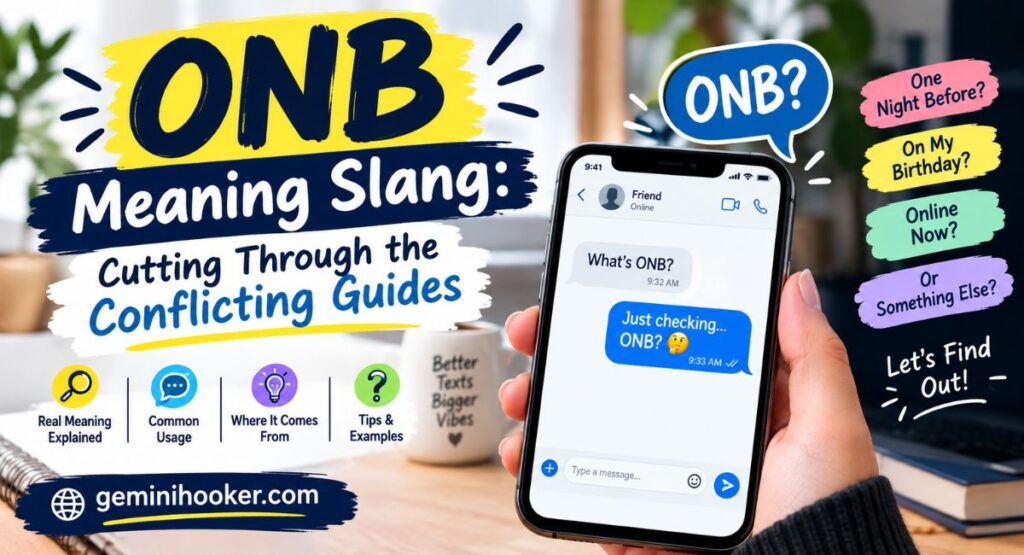
ONB Mean: ONB is texting slang for “on bro,” a way of swearing that you’re telling the truth or meaning what you say. It works like “I swear,” “for real,” or “I promise.” It’s casual and informal. The twist: it adds emphasis, not proof, and what it’s attached to (a fact, a promise, or an opinion) changes how you should answer.
What You’re Swearing On: The Grammar of ONB
ONB is an initialism for “on bro.” Underneath, it’s a short prepositional phrase: “on” plus the person or thing you’re swearing by. Slang has several versions of the same pattern, such as “on God” or “on my mom.” The only thing that changes is what the speaker puts on the line.
Here’s how it behaves:
- Part of speech: an emphasis marker added to a sentence, not a noun or a verb. It can open a message, close it, or stand alone as a reply.
- Punctuation: a comma separates it from the rest: “ONB, I’ll be there” or “I’ll be there, ONB.” Alone, it needs nothing.
- Capitalization: capitals and lowercase both appear. Lowercase (“onb”) feels more relaxed.
- What “bro” means here: a close friend or trusted person, not a literal brother. The word isn’t addressed to you, so ONB isn’t calling you “bro.”
- Who can say it: anyone. The sender’s gender doesn’t change the meaning.
- Formal vs casual: casual only. In formal writing, use “I promise,” “to be honest,” or “I’m serious.”
- Who says it and when: friends chatting in texts, social apps, or game chats, usually when they want to be believed.
| Phrase | Stands for | What the speaker swears by | Typical feel |
| ONB | on bro | A close friend | Casual, emphatic |
| ONG | on God | God | Oath-like, intense |
| “on my mom” | (written in full) | A parent | Casual, personal |
| ISTG | I swear to God | God (a full clause) | Insistent, often frustrated |
Fact, Promise, or Opinion? What ONB Is Attached To
ONB doesn’t have one fixed mood. Its job changes with the sentence it supports, and each type calls for a different reply.
| ONB is attached to | Example | What it means | Best way to answer |
| A fact about the past | “I was stuck in traffic, ONB” | “I swear this happened” | Accept it, or ask a calm follow-up |
| A promise about the future | “ONB, I’ll bring it tomorrow” | “I’m committing to this” | Agree on a time or a check-in |
| An opinion | “The sequel is better ONB” | “I really mean it” | Engage with the opinion, not the oath |
| A short reply to a question | “ONB.” | “Yes, I swear” | Confirm the plan |
The key is that ONB adds emphasis, not evidence. A fact can still be checked, a promise can still be broken, and an opinion can’t be proven at all. If you treat every ONB as proof, you’ll misread it.
Example Conversations, and the Best Reply to Each
These are written examples for illustration, not real user data.
Thread 1: A promise between friends
Maya: are you actually coming tonight Zed: ONB, I’m leaving at 7
Decoder: “I promise, I’m leaving at 7.”
Best reply: “Great, text me when you leave.” Why: A promise works best with a small check-in. This keeps things friendly without sounding like you doubt him. Friends, casual chat.
Thread 2: A claim that someone doubts
Sam: you’re 40 minutes late Ali: I really was stuck in traffic ONB
Decoder: “I swear I was stuck in traffic.”
Best reply: “Okay, thanks for telling me. Next time, text me earlier.” Why: You don’t have to prove or disprove the story. Accept it and move to what you need. Friends or siblings, tense but not hostile.
Thread 3: An opinion
Nora: the first movie was better Kai: the sequel is better ONB
Decoder: “I really mean it: the sequel is better.”
Best reply: “Haha okay, I’ll rewatch it and decide.” Why: An opinion can’t be proven, so ONB shouldn’t start an argument. Keep it light. Friends, playful tone.
Other Things ONB Can Mean (and How to Rule Them Out)
“On bro” is the main reading. Some sources also list “old news, bro,” a dismissive reply to news you already know, and a rarer “outward nose breath” for a quiet laugh.
Two quick checks:
- Is the sentence about truth, a promise, or agreement? Then it’s “on bro.”
- Is it a bare reply to news? Then “old news, bro” could be the intent. If it matters, ask: “Do you mean on bro?”
When in doubt, “on bro” is the safest reading.
Where ONB Fits and Where It Backfires
It fits when:
- you’re texting friends and want to stress you mean it
- you’re making a casual promise
- you’re agreeing strongly in a group chat
It backfires when:
- you’re writing to a teacher, manager, or client
- you’re apologizing and need to sound careful
- the other person doesn’t know the slang, since it can look careless
If the stakes are real, drop the slang. “I promise” sounds firmer than ONB to people who don’t use it.
Four Slips People Make With ONB
- Treating it as proof. It shows how strongly someone feels, not whether they’re right.
- Reading it as “hey bro.” “Bro” is the thing being sworn on, not a greeting.
- Using it in formal writing. Readers outside your group may not recognize it.
- Overusing it. If every message ends with ONB, it stops adding weight.
Related Reads
- ISTG, the “I swear to God” version of the same emphasis
- What SMH signals when you don’t buy the story
- How GTK can read when you simply acknowledge a promise
FAQs
What does ONB mean in text?
ONB is slang for “on bro.” It’s a casual way of saying you’re telling the truth, making a promise, or strongly meaning what you said, similar to “I swear” or “for real.”
What else can ONB mean?
“On bro” is the main meaning. Some sources also list “old news, bro,” a dismissive reply to news you already know, and the rarer “outward nose breath.” Check the sentence to see which fits.
How do I reply when someone texts ONB?
Reply to what ONB is attached to. Accept a fact or ask a calm follow-up, agree on a time for a promise, and engage with an opinion. You don’t need to use the slang back.
Can anyone say ONB, or only guys?
Anyone can. “Bro” in ONB is the person or bond being sworn on, not a greeting to you, so the sender’s gender doesn’t change the meaning.
Is ONB okay at work or school?
Usually not. ONB is informal slang, so use “I promise,” “to be honest,” or “I’m serious” in professional or formal messages.