By MeaningByte Team | Last updated: October 30, 2026
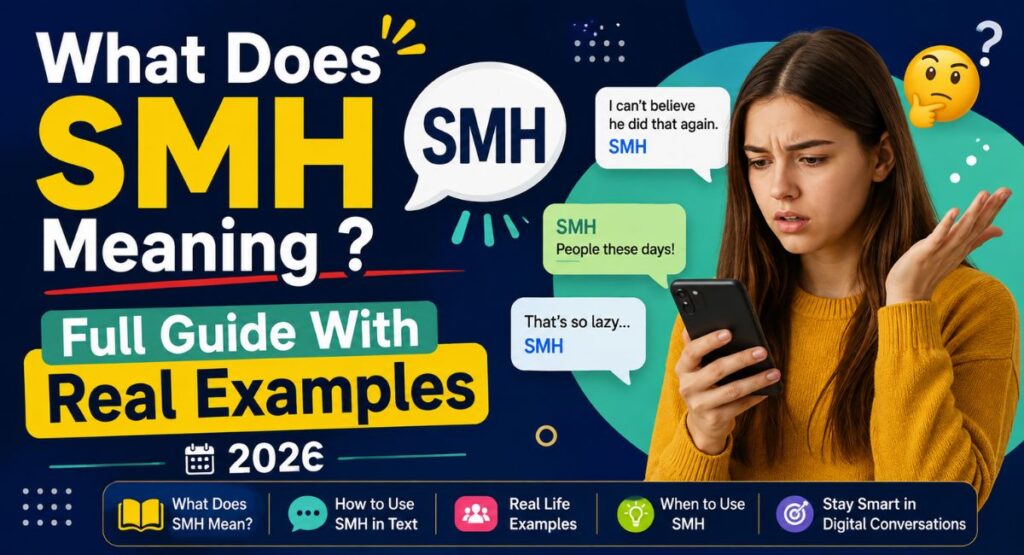
SMH stands for “shaking my head.” People type it to show disbelief, disappointment, mild frustration, or “I can’t believe this.” It copies the real gesture of shaking your head from side to side. Some people also read it as “scratching my head” when they are confused, but “shaking my head” is the standard meaning.
You will see SMH in comment sections, group chats, captions, and replies. It is short, it is casual, and it says a lot without a full sentence. This guide explains the SMH meaning in text and chat, where it came from, the grammar rules for using it, how it differs from SMDH and SMFH, how to reply, and when to avoid it.
SMH Meaning in Text, Chat, and Slang
| Detail | Info |
|---|---|
| Full form | Shaking my head (also written “shake my head”) |
| Type of word | Interjection / reaction word |
| Common feelings | Disbelief, disappointment, annoyance, sarcasm, amusement |
| Strength | Mild. Closer to an eye-roll than an insult. |
| Spelling | SMH, Smh, or smh. All are fine. |
| Used on | Texting, WhatsApp, X, Instagram, TikTok, Reddit, Discord, Snapchat |
In plain words: when someone writes “smh,” they are saying, “I can’t believe this” or “Wow, that’s disappointing.”
Where Did SMH Come From?
SMH is part of the shorthand that grew in early internet chat rooms, forums, and instant messaging, together with LOL, BRB, and TTYL. People typed fast and shortened common reactions into initials. It is hard to name the first person to use it, but it has been used online for many years, well before smartphones.
The idea behind it is much older than the internet. Shaking your head is a body-language signal that most people understand at once: “no,” “not good,” “I can’t believe it.” That is why SMH spread easily. Nobody needed a long explanation. When texting became the main way to chat, SMH moved over with the same meaning and became common on social media.
How SMH Feels: Different Tones
The same three letters can carry different moods. The surrounding words, emojis, and the people involved decide which one you are seeing.
| Tone | Example |
|---|---|
| Disbelief | “He wore two different shoes to the interview, smh.” |
| Disappointment | “They cancelled the show again. smh.” |
| Annoyance | “People still don’t use their turn signals, smh.” |
| Sarcasm | “Oh great, another Monday meeting. smh 🙄” |
| Playful teasing | “You locked your keys in the car again, smh 😂” |
How to Use SMH in a Sentence (Grammar Guide)
SMH works like “wow,” “ugh,” or “seriously.” It is an interjection, so it does not need a subject or a verb of its own. You can use it in a few different places:
1. On its own
It can be a full reply by itself, such as a comment under a video: “smh.”
2. At the end of a sentence (most common)
Put it after a comma or a period to add tone: “He forgot his own birthday, smh.”
3. At the start of a sentence
It sets the mood before the details: “Smh, he did it again.”
4. With “at” or “about” (informal)
People sometimes write “smh at this” or “smh about the whole thing” to point to the thing they react to. This is casual and mostly used in social media comments.
Punctuation and Capital Letters
- No dots inside it. Write SMH, not S.M.H.
- Capitalization is flexible. “smh” is the most common in chats, “SMH” is used for emphasis or in headlines.
- A comma before it (usually) separates it from the sentence: “That’s wild, smh.”
- Stacking: some people repeat it for humor (“smh smh smh”), which makes the reaction stronger.
Common Mistakes
| Mistake | Why it is a problem | Better |
|---|---|---|
| “That was so smh.” | SMH is not an adjective. | “That was ridiculous, smh.” |
| “I’m smh-ing right now.” | It is a reaction word, not a normal verb. It is seen online, but it reads as awkward. | “I’m shaking my head.” |
| “Smh” after sad or serious news | It can sound cold. | “I’m so sorry to hear that.” |
| “Shaking my head smh” | Repeats itself. | Use one or the other. |
| Using it in a formal email | Too casual. | “I was surprised to hear that.” |
SMH vs SMDH vs SMFH
| Slang | Meaning | Strength |
|---|---|---|
| SMH | Shaking my head | Standard, mild |
| SMDH | Shaking my damn head | Stronger, adds frustration |
| SMFH | Shaking my f***ing head | Strongest, contains a swear word |
| SMH (alternate) | Scratching my head | Confusion rather than disapproval |
Some people explain SMDH as “so much disbelief,” but the most common reading is “shaking my damn head.” In everyday chat, both ideas are close, because both show a stronger reaction than plain SMH.
Real Chat Examples (With the Best Reply)
Example 1: Friendly teasing
Ali: I forgot my umbrella again 😅
Sara: smh, it’s the third time this week
Best reply: “I know, I know 😂 Can I borrow yours?”
Example 2: Reacting to the news
Post: Fans threw trash on the field after the game.
Comment: smh. Some people never learn.
Best reply: “Right? So disrespectful.” (A short agreement is enough.)
Example 3: When it might sound cold
Friend: I failed my driving test today.
You: smh
Better message: “Aw, that’s tough. You’ll pass next time!” (SMH can feel like criticism when someone is already upset.)
Example 4: Confused version
Coworker: They moved the deadline to yesterday?? smh
Best reply: “Same here, I’m confused too. Let’s ask the manager.”
How SMH Is Used on Different Platforms
- Texting and WhatsApp: usually playful, between friends.
- X (Twitter): a quick reaction to news, sports, and viral posts.
- Instagram and TikTok: common in comments on funny, dramatic, or cringe videos.
- Reddit and Discord: used to react to bad opinions or silly mistakes.
- Group chats: friendly and teasing, rarely serious.
With emojis: SMH often appears with 🤦 (facepalm), 🙄 (eye roll), 😂 (laughing), or 😒 (unimpressed). Emojis help show whether you are joking or genuinely annoyed.
How to Reply to SMH
| Situation | Good reply |
|---|---|
| Friendly or joking | “😂 I know.” / “Don’t judge me.” |
| You agree | “Right?” / “Fr.” / “Facts.” |
| They are annoyed with you | “Sorry, my bad.” / “Fair enough.” |
| You want to explain | “Okay hear me out…” |
| You don’t know why | “What happened?” |
Is SMH Rude?
Usually not. SMH is one of the gentler internet acronyms. Still, context matters:
| Situation | How SMH lands |
|---|---|
| Casual chat with friends | Light, often funny |
| Memes and social comments | Normal |
| Someone is sad, hurt, or stressed | Can feel dismissive. Avoid it. |
| Work chats, teachers, clients | Too casual. Skip it. |
If you are unsure, swap it for a full sentence: “That’s hard to believe,” or “I’m disappointed to hear that.” It says the same thing, and nobody can misread it.
Other Ways to Say SMH
- “I can’t believe this.”
- “Unbelievable.”
- “Seriously?”
- “Wow, just wow.”
- “I’m speechless.”
- 🤦 (facepalm emoji)
- “Not again…”
Similar Slang and How It Differs
| Slang | Meaning | Difference from SMH |
|---|---|---|
| LOL | Laughing out loud | Reacts to something funny |
| OMG | Oh my God | General shock, good or bad |
| IDK | I don’t know | Shows uncertainty, not disapproval |
| TBH | To be honest | Introduces an honest opinion |
| FR | For real | Agreement or emphasis |
| IDGAF | I don’t give a f*** | Shows total indifference, not disbelief |
Does SMH Have Other Meanings?
In chat and social media, SMH almost always means “shaking my head.” In other places, the same letters can stand for something else, such as the Sydney Morning Herald, an Australian newspaper that is often shortened to SMH. If you see it in a news headline or a link from Australia, that may be what it means. The context tells you which one.
Quick Quiz: Do You Know SMH?
Choose the best answer, then click the question to check.1. What does SMH stand for in text?2. Which one is the stronger version: SMH or SMDH?3. Is “That was so smh” grammatically good?4. Your friend says they failed an exam. Should you reply “smh”?5. Is it okay to use SMH in a formal email to a client?6. Does SMH need dots (S.M.H.)?
Frequently Asked Questions
What does SMH mean in a text?
SMH means “shaking my head.” It shows disbelief, disappointment, or mild frustration about something.
What does SMH stand for in chat?
It stands for “shaking my head.” Some people also read it as “scratching my head” when confused.
Is SMH the same as SMDH?
Not exactly. SMDH is a stronger version that usually means “shaking my damn head.”
Is SMH rude or offensive?
Generally no. It is mild, but it can sound dismissive if someone is upset or if you use it in a serious conversation.
Can I use SMH at work?
It is best to avoid it in work emails and client chats. Use a full sentence such as “I was surprised by that.”
Should SMH be capital or lowercase?
Both are correct. Lowercase “smh” is more common in chats, and uppercase “SMH” is used for emphasis.
Where did SMH come from?
It grew from early internet chat and instant messaging shorthand, alongside LOL and BRB, and it is based on the familiar gesture of shaking your head.
How do I reply to SMH?
Keep it short: a laughing emoji, “I know,” “Right?” or “Fr.” If the person seems upset, ask what happened.
Does SMH always mean anger?
No. It usually shows mild disappointment, disbelief, or amusement. Between friends, it is often teasing.
What is the difference between SMH and IDK?
SMH shows disapproval or disbelief. IDK means “I don’t know” and shows uncertainty.
Related Reads
The Bottom Line
SMH means “shaking my head.” It is a quick, mild way to say “I can’t believe this,” best used with friends and in casual comments. Put it at the end or start of a sentence, keep it lowercase or uppercase as you like, and skip it when someone is hurting or when you are writing for work. When the tone matters, a full sentence is always safer.