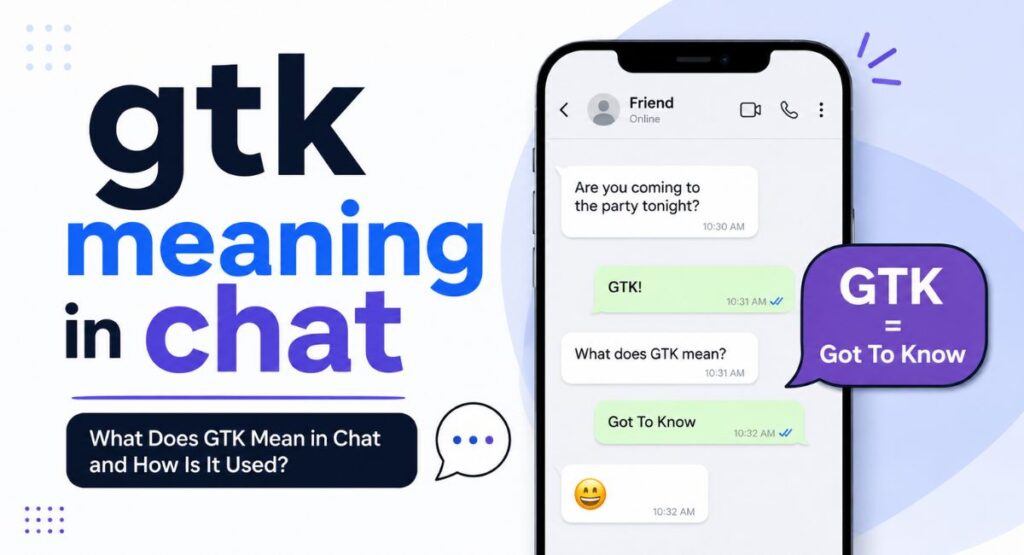
GTK Meaning in Chat: You send a long message about your week. The reply arrives in two seconds: “gtk.” Three letters, no emoji, no follow-up question. Is that a friendly nod or a polite way of ending the conversation?
Quick answer: GTK stands for “good to know.” It is a quick reply that acknowledges useful information, like a schedule change or a tip. The words are friendly, but the tone depends on what came before it: a short GTK after practical news is normal, while a lone GTK after personal news can feel like a brush-off.
This guide shows you how to read the tone, how to reply, and the grammar behind the phrase.
GTK Full Form: “Good to Know” and Its Other Meanings
In almost every chat, GTK means “good to know.” People send it to say “thanks, I have noted that.”
Two other meanings exist, and context tells them apart:
- Getting to know (dating chats): sometimes used as “we are in the GTK phase,” meaning two people are still learning about each other. This is less common than “good to know.”
- GTK as a software toolkit: in developer circles, GTK is the name of a toolkit for building graphical interfaces. The name began as “GIMP Toolkit.” If you are reading code or documentation, this is the meaning.
In a normal text, assume “good to know” unless the topic clearly says otherwise.
Polite, Neutral, or Cold? How to Read the Tone of GTK
The three letters never change. The message around them does. Here are the three tones you will meet.
The friendly acknowledgment
“Free pastries at the cafe until noon!” “Oh wow, GTK! On my way.”
The reply is warm and shows action. Clues: an exclamation, an emoji, or a follow-up.
The neutral acknowledgment
“Meeting moved to Room 302.” “GTK.”
Efficient and professional. The information was practical, so a short reply fits.
The brush-off
“I failed my driving test today, I feel awful.” “gtk”
This is where GTK stings. The news was personal, and the reply treats it like a schedule update. It does not have to be unkind, but it feels dismissive.
The matching rule: compare the value of the information with the size of the reply. Practical news earns a short GTK. Personal or emotional news deserves more.
4 Real GTK Chats (and the Best Reply for Each)
Chat 1: The practical update
You: Bus is running 10 minutes late. Friend: GTK, thanks!
Best reply to a friendly GTK: “Anytime! See you soon.” Why: the conversation is complete. A short wrap-up is enough.
Chat 2: The lone GTK after personal news
You: I’ve been really overwhelmed with work lately. Friend: gtk You: ?
Best reply: “Thanks for reading. I could use a quick call if you have time.” Why: it names what you need instead of guessing their intent. The friend may simply be busy.
Chat 3: The work chat
Manager: The client call has moved to 4 p.m. You: ?
Best reply: “Good to know, thank you. I’ll adjust my schedule.” Why: in a work channel, the full phrase sounds more polished than GTK, and it confirms you will act.
Chat 4: The Taglish and Hinglish mix
Mika: Sarado pala ang mall ngayon. You: GTK, salamat!
Hira: Yaar, meeting kal subah hai. You: GTK yaar, thanks!
Best reply: match the language and add a thank-you. Why: GTK works inside mixed-language chats the same way, and a short thanks keeps the tone warm.
Grammar Corner: Why “Good to Know” Drops Words
What is missing?
The complete sentence is “It is good to know that.” GTK keeps only the useful part: an adjective (“good”) followed by an infinitive (“to know”). The subject and the verb (“it is”) are dropped, which is common when someone reacts to information in a chat.
Pronunciation and form
GTK is an initialism, so people say the letters one by one: G-T-K. It works as a short reply, not as a noun: you can say “GTK, thanks,” but “a GTK” sounds odd.
Capitalization and punctuation
- “GTK.” with a period reads neutral or businesslike.
- “GTK!” reads warm and enthusiastic.
- “gtk” in lowercase with no punctuation reads casual and sometimes distracted.
Punctuation is where much of the tone hides, so treat it as a clue.
GTK vs FYI vs TIL vs “Noted”
| Phrase | Who usually sends it | What it does |
| FYI | The person sharing information | Introduces the information (“for your information”) |
| GTK | The person receiving information | Acknowledges it (“good to know”) |
| TIL | The person who just learned something | Announces a discovery (“today I learned”) |
| Noted | The person receiving information | A more formal acknowledgment |
The key difference: FYI starts the exchange and GTK answers it. If you say “FYI” in reply to someone’s news, you are mixing up the direction.
How to Reply When Someone Sends GTK
| Situation | Easy reply |
| They thanked you for an update | “Anytime!” |
| They sent a lone GTK after your news | “Thanks for listening. Can we talk later?” |
| They sent it at work | “Great, let me know if you need anything.” |
| You do not want to continue | No reply is needed. |
If GTK is the end of the conversation, you do not have to answer. If you want to keep talking, add a question: “Do you want me to send the details?”
Does the Platform Change It?
The meaning stays the same on every app. The difference is how formal the setting is:
- Private chats and group chats: casual and quick.
- Comments on videos: people often write “GTK, trying this tonight!” under tips and tutorials.
- Work channels: the full phrase “good to know” or “noted, thanks” is usually safer.
When to Use GTK (and When to Pick Another Phrase)
Use GTK for: schedule changes, practical tips, small facts, and logistics.
Choose a warmer phrase for: personal news, someone sharing a worry, or a serious conversation. Try “That sounds hard. Tell me more.” or “I’m glad you told me.”
A quick test: would a spoken “good to know” fit this moment? If it would sound cold out loud, add a human sentence in your chat.
Clues Around a GTK That Tell You What It Means
Before you read too much into a lone GTK, scan the rest of the conversation:
- Speed. An instant reply often means the person is multitasking, not upset.
- History. If this friend always replies in short bursts, a short GTK is just their style.
- Follow-up. A second message with a question or emoji usually signals interest. Silence after a personal message is the stronger warning sign.
- Topic. Practical updates fit a short GTK. Feelings do not.
When two or more clues point to a brush-off, a kind direct message works better than guessing: “Do you have a few minutes to talk?”
Common GTK Mistakes
- Sending it after emotional news. It can feel like a brush-off.
- Confusing it with FYI. FYI is for the sender, GTK is for the receiver.
- Assuming it is always rude. Most GTK messages are neutral.
- Using it in formal emails. Write “good to know, thank you” instead.
- Reading too much into a lone GTK. A busy person may reply short without any hidden meaning.
Related Reads
- Wondering how a short reply can change the mood? See TSSS meaning in text.
GTK Meaning in Chat: FAQs
What does GTK mean in chat?
GTK stands for “good to know.” It is a quick reply that acknowledges useful information, such as a schedule change or a tip. The tone depends on the message that came before it.
Is GTK rude or passive-aggressive?
Usually not. A short GTK after practical news is normal. A lone GTK after personal or emotional news can feel dismissive, so look at the context, the punctuation, and whether a follow-up message comes.
What does GTK mean from a guy or a girl?
The sender’s gender does not change the meaning. What matters is your relationship, the topic, and the tone. If you are unsure, ask a friendly follow-up question to check whether they are interested in the conversation.
How do I reply to GTK?
You do not have to reply if it ends the conversation. To keep talking, add a question or a warm sentence, such as “Anytime! Do you want me to send the details?”
What is the difference between GTK and FYI?
FYI (“for your information”) is what the person sharing information writes. GTK (“good to know”) is what the person receiving it writes. One starts the exchange and the other answers it.