You’re scrolling through a group chat and someone types: “ngl I’m lwk stressed rn.” You get the vibe — but if you tried to write that sentence yourself, would you know whether to capitalize it, hyphenate it, or use it before or after the verb? Most guides skip that part entirely. This one doesn’t.
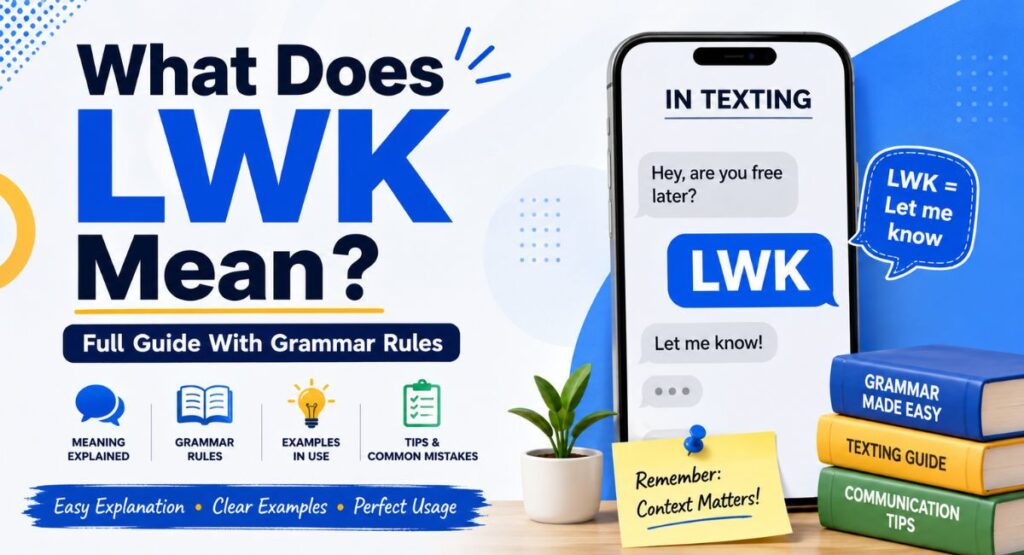
lwk mean Quick answer: LWK stands for “low-key.” It’s used as an adverb (sometimes an adjective) to soften a statement — meaning “somewhat,” “secretly,” or “without making a big deal of it.” Example: “I’m lwk nervous about tomorrow” = “I’m a little nervous, but I don’t want to make it a whole thing.”
That’s the definition everyone agrees on. What almost nobody explains is how to actually use it correctly in a sentence — and that’s where most people trip up.
What Does LWK Stand For?
LWK is a texting abbreviation for low-key (sometimes written as one word, “lowkey,” or hyphenated, “low-key” — more on that below).
| Term | Full Form | Word Type | Common Spelling Variants |
| LWK | Low-key | Adverb / Adjective | lwk, lowkey, low-key, low key |
Unlike acronyms like NASA or ASAP, LWK isn’t pronounced as a word on its own — people say “low-key” out loud even when they type “lwk.” It’s a disemvoweled abbreviation (the vowels are dropped: l-o-w-k-e-y becomes l-w-k), the same technique used in words like “txt” or “msg.” That’s a real linguistic pattern, not random shorthand — it’s how texting culture compresses common words while keeping them readable.
The Grammar Nobody Talks About: Is It “Lwk,” “Lowkey,” or “Low-Key”?
This is the single biggest source of confusion, and it’s worth slowing down for.
In formal or standard English writing, “low-key” is a compound adjective, and it follows a specific rule:
- Hyphenated before a noun: “It was a low-key event.” ✅
- No hyphen after a linking verb (in traditional style guides): “The event was low key.” (Though in casual modern usage, most people keep the hyphen everywhere.)
In texting and social slang, the rules loosen completely:
- “lwk” — the abbreviated form, always lowercase, no punctuation
- “lowkey” — one word, used as an adverb before a verb or adjective (“I lowkey love this”)
- “low-key” — the hyphenated, standard-English version, used more in captions or slightly more formal casual writing
Why this matters: If you’re writing a caption, a professional Slack message, or a school essay and you’re not sure which form to use, default to “low-key” (hyphenated) in standard writing, and “lwk” or “lowkey” only in casual texting with friends. Using “lwk” in an email to a professor is a common mistake that makes writing look careless — not because slang is “wrong,” but because register mismatch (casual word, formal context) reads as unpolished.
Part of Speech: How LWK Actually Functions in a Sentence
This is where most competitor explanations stop at “it means low-key” and leave you guessing. Here’s the actual grammar:
As an Adverb (most common use)
Placed before the main verb or adjective to soften it.
- “I lwk want to leave early.” (modifies “want”)
- “That test was lwk hard.” (modifies “hard”)
As an Adjective (less common, but valid)
Describes a noun directly, usually after a linking verb.
- “This whole situation is kind of lwk.” (describes “situation”)
Where It Sits in the Sentence
LWK almost always comes right before the word it’s softening — not at the start or end of the sentence. “Lwk I’m tired” works because it’s softening the whole statement that follows. But “I’m tired lwk” (tacked on at the end) sounds off to native speed-texters — it’s a common mistake for people newer to the slang.
LWK Meaning in Simple Words
- Slightly
- Secretly / privately
- Without making it a big deal
- Somewhat, but not fully committing to the feeling
Example: “I lwk think that movie was overrated” means the speaker believes it, but is downplaying how strongly they feel — often to avoid sounding too opinionated or dramatic.
Real Examples of LWK in Sentences
| Sentence | What It Actually Means |
| I’m lwk done with this class | I’m genuinely frustrated, but saying it casually |
| That outfit is lwk fire | I really like it, but I’m keeping my tone chill |
| I lwk forgot your birthday | Admitting a mistake without over-apologizing |
| She’s lwk the smartest person I know | A real compliment, delivered casually |
Notice something interesting: in real usage, LWK often doesn’t soften the feeling — it softens the delivery. People often use “lwk” right before saying something they actually feel strongly about, almost as a verbal cushion. That’s a nuance most definition sites miss entirely.
Common Mistakes People Make With LWK
- Capitalizing it mid-sentence unnecessarily — “I LWK love this” reads like shouting. Lowercase (“lwk”) is the norm in casual texting.
- Using it in formal writing — emails, cover letters, academic work. It signals informality that most formal contexts don’t want.
- Placing it at the end of a sentence — it almost always precedes the word it modifies.
- Confusing it with “IDK” or “TBH” — LWK softens intensity; it doesn’t express uncertainty (IDK) or signal honesty (TBH). They’re often combined (“ngl lwk I’m nervous”) but they do different grammatical jobs.
- Punctuating around it like a full word/interjection — “Lwk, I’m tired” (with a comma) is grammatically inconsistent with how it functions as an adverb. Most fluent users skip the comma: “lwk I’m tired.”
Where LWK Comes From
“Low-key” has been part of standard English for decades, originally describing something restrained or subdued (a “low-key celebration,” for instance). Its slang usage as an intensity-softener grew out of African American Vernacular English (AAVE) and hip-hop culture in the 2000s–2010s, before crossing into mainstream texting and social media slang through platforms like Vine, Twitter, and later TikTok. The abbreviated “lwk” form is a newer, keyboard-driven shorthand — a natural evolution of typing speed culture rather than a separate word with its own origin.
LWK vs. Similar Softening Slang
| Slang | Meaning | Grammatical Role |
| LWK | Slightly / secretly | Adverb/adjective — softens intensity |
| TBH | To be honest | Sentence opener — signals honesty |
| NGL | Not gonna lie | Sentence opener — signals honesty |
| KINDA | Kind of | Adverb — softens degree |
| ISH | -ish (approx.) | Suffix — softens precision |
LWK and “kinda” are the closest grammatical cousins — both function as degree-softening adverbs. TBH and NGL, by contrast, are honesty markers, not intensity softeners, even though they often show up in the same sentence.
When to Use (and Avoid) LWK
Use it when:
- Texting friends or casual group chats
- Writing informal social captions
- Softening an opinion in a low-stakes conversation
Avoid it when:
- Writing emails, essays, or professional messages
- Speaking in an interview or formal presentation
- Any context where clarity and formality matter more than tone
FAQs About LWK
What does LWK mean in text?
LWK means “low-key.” It’s used to soften a statement, showing that something is felt slightly or without wanting to make a big deal of it.
Is LWK a real word or just internet slang?
“Low-key” is a real, dictionary-recognized compound adjective. “LWK” is the internet-slang abbreviated spelling used specifically in texting.
Is LWK one word or two?
It depends on context: “lwk” is the texting abbreviation, “lowkey” is the informal one-word spelling, and “low-key” is the standard hyphenated English form.
Can you use LWK in formal writing?
No. LWK (and its variants) are informal and should be avoided in emails, academic writing, or professional communication.
What’s the difference between LWK and TBH?
LWK softens how strongly you feel about something (“I lwk like it” = mild liking). TBH signals honesty (“TBH I don’t like it” = an honest admission), regardless of intensity.