What Does ONB Mean in Slang?
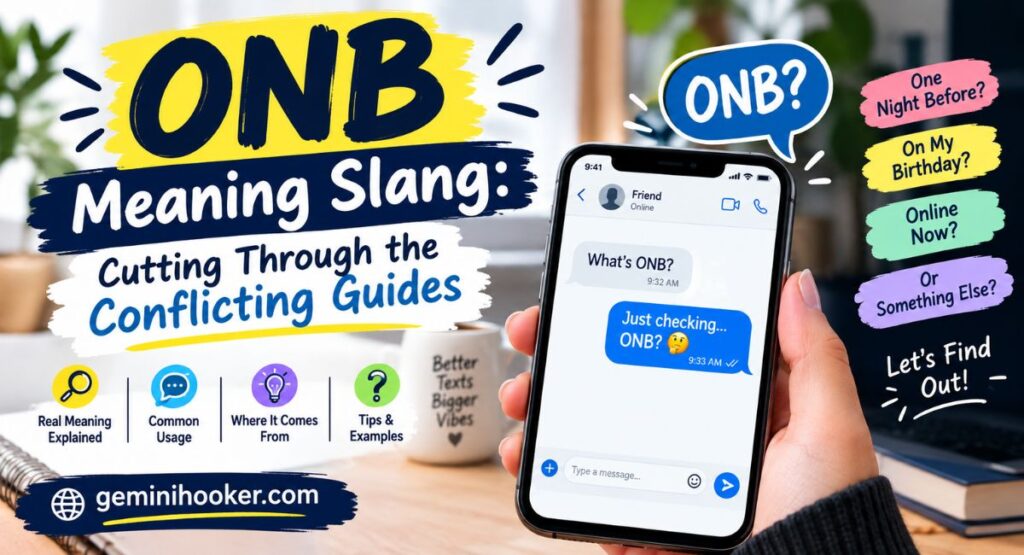
ONB Meaning Slang: ONB stands for “On Bro” (sometimes written “on my brother”), used to back up a statement as genuinely true — similar to saying “I swear” or “for real.” It’s a shortened form of swearing on someone close to you, a pattern that’s existed in spoken slang for years before moving into texting.
Here’s something worth flagging before the definition: if you’ve searched this term already, you’ve probably noticed different sites confidently giving you different answers.
Why This Term Has So Many Conflicting “Definitions” Online
Searching “ONB meaning” turns up guides claiming it means “Oh No Baby,” “On My Baby,” “Only No Bull,” or even “On Board” — each stated with total confidence, and each contradicting the others. None of these come with any real evidence of actual usage. The consistent, verifiable meaning across independent slang references and usage examples is “On Bro” — a callback to the older spoken habit of swearing on something you care about (“on my mom,” “on my life,” “on my brother”). When you see conflicting slang definitions like this, it’s worth checking whether multiple independent sources actually agree, rather than trusting whichever page loads first.
Real Chat Examples
Example 1 — Backing up a claim
Friend: “wait, you actually stayed up all night for this?” You: “onb, I didn’t sleep at all”
Here ONB is doing exactly what it’s built for — confirming something surprising is genuinely true.
Example 2 — Reacting to disbelief
Someone: “there’s no way that restaurant is that good” You: “onb, best burger I’ve had all year”
The word adds emphasis to counter the other person’s doubt.
Example 3 — Casual, low-stakes use
Group chat: “this show is so underrated” Reply: “onb, more people need to watch it”
A lighter use — not defending against doubt, just adding weight to an opinion.
The rule of thumb: ONB shows up when someone feels their plain statement might not be believed or taken seriously enough — it’s a small trust signal, not a promise about the future.
Grammar & Common Mistakes
- Part of speech: ONB functions as an interjection or tag added to the end (or occasionally start) of a sentence to reinforce it — it doesn’t change the sentence’s grammar otherwise.
- Capitalization: Lowercase “onb” is the casual default in texting; all-caps doesn’t change the meaning.
- Common mistake: Assuming ONB is a future commitment, like “I promise.” It’s closer to “I swear this is true right now” than a promise about future action.
- Common mistake: Using ONB in professional or formal writing — it’s strictly casual slang and can read as unprofessional in work messages.
When to Use (and Avoid) ONB
Good fits:
- Backing up a surprising or hard-to-believe statement among friends
- Casual replies on social media confirming something is real
- Group chats where a quick trust signal fits the tone
Avoid it:
- Professional emails or work chats — spell out “I’m serious” instead
- Formal or first-time conversations — it can feel overly casual too soon
- Treating it as a future promise — it confirms present truth, not future commitment
ONB vs. Similar Slang
| Term | Meaning | Tone |
| ONB | On Bro | Casual, friendly emphasis |
| ONG | On God | Casual, slightly stronger emphasis |
| FR | For Real | Casual, confirms or questions depending on punctuation |
| NO CAP | Not lying | Casual, playful |
ONB sits closely alongside ONG and FR — all three exist to add believability to a statement, differing mainly in intensity and regional popularity.
Related Reads
FAQs
What does ONB mean in slang? ONB stands for “On Bro,” used to back up a statement as genuinely true, similar to saying “I swear” or “for real.”
Why do different websites give different meanings for ONB? Several low-quality guides offer unverified, conflicting definitions like “Oh No Baby” or “On My Baby.” The consistently attested meaning across real usage and independent sources is “On Bro.”
Is ONB a promise to do something? No — it confirms that something is true right now, closer to “I swear this is true” than a commitment to future action.
Is ONB appropriate in professional messages? No — it’s casual slang and can come across as unprofessional in work or formal writing.
What’s the difference between ONB and ONG? Both add emphasis to confirm honesty, but ONG (“On God”) tends to carry slightly stronger weight than ONB (“On Bro”).