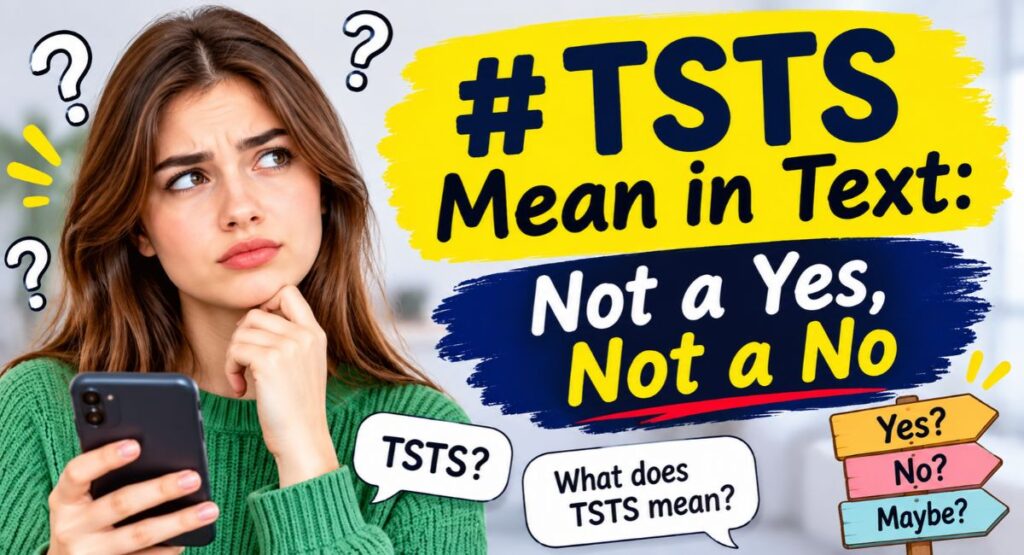
You ask a simple question and get four letters back: “TSTS.” No yes, no no, no explanation. Before you decide it is a brush-off, look at what the message was answering.
TSTS is most often read as “too soon to say”: a reply meaning the outcome isn’t known yet, so there is nothing firm to tell you. It is not a yes, a no or a maybe. But that reading only holds when a question about an outcome came right before it.
TSTS Mean in Text: TSTS is informal shorthand with no official definition, so usage varies from person to person. What follows is the reading that fits most chats, plus the situations where it does not.
The Question-Before-It Test
“Too soon to say” is an answer, so it needs a question to answer. And not just any question: it needs one about an outcome that has not happened yet.
| Question before TSTS | Does “too soon to say” fit? |
| “Will you get the job?” | Yes. The result is not in. |
| “Is the new schedule working?” | Yes. Not enough time has passed. |
| “Are you coming Friday?” | Sometimes. Only if the plan is really unsettled. |
| “Did you finish the report?” | No. That has already happened, so the answer is known. |
| “What’s your birthday?” | No. That is a fact, not an outcome. |
If the question was about the past or about a fact the person knows, TSTS is unlikely to mean “too soon to say”. Check the tone and any emoji before you decide what it does mean.
The Grammar Behind “Too Soon to Say”
“Too soon to say” is built as too + adjective + to-infinitive. The full sentence is “It’s too soon to say.” TSTS drops the “it’s” and keeps the four content words.
A few rules worth knowing:
- Part of speech: TSTS is an initialism (each letter stands for a word) used as a complete reply. It works as a whole sentence on its own.
- Capitalization: TSTS, tsts and Tsts read the same. Capitals make it look like an abbreviation, which helps readers who do not know it.
- Punctuation: It usually stands alone or takes a comma and a reason: “TSTS, still waiting on the offer.” It is an answer, so it does not need a question mark.
- Who says it and when: Friends, family and peers in casual chats, usually while waiting on a result, on someone else’s decision, or on time to pass.
Common mistakes:
- Adding “yet”: “TSTS yet” repeats itself, because “too soon” already means “not yet”.
- Using it for known facts: Birthdays and finished tasks are not “too soon to say”.
- Using it as a polite no: It says “unknown”, not “no”, so the other person may keep waiting.
- Using it in formal messages: Readers who do not know the abbreviation are left guessing.
TSTS vs IDK vs TBD: Who Doesn’t Know What
These three can look like the same shrug, but each one says something different.
| Abbreviation | Stands for | What it signals | Fits a question like |
| TSTS | too soon to say | The outcome has not happened yet | “Will it work out?” |
| IDK | I don’t know | You lack the information | Almost any factual question |
| TBD | to be decided | A choice is still open | “Where are we eating?” |
| Maybe | maybe | A possibility, with no timing | “Can you come?” |
The short version: IDK is about what you know. TSTS is about when it can be known. If you say IDK, you could go and find out. If you say TSTS, nobody can know yet.
Three Chats and the Right Reply
These are example conversations written to show common patterns, not real user messages.
Chat 1: Waiting on a Result
9:14 Hira: Did you hear back about the interview? 9:15 Omar: TSTS
✅ Best reply (from Hira): “Okay, fingers crossed. Want to check in on Friday?” Why: Omar has already said there is no news. Asking “but did they say anything?” repeats the question. A light check-in date keeps the tone kind and gives the chat a next step.
Chat 2: When It Starts to Sound Like a Dodge
6:02 Nida: Friday dinner. Are you in? 6:03 You: TSTS
✅ Best reply (from Nida): “No stress. Can you tell me by Thursday noon? I need to book.” Why: TSTS gives no date, so the plan stays stuck. Ask for a deadline and give your reason for needing one, instead of asking the same question again.
Chat 3: No Question, Just “tsts”
8:40 Sana: He wore the same shirt again 🙄 8:41 Ali: tsts
Nothing is pending here, so “too soon to say” does not fit. Some people type the disapproving “tsk tsk” sound this way, though that reading is informal and not an established abbreviation.
✅ Best reply (from Sana): “tsts like tsk-tsk, or too soon to say? 😂” Why: When the question-before-it test fails, ask. It takes five seconds and saves you from guessing wrong.
When TSTS Sounds Like a Dodge
TSTS itself is neutral. The context decides how it feels.
- Reads fine: “TSTS, still waiting on the offer.” The reason shows the person is not hiding anything.
- Can feel evasive: A bare “TSTS” sent again and again to the same question, or sent when someone wants reassurance.
- Easy fix: Add a reason and a time marker: “TSTS, I’ll know by Friday.”
If you are the one receiving it, the most useful reply is usually a time marker, not more pressure: “No rush, update me when you know.”
Two Other Readings to Check Before You Reply
- A disapproving sound. As in Chat 3, “tsts” with no question before it may be someone typing “tsk tsk”. Look for an eye-roll emoji or a complaint in the message above.
- A sign-off. Some sites list “talk soon, text soon” for TSTS. That reading is less established. Consider it only when the message is clearly a goodbye and no question came before it.
When neither the question test nor the tone settles it, ask the person directly.
Writing It Out for Work and Formal Messages
TSTS is too casual for emails, job messages and anything a client will read. It can also confuse readers who are still learning English. Write the full thought instead:
- “It’s too soon to say. I’ll update you by Friday.”
- “Not sure yet. I’ll confirm by Thursday.”
- “Still waiting on the decision. I’ll let you know as soon as I hear.”
Related Reads
- What GL means when you wish someone luck while they wait
- Polite wording for messages where abbreviations don’t belong
Frequently Asked Questions About TSTS
What does TSTS mean in text?
TSTS is most often read as “too soon to say.” It means the outcome is not known yet. It is informal shorthand with no official definition, so check the message before it.
Is TSTS the same as IDK?
No. IDK means you lack the information. TSTS means the information does not exist yet because the outcome has not happened.
How do I reply to TSTS?
Ask for a time marker instead of pushing for an answer. For example: “No rush, can you tell me by Thursday?” or “Okay, keep me posted.”
Does TSTS mean yes, no or maybe?
None of the three. It postpones the answer. If you need a decision, ask for a date.
Can I use TSTS in work messages?
It is better not to. Write “It’s too soon to say. I’ll update you by Friday.” so every reader understands.