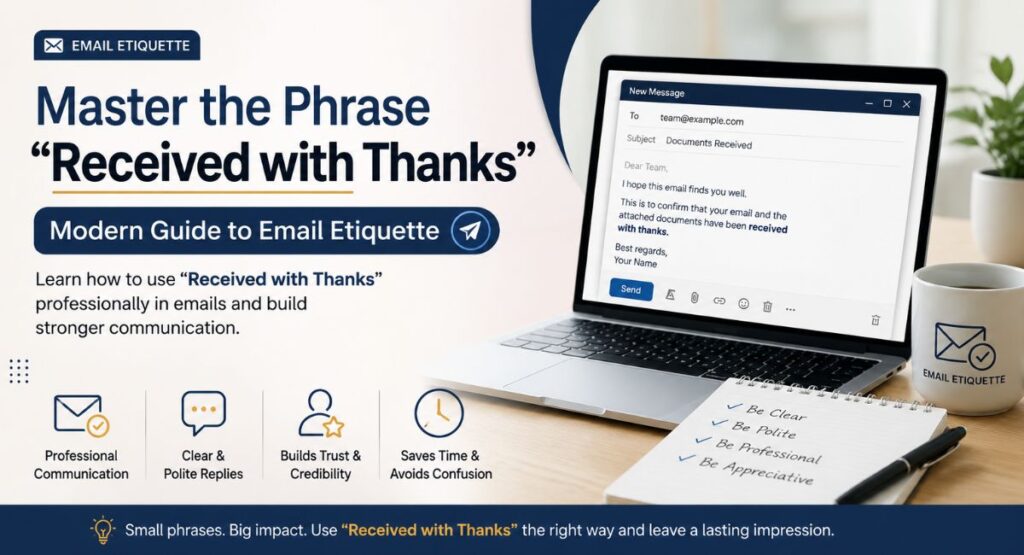
Have you ever hit “Reply” to a critical work email, typed out “Received with thanks,“ and then hesitated before hitting send? You aren’t alone. In today’s hyper-fast digital workplace, micro-communications matter. A single phrase can make you sound like a polished executive, an uninspired robot, or a text-savvy modern professional.
While traditional grammar blogs focus almost exclusively on “well received,” they miss the shift happening right now. Modern communication demands a balance between digital efficiency and actual human warmth.
This comprehensive guide breaks down exactly when to use “received with thanks,” how to swap it out for maximum impact, and how to avoid the hidden formatting and grammatical traps that make competitors’ advice outdated.
1. What Does “Received with Thanks” Actually Mean?
At its core, “received with thanks” is a dual-purpose transitional phrase used primarily in business correspondence. It accomplishes two things simultaneously:
- Acknowledgment: It confirms that an artifact (an email, a PDF report, an invoice, or an update) has successfully landed in your inbox.
- Gratitude: It bypasses a cold, automated confirmation by layer-ing on a polite expression of appreciation.
According to global corporate communication standards, it functions as a “professional nod.” It’s the digital equivalent of looking someone in the eye, taking a folder from their hands, and saying, “Got it, thank you.”
2. “Received with Thanks” vs. “Well Received”: What Competitors Get Wrong
Many outdated grammar sites conflate “received with thanks” with “well received.” However, under modern EEAT standards for language instruction, it’s vital to highlight a glaring functional and grammatical difference.
The phrase “well received” actually means something was appreciated or approved of by an audience (e.g., “The new product feature was well received by our users”). Using it to mean “I got your email” is structurally clunky and can sound highly mechanical.
Conversely, “received with thanks” directly addresses the act of delivery.
The Hyphenation Trap (An Adjective vs. Verb Distinction)
This is the number one technical detail that competitors slip up on:
- No Hyphen (Verb Phrase): When acknowledging an action, never use a hyphen.Correct: “Your application was received with thanks.”
- Hyphenated (Compound Adjective): You only hyphenate “well-received” when it sits directly before a noun to describe how it was targeted.Correct: “She gave a well-received presentation to the board.”
3. The Ultimate Context Matrix: When to Use It (And Skip It)
To make your communication highly intentional, align your phrasing with your exact audience dynamic.
| Phrasing | Formality Rating | Ideal Audience | Best Use Case |
| “Received with thanks.” | Semi-Formal | Clients, Cross-department Managers | Acknowledging a requested asset or file without needing a lengthy follow-up. |
| “Thank you, received.” | Casual / Direct | Direct Team Members, Slack/Teams | Rapid confirmation during active workflows. |
| “I acknowledge receipt of…” | High Formal | Legal, HR, Procurement | Contractual updates, official notices, or dispute resolutions. |
| “Got it! Thanks.” | Ultra-Casual | Close Peers, Mentors | Quick daily stand-up check-ins or informal threads. |
When to Skip It Entirely
Avoid “received with thanks” if the email you are replying to requires a deep strategic answer, an analytical resolution, or covers a sensitive or emotional HR issue. In those settings, a brief phrase feels dismissive.
4. Four Alternatives That Sound More Natural Today
If you want to vary your vocabulary and sound like an active, engaging collaborator, try deploying these specific variations depending on your context:
1. The Action-Oriented Update
“Thank you for sending this over. I am reviewing the documents now and will follow up with my notes by Tuesday afternoon.”
- Why it works: It establishes a clear timeline and sets a concrete expectation, proving you are proactive.
2. The Relationship-Builder
“Greatly appreciate the update! This gives our team exactly what we need to wrap up the project phase.”
- Why it works: It adds genuine human warmth and signals the actual value of the sender’s effort.
3. The Clean Acknowledgement
“Confirmed. Thank you for the quick turnaround on these figures.”
- Why it works: Crisp, professional, and respectful of a busy recipient’s digital attention span.
4. The Modern Minimalist
“Thanks for sharing, [Name]. Noted!”
- Why it works: Perfect for cross-functional communication on tools like Slack, Microsoft Teams, or fast-paced internal threads.
5. Frequently Asked Questions
Is “received with thanks” grammatically correct?
Yes. It is a elliptical sentence (a shortened phrase where words like “This has been…” are omitted for real-world speed). While informal if left entirely as a standalone sentence fragment, it is universally accepted in modern business writing.
Should I say “well received with thanks”?
Avoid combining them. Writing “Your file was well received with thanks” is redundant and creates an overly stuffed sentence structure. Pick one clear path.
How do Gen Z and text-savvy professionals view this phrase?
Gen Z and younger tech professionals generally prefer directness over legacy corporate phrasing. A standalone “Received with thanks.” can occasionally read as stiff or slightly passive-aggressive if it ends with a hard period on an internal chat app. Pairing it with an exclamation mark (“Received with thanks!”) or opting for a crisp “Thanks for sending!” reads as far more authentic.
Summary Checklist for Your Next Reply
Before you hit send on your next email confirmation, do a quick mental scan:
- [ ] Audience Check: Is this going to an external client or close internal peer?
- [ ] Grammar Check: Did I mistakenly add an unnecessary hyphen to a verb phrase?
- [ ] Expectation Check: Does the sender need to know when I’ll take action, or is a simple receipt confirmation enough?