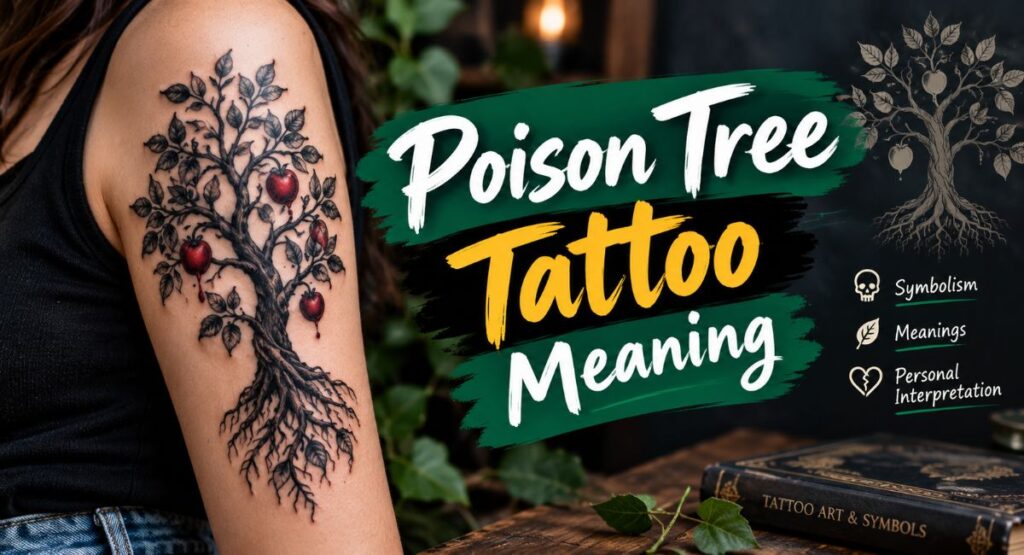
Two people can sit in the same studio chair, ask for the same twisted tree, and mean opposite things by it. One is warning themselves about anger. The other is celebrating that they got out of something toxic.
That gap is why this tattoo is so often misread, and why a few small details decide what it says.
Poison Tree Tattoo Meaning : A poison tree tattoo usually symbolizes resentment that grows when anger is kept hidden. The best-known source is William Blake’s 1794 poem “A Poison Tree,” where unspoken wrath turns into a tree with harmful fruit. But the same image can flip into a story of survival, depending on what is growing from the branches.
Blake’s Poem in Plain English (No Quoting, Just the Idea)
“A Poison Tree” appears in Blake’s Songs of Experience, published in 1794. It is short, and its logic is simple.
The speaker describes two situations. With a friend, anger is spoken aloud and it fades. With an enemy, anger is hidden, and it grows.
The speaker then feeds that hidden anger with false smiles and careful scheming, until it becomes a tree bearing a shiny fruit. The enemy is drawn to it, and the poem ends darkly for him.
So the poem is not really about revenge as a win. It is about what silence and scheming can grow into. That is the idea most tattoos borrow.
How to Write and Say “Poison Tree” Without Slipping
Most pages on this topic skip the language side. For readers who care about getting words right, especially if lettering is going on skin, it matters.
What kind of phrase is it?
Poison tree is a noun phrase. Here poison is a noun acting like an adjective, the same way it does in “poison ivy.” It names a type of tree, one that harms.
Poison, poisonous or poisoned?
- Poison tree: a tree that is a source of harm (the poem’s idea).
- Poisonous tree: a tree that is harmful by nature. You may know the legal phrase “fruit of the poisonous tree,” which is a separate expression and not the same as Blake’s title.
- Poisoned tree: a tree that someone has poisoned. That is a different meaning, so avoid it if you mean Blake’s tree.
Capitalization and punctuation
- The poem title starts with A, so it is “A Poison Tree,” not “The Poison Tree.”
- Short poems usually go in quotation marks. The book they sit in, Songs of Experience, goes in italics.
- The generic phrase stays lowercase: poison tree tattoo.
- Before a noun, write Blake-inspired with a hyphen. Whether to hyphenate poison-tree design varies by style guide, so choose one style and keep it.
Formal or casual?
In essays and captions, use the full title with quotation marks. In casual chat, “the Blake tree” or “a poison tree piece” is fine and people will follow.
Common mistakes
- Writing “poisoned tree” when you mean the poem’s idea.
- Dropping the A from the title.
- Assuming every poison tree design comes from Blake. Some people choose it purely for dark botanical style.
- Skipping a spelling check on any lettering. Ask for a stencil proof before the needle starts.
Who says it, and when?
- Literature students and Blake readers refer to the poem.
- Tattoo artists and collectors use it as a design category.
- Everyday speakers use it as a metaphor for a grudge or a toxic situation.
Poison Tree Wording at a Glance
| Phrase | Works as | What it points to | Watch out for |
| poison tree | Noun phrase (noun as modifier) | A tree that is a source of harm | Not the same as “poisoned” |
| poisonous tree | Adjective + noun | A tree harmful by nature | Legal phrase “fruit of the poisonous tree” is separate |
| poisoned tree | Participle + noun | A tree someone poisoned | Changes the meaning |
| “A Poison Tree” | Title of a poem | Blake’s 1794 poem | Keep the A; quotation marks, not italics |
| Blake-inspired | Compound adjective | A design drawn from the poem | Hyphen before a noun |
Reading the Tree From Roots to Fruit
Instead of memorizing a symbol list, read the design the way the poem grows: bottom to top.
- Roots: where the feeling started. Exposed, tangled roots suggest something carried for a long time.
- Trunk: how long it lasted. Scars and knots can show time and endurance.
- Branches: how far it spread. Sharp or broken branches suggest conflict. Open, balanced ones suggest calm.
- Fruit: the result. A single apple connects most directly to Blake. Falling fruit can read as letting go.
- Extras: thorns (boundaries), a snake (deception or temptation), fresh leaves or flowers (recovery).
Treat these as a vocabulary, not a rulebook. No official dictionary of tattoo symbols exists, so the wearer’s story always has the final word.
Can You Wear Anger Forever? A Question Before the Needle
Here is a practical angle few designs consider: tense. A tattoo that says “I am angry” is present tense, and feelings change. A tattoo that says “I learned what hidden anger does” is past tense, and it keeps its meaning.
A simple test: write your meaning as one sentence, then imagine reading it ten years from now. If it still feels true, the design fits. If it only fits this month, adjust it.
Many people solve this by adding something that signals movement, such as new leaves, a fallen fruit, or light at the top. The tree stays dark, but the story is no longer stuck.
Three Awkward Questions About the Tattoo, and Replies That Work
These are example conversations written for this guide, not real user data.
1. The curious friend
Example conversation (direct message)
Sana
Wait, is that tree tattoo from that Blake poem?
You
Yes! A Poison Tree. I liked the idea that hidden anger grows.
Sana
So it’s about revenge?
Best reply (casual, with a friend): “Not exactly. It’s more of a reminder to say things out loud before they grow.”
Why: It corrects the common “revenge” reading in one line and keeps the tone light.
2. The worried relative
Example conversation (family group chat)
Aunt
Beta, a tree with poison? Is something wrong?
You
…
Best reply (warm, brief, reassuring): “Nothing is wrong. It’s a reminder about a lesson I learned, and the new leaves at the top are the part that matters to me.”
Why: It calms concern without a long explanation, and it points to the hopeful detail. You do not owe anyone the full backstory.
3. The studio consultation
Example conversation (email with a tattoo artist)
Artist
What should this piece say? Dark and dead, or dark with growth?
Best reply (clear and professional): “Dark trunk and roots, one apple, and new leaves at the top. The meaning is: I learned what hidden anger does, and I moved on. I would like to review the stencil before we start.”
Why: One sentence of meaning, a few concrete details, and a request for a proof. That gives the artist direction.
When a Poison Tree Means Healing, Not Harm
Dark imagery is not the same as a dark message. Plenty of people choose this design as a marker of something they left behind: a toxic friendship, a betrayal, or a period of bitterness.
In those designs the tree is damaged, but it is also still growing. The poison is the past, and the leaves are the present.
It is also worth saying plainly that a tattoo does not heal anything by itself. It can mark a decision you have already made, or serve as a reminder, but the work happens outside the studio.
Before You Book: What to Bring the Artist
- One sentence of meaning, written in your own words.
- Two or three reference images, mainly for mood and line style rather than copying.
- A decision on the fruit: one apple, many, or none.
- A decision on tone: bare and dark, or dark with growth.
- Placement and size, since very fine details can lose clarity in small spaces. Ask how fine lines age on skin.
- Any text, spelled out, so you can check it on the stencil.
Test Yourself: Which Poison Tree Story Fits You?
A quick checker with no score. Pick the sentence closest to what you want the tattoo to say. This is only an extra; everything above works without it.
What do you want the tree to say?
A warning to myself about hidden anger
Something I survived: a betrayal or toxic relationship
I love dark, gothic botanical art
Letting go of an old grudge
Something small and quiet
Choose an option to see a matching design idea.
Related Reads
Poison Tree Tattoo Meaning: FAQs
What does a poison tree tattoo mean?
It most often symbolizes resentment or suppressed anger that grows over time, drawing on William Blake’s poem “A Poison Tree.” Depending on the design, it can also mean betrayal, a toxic situation, or healing after one.
Is a poison tree tattoo based on William Blake?
Often, but not always. Blake’s 1794 poem is the best-known source, and the apple is a direct link to it. Some people choose the image purely for its dark botanical style.
What does the apple mean in a poison tree tattoo?
In Blake-inspired designs, the apple stands for the harmful result of nurtured anger. More broadly, fruit can suggest temptation or consequences, so the wearer’s own story decides the final meaning.
Is it “poison tree” or “poisoned tree”?
Blake’s title is “A Poison Tree.” A “poisoned tree” would mean a tree someone has poisoned, which is a different idea, so use “poison tree” when referring to the poem.
Can a poison tree tattoo represent healing?
Yes. Adding new leaves, flowers or light to a dark tree can turn the message from pain into recovery. The visual contrast shows the past without letting it be the wholes.