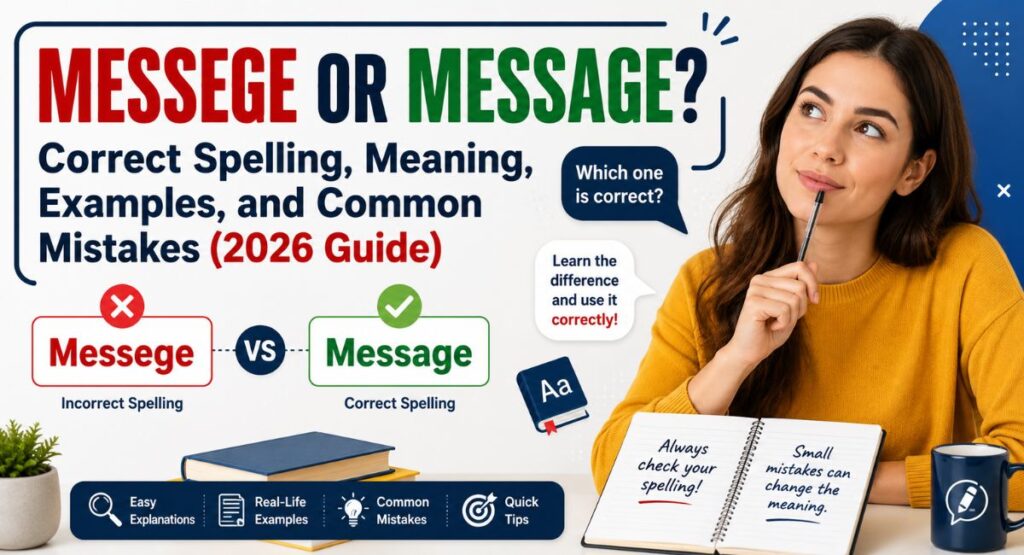
If you’ve ever typed “messege or message“ into Google, you’re not alone. Thousands of people wonder which spelling is correct while writing emails, text messages, assignments, social media posts, or business documents. The short answer is simple: “message” is the correct English spelling, while “messege” is a common spelling mistake.
However, there is much more to understand than simply knowing the correct spelling. This guide explains why people confuse the two words, how to remember the correct spelling forever, where the mistake comes from, and how to avoid it in professional and everyday writing. Whether you’re a student, content writer, blogger, business professional, or someone who simply wants to improve English, this article provides everything you need in one place.
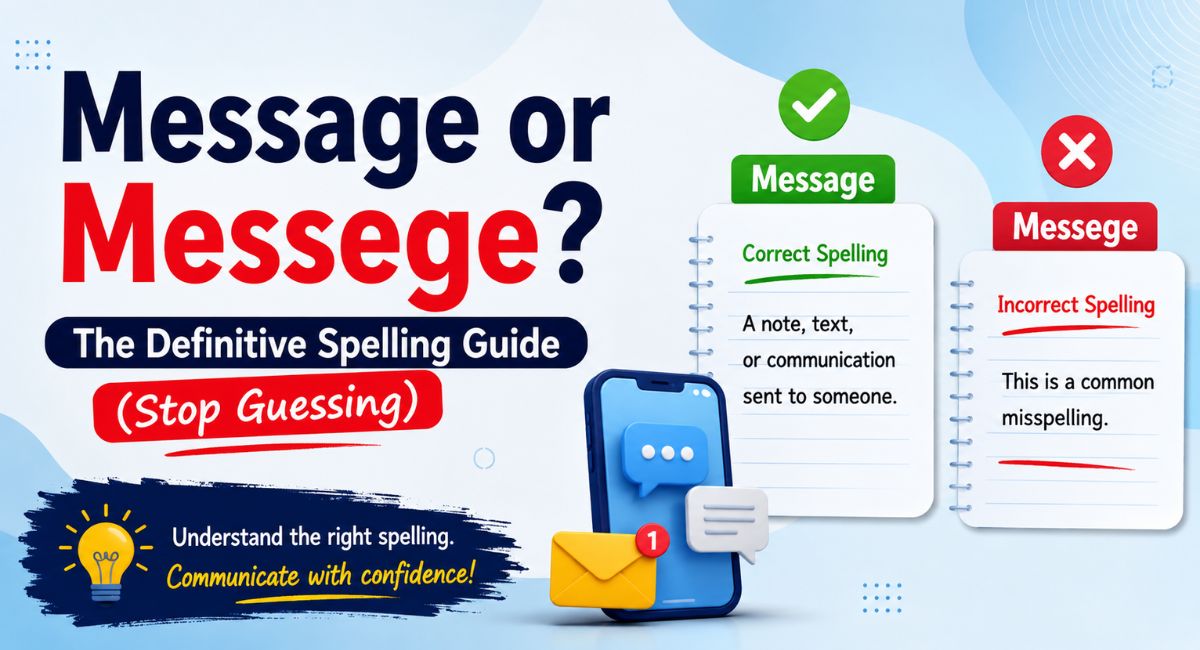
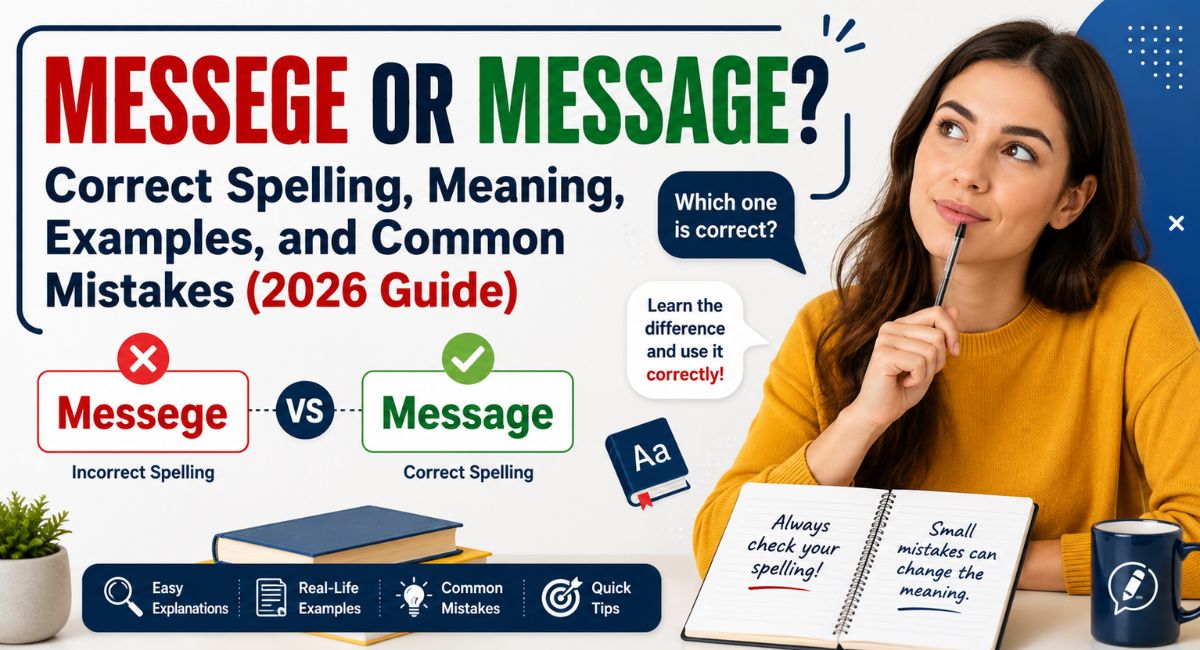
Message or Messege: Which Is Correct?
The correct spelling is:
✅ Message
The incorrect spelling is:
❌ Messege
“Message” is the only spelling recognized by English dictionaries worldwide, including Oxford, Cambridge, Merriam-Webster, and Collins.
Whenever you write an email, text, WhatsApp chat, school assignment, or business document, always use message.
| Word | Correct? | Meaning |
|---|---|---|
| Message | ✅ Yes | A piece of communication sent to someone |
| Messege | ❌ No | Misspelling of “message” |
What Does “Message” Mean?
A message is any information that one person sends to another.
It can be spoken, written, typed, recorded, or sent digitally.
Examples include:
- A text message
- An email
- A WhatsApp message
- A Facebook Messenger message
- A voicemail
- A handwritten note
- An announcement
- A lesson or moral from a story
In simple words, a message communicates information from one person to another.
Why Do People Write “Messege” Instead of “Message”?
This mistake is surprisingly common.
Several reasons explain why people type messege instead of message.
1. Pronunciation Confusion
The pronunciation of “message” sounds similar to “mess-ij.”
Many learners assume it should be spelled with “ege” instead of “age.”
2. Fast Typing
When typing quickly on phones or keyboards, fingers often hit the wrong letters.
For example:
- messege
- mesage
- messgae
- messeage
These are all typing errors.
3. English Isn’t Completely Phonetic
English spelling doesn’t always match pronunciation.
Many words sound different from how they’re spelled.
Examples include:
- Friend
- Business
- Enough
- Message
This makes spelling confusing for English learners.
4. Autocorrect Doesn’t Always Save You
Sometimes autocorrect fails, especially when:
- Writing offline
- Using older devices
- Typing in forms
- Using gaming chats
That’s why proofreading remains important.
How to Remember the Correct Spelling
An easy memory trick is:
Message contains “age” at the end.
Think of this sentence:
“A good message gets better with age.”
Another trick:
Break it into parts:
Mes + sage
Although “sage” has another meaning, the visual pattern helps many people remember the correct spelling.
Pronunciation of Message
Message is pronounced:
/ˈmes.ɪdʒ/
It sounds like:
MESS-ij
Notice that pronunciation does not indicate the spelling clearly, which is why many people mistakenly write “messege.”
Examples of “Message” in Sentences
Here are everyday examples.
Personal Communication
Please send me a message when you arrive.
I forgot to reply to your message yesterday.
Business Communication
The manager sent an important message to every employee.
Please read the message before attending the meeting.
School
The teacher left a message on the classroom board.
Social Media
She replied to my Instagram message within minutes.
Technology
Your phone has received a new message.
Common Types of Messages
The word “message” appears in many situations.
Here are the most common examples.
| Type | Example |
|---|---|
| Text Message | SMS sent from one phone to another |
| Email Message | Gmail or Outlook email |
| Voice Message | Audio recording |
| WhatsApp Message | Chat sent through WhatsApp |
| Instagram Message | Direct Message (DM) |
| Facebook Message | Messenger chat |
| System Message | Computer notification |
| Error Message | Warning displayed by software |
Is “Messege” Ever Correct?
No.
There are no situations where messege is considered correct English.
It is not:
- British English
- American English
- Australian English
- Canadian English
- Academic English
Every major English style guide accepts only message.
British vs American English
Some English words have different spellings.
Examples include:
| American | British |
|---|---|
| Color | Colour |
| Favorite | Favourite |
| Organize | Organise |
However, message stays exactly the same in both British and American English.
There is no variation.
Common Misspellings
People frequently search these spellings.
- Messege
- Mesage
- Messgae
- Messeage
- Msg
- Messge
Only message is correct.
Grammar Tips
Message is usually a noun.
Examples:
She sent a message.
I received your message.
It can also appear in verb phrases.
Examples:
Please message me later.
He messaged his friend yesterday.
Modern English commonly uses message as both a noun and a verb, especially in digital communication.
Message as a Verb
Today, people often say:
- Message me.
- I’ll message you tonight.
- She messaged me on Instagram.
Although older grammar books preferred “send a message,” modern English dictionaries recognize message as a verb.
Synonyms of Message
Depending on context, you can replace “message” with:
- Note
- Communication
- Notification
- Announcement
- Letter
- Text
- Memo
- Information
- Statement
Each has slightly different usage.
Real-Life Examples
Example 1
Incorrect:
I received your messege.
Correct:
I received your message.
Example 2
Incorrect:
Please check your messege.
Correct:
Please check your message.
Example 3
Incorrect:
Thanks for your messege.
Correct:
Thanks for your message.
Why Correct Spelling Matters
Correct spelling builds trust.
Whether you’re:
- Applying for a job
- Sending business emails
- Writing academic papers
- Creating blog posts
- Posting on social media
Using the correct spelling creates a more professional impression.
Even small spelling mistakes can affect credibility, especially in formal communication.
Message in Digital Communication
Today, the word “message” appears everywhere.
Examples include:
- SMS
- Telegram
- Signal
- Facebook Messenger
- Slack
- Microsoft Teams
- Discord
Although the platforms differ, the spelling never changes.
What Miss
Many articles simply state that message is correct and stop there. They rarely explain why the mistake happens or how modern English uses the word in different contexts. Here are important details that help readers more effectively.
Why Search Engines Suggest “Message”
When you search for messege, search engines usually suggest “Did you mean: message?” because “message” is the standard dictionary spelling and appears far more frequently in books, websites, and everyday communication.
Spell Check Isn’t Perfect
Spell-check tools can catch many errors, but they may not work in every app or language setting. Developing a habit of proofreading important emails, assignments, and work documents is still the safest approach.
“Message” in the Age of AI
With AI writing tools, chat apps, and workplace collaboration platforms becoming more common, the word message is used as both a noun and a verb more than ever. Understanding the correct spelling helps you communicate clearly across professional and personal platforms.
messege or message: Frequently Asked Questions
Is “messege” a real English word?
No. It is simply a misspelling of message.
Which spelling should I use?
Always use message.
Why do I keep typing “messege”?
It usually happens because of pronunciation, typing speed, or unfamiliarity with English spelling patterns.
Is “message” correct in British English?
Yes.
British English and American English both use message.
Can “message” be used as a verb?
Yes.
Examples:
- Message me tomorrow.
- She messaged her teacher.
What is the plural of message?
The plural form is:
Messages
Example:
I received twenty messages today.
Is “msg” the same as “message”?
“Msg” is an informal abbreviation commonly used in texting and online chats. In formal writing, use the full word message.
How can I remember the correct spelling?
Remember that message ends with “age”, not “ege.” A simple mnemonic is: “A clear message improves with age.”
Conclusion
The debate over “messege or message” has one clear answer: message is the only correct spelling in English, while messege is always a spelling mistake. Understanding why the error occurs, learning simple memory techniques, and seeing the word used in real-life examples can help you avoid repeating the mistake. Whether you’re sending a text, writing an email, publishing a blog post, or preparing a professional document, using the correct spelling improves clarity, credibility, and confidence. The next time you’re unsure, remember this simple rule: always write “message,” never “messege.”