Someone looks at your ten-slide birthday video and says, “Okay, that’s a bit OTT.” Are you being praised or told to tone it down?
The answer sits in the tone, the punctuation and who typed it. Below you’ll find what OTT means, a simple grammar rule most guides skip, three example chats with suggested replies, and a short checker.
Quick answer: OTT stands for “over the top.” In chat, it means excessive, dramatic, or more elaborate than the moment needs. In tech and media, OTT describes video services delivered over the internet instead of cable or satellite. But in texts, the same label can sting or flatter, depending on who sends it.
What OTT Is Really Measuring: Size, Not Intent
OTT compares two things: how big the effort or reaction is, and how big the occasion is. A 14-slide slideshow for a birthday is OTT. The same slideshow for a wedding probably isn’t.
That is why OTT is not automatically an insult. It describes a mismatch in scale. The speaker’s tone decides whether the mismatch is charming or annoying.
- Playful: “You made three cakes? That’s so OTT 😂”
- Admiring: “The decorations were OTT in the best way.”
- Critical: “Her apology was totally OTT.” (no emoji, no warmth)
The Hyphen Test: “An Over-the-Top Gift” vs “The Gift Was Over the Top”
This is the grammar point most explainers skip. The spelled-out phrase changes shape depending on where it sits in the sentence.
Part of speech and punctuation
- Before a noun, use hyphens: “an over-the-top reaction.” The three words work together as one adjective.
- After a verb, drop the hyphens: “The reaction was over the top.”
- As an acronym, there is nothing to hyphenate: “The reaction was OTT.” This is why chat users prefer it.
Most style guides treat compound modifiers this way, though a few dictionaries list “over-the-top” as hyphenated in every position. If your site has a house style, pick one and stay consistent.
Capitalization
Write it as OTT, in capitals. Lowercase “ott” is common in quick chat and fine there. In anything formal, use capitals or spell the phrase out. “Ott” with a capital O alone looks like a surname.
Formal vs casual
The slang sense is casual. In an email to a manager or teacher, write “excessive,” “elaborate,” or “more detailed than necessary.” The streaming sense is the opposite: it is standard vocabulary in business and tech writing.
Who says it, and when
Observed patterns, not statistics: friends use it to tease each other about effort (parties, captions, apologies, outfits). Commenters use it under posts. Journalists and marketers use the streaming sense. Usage varies by group, so read the tone first.
“A Bit OTT,” “Slightly OTT,” “So OTT”: How Wording Changes the Sting
OTT works like a gradable adjective, so the words around it change the force.
- “A bit OTT” / “slightly OTT”: softer, often a gentle tease. Still, “a bit” is sometimes used to cushion a real criticism.
- “So OTT” / “totally OTT”: stronger. Could be delighted or disapproving, so check emojis and context.
- “OTT much?”: a rhetorical question. It is usually sharper than a plain statement because it invites you to admit you overdid it.
- “Going OTT”: describes the act of overdoing it. “She went OTT with the lights” is about the action, not the person.
Without a voice or a face, a single message can read two ways. When you’re the one sending it, add an emoji or a clause like “in a good way” to remove the doubt.
OTT in Real Chats: 3 Example Conversations and What to Reply
These are illustrative examples, not real user messages.
Example 1: Group chat with friends
Hira: I made a slideshow for Sana’s birthday. 14 slides. Music included 🎶
Zoya: 14?? okay that’s a bit OTT 😂 but I’m watching it
Hira: too much?
Zoya: no no, OTT in a good way
Best reply (as Hira): “Guilty 😄 want the short version?”
Why: Close friends, playful emoji, no real criticism. Own it lightly and offer an exit. Defending the slideshow would make the tease feel heavier than it was.
Example 2: A comment under a public post
Caption (400 words about morning tea).
Comment: this is so OTT
Best reply: Either skip it, or reply once and lightly: “Tea is serious business ☕”
Why: Public thread, no emoji, unclear relationship. Don’t get defensive. If the commenter is a stranger, ignoring it is fine.
Example 3: A work chat
Manager: Let’s plan budget for an OTT push next quarter.
Intern: Do you mean a big, dramatic campaign?
Manager: No, streaming platforms. Ads and partnerships.
Best reply: Ask what the term means before you plan: “Just to confirm, OTT as in streaming platforms?”
Why: At work, OTT almost always points to streaming. One short question prevents a wasted week.
When Someone Calls Your Message OTT: A Quick Reply Guide
| What they sent | What it likely means | Safe reply |
| “a bit OTT 😂” | Friendly tease | “Guilty 😄” |
| “OTT in the best way” | Compliment | “Thank you, I enjoyed making it!” |
| “that was so OTT.” (no emoji, after something emotional) | Possibly annoyed or hurt | “Did that come across too intense? I didn’t mean it that way.” |
| “OTT much?” | Sharp, rhetorical | Stay calm: “Maybe a little. Message received.” |
OTT in Streaming Talk: Why It Has Nothing to Do With Being Dramatic
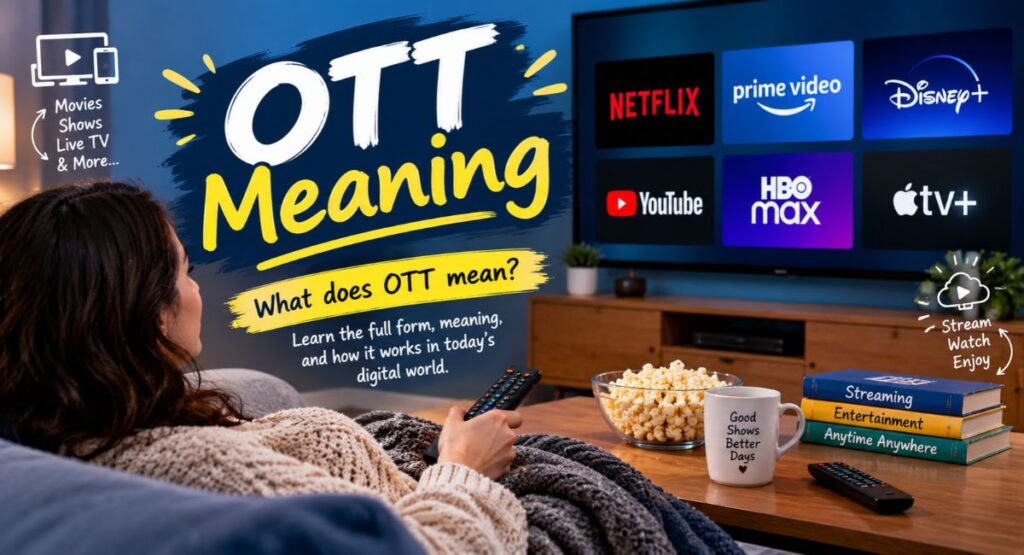
In media and technology, OTT means content delivered to viewers over the internet, without a cable or satellite operator acting as the gatekeeper. Netflix is the standard example.
The two meanings share a phrase, not an idea. One describes excess; the other describes delivery.
In South Asian film and entertainment coverage, “OTT platform” and “OTT release” are common phrasings for titles that go straight to streaming. In telecom discussions, OTT can also cover messaging and calling apps that run over the internet rather than through a carrier’s own service.
OTT vs “Extra” vs “Overkill”: Grammar Comparison Table
| Term | Form | Tone | Formal writing? |
| OTT (slang) | Adjective | Playful to critical | No |
| over the top | Predicate adjective phrase | Neutral to critical | Acceptable |
| over-the-top | Compound modifier before a noun | Neutral to critical | Acceptable |
| OTT platform | Noun modifier (streaming) | Neutral, technical | Yes |
| extra | Slang adjective | Often playful or admiring | No |
| overkill | Noun | Usually critical | Acceptable |
Where OTT Goes Wrong: Common Mistakes
- Using it to dismiss real feelings. If someone is upset, “that’s OTT” reads as brushing them off.
- Apologizing with it. “Sorry if I was OTT” sounds half-hearted. Name what you’re sorry for instead.
- Using it in formal writing. Replace it with “excessive,” “elaborate,” or “detailed.”
- Mixing up the two meanings. “OTT platform” does not mean a dramatic platform.
- Hyphenating the acronym. “O-T-T” or “OTT-” is unnecessary. Write OTT.
Related Reads
- SMH, the shorthand people use when a message feels like too much
- IMAO and other chat abbreviations that change a message’s tone
FAQs
What does OTT mean in text?
OTT means “over the top.” In texts it describes something excessive, dramatic or more elaborate than the situation needs. It can be a playful tease, a compliment or a criticism, depending on tone.
Is OTT an insult?
Not always. It comments on scale, not necessarily on the person. Between friends it is often a tease. From a stranger, or with no emoji, it can read as criticism.
Is it “over the top” or “over-the-top”?
Use hyphens when the phrase comes before a noun (“an over-the-top reaction”) and drop them after a verb (“the reaction was over the top”). The acronym OTT needs no hyphens.
What does OTT mean on Netflix and streaming?
OTT refers to video services delivered over the internet instead of through a cable or satellite provider. Netflix is a common example.
How should I reply if someone says my message is OTT?
Check the tone first. If it is playful, answer lightly (“Guilty 😄”). If it follows something emotional and has no emoji, ask whether your message came across too intense.