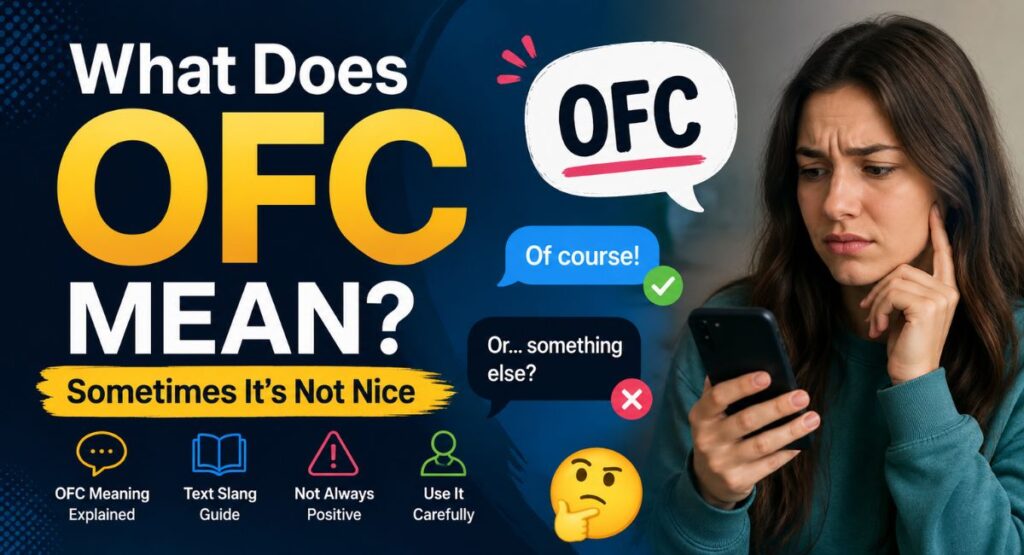
Quick Answer: OFC stands for “Of Course” — used to confirm, agree, or answer a question positively. In casual chats it usually signals warm agreement, but the same word can sound dismissive or slightly annoyed if it follows a question the sender thought was obvious. The tone isn’t in the word — it’s in what it’s replying to.
Most guides list “of course” as the meaning and move on. The part that actually trips people up is that OFC carries the exact same double-edge as saying “of course” out loud — it can be warm, or it can be a subtle way of saying “obviously.”
Why OFC Isn’t Always as Nice as It Looks
Say “of course” out loud after someone asks an easy favor, and it sounds friendly. Say it after someone asks something they should already know the answer to, and it can sound like you’re mildly annoyed they even asked. OFC carries that exact same risk in text — and because text strips out tone of voice, it’s easier to misread in either direction.
Real Chat Examples
Example 1 — Warm agreement
Friend: “can you help me move this weekend?” You: “ofc! what time works for you?”
Paired with an exclamation point and a follow-up question, this reads as genuinely happy to help.
Example 2 — Mildly dismissive
Someone: “wait, are you actually coming tonight?” You: “ofc”
No punctuation, no extra warmth, replying to a question that implies doubt — this version can land as slightly annoyed (“obviously, why would you ask”).
Example 3 — Clearly sarcastic
Someone: “did you seriously forget again?” You: “ofc I did 🙄”
The eye-roll emoji removes any ambiguity — this is sarcasm, not agreement.
The rule of thumb: OFC reads warm when it answers a genuine request and comes with extra warmth (an exclamation point, a follow-up, an emoji). It reads dismissive when it’s a bare one-word reply to a question that questioned your reliability or memory.
Grammar & Common Mistakes
- Capitalization: Lowercase “ofc” is the casual default. All-caps “OFC” doesn’t add rudeness by itself, but combined with no punctuation, it can read more clipped and less warm.
- Punctuation: An exclamation point after OFC (“ofc!”) almost always signals genuine enthusiasm. A bare “ofc” with nothing after it is the version most likely to be misread as short or annoyed.
- Common mistake: Replying “ofc” with no other words to a question someone asked nervously or sincerely — it can come across as brushing them off, even if that’s not the intent.
- Common mistake: Using OFC in a professional context. Even the spelled-out phrase “of course” can sound clipped in an email; the abbreviated slang version compounds that risk.
When to Use (and Avoid) OFC
Good fits:
- Confirming plans warmly, especially with an exclamation point or follow-up
- Agreeing to help with something, paired with enthusiasm
- Casual chats where a quick “yes, definitely” fits naturally
Avoid it:
- Replying to someone who sounds nervous, unsure, or sincere — a bare “ofc” can feel dismissive
- Professional messages — spell out “of course” at minimum, or rephrase entirely
- When you actually mean something closer to “obviously” in a sarcastic way — that tone often needs an emoji to land clearly rather than confuse the reader
OFC vs. Similar Slang
| Term | Meaning | Tone Risk | Best Used With |
| OFC | Of Course | Can read as dismissive if bare | Warm confirmations, paired with punctuation |
| FR | For Real | Low | Agreement, emphasis |
| IKR | I Know Right | Low | Shared reactions |
| TBH | To Be Honest | Low | Prefacing an opinion |
OFC stands out on this list because, unlike FR or IKR, its tone genuinely swings both ways depending on context — the others are consistently low-risk.
Related Reads
FAQs
What does OFC mean? OFC stands for “Of Course,” used to confirm, agree, or answer a question positively in casual texting.
Can OFC sound rude? Yes — a bare “ofc” replying to a question that implies doubt or nervousness can read as dismissive, even without that intention.
How do I make OFC sound warm instead of dismissive? Pair it with an exclamation point, an emoji, or a follow-up question — bare one-word replies are the most likely to be misread.
Is OFC appropriate at work? It’s best avoided in professional messages — even the full phrase “of course” can sound clipped in email, and the slang version increases that risk.
Does OFC always mean agreement? Usually, but context matters — paired with an eye-roll emoji or following a sarcastic question, it can signal sarcasm instead of genuine agreement.