You’re mid-conversation on WhatsApp, your friend types “brb,” and the chat just… stops. No goodbye, no explanation of when they’ll be back. If you’ve ever stared at that message wondering whether it’s rude, romantic, or just three random letters, you’re not alone — and you’re not bad at English for not knowing.
Most guides will tell you BRB means “Be Right Back” and leave it there. That’s true, but it’s only half the story. The real confusion isn’t about what BRB means — it’s about how to use it without sounding awkward, unprofessional, or grammatically off. That’s what this guide actually fixes.
Quick Answer: What Does BRB Mean?
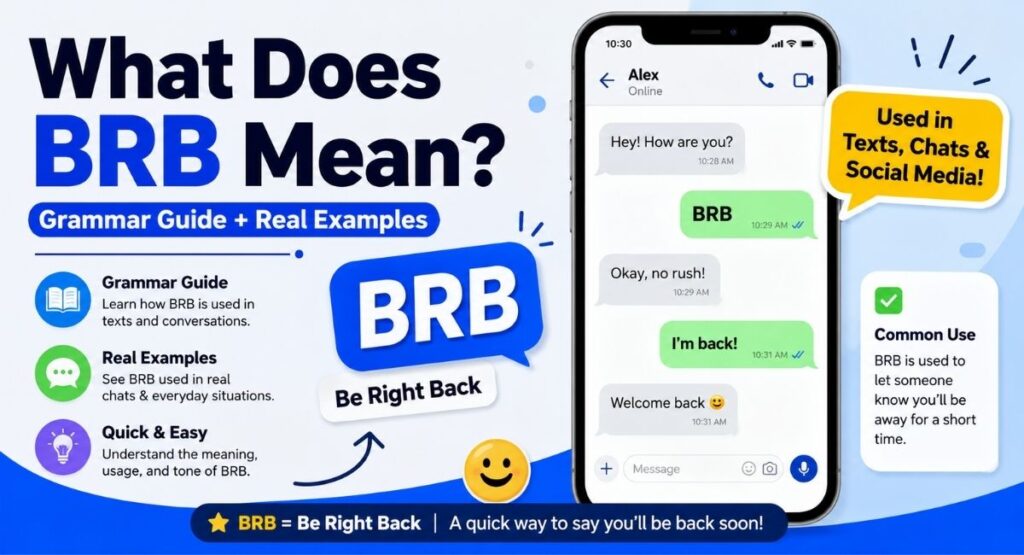
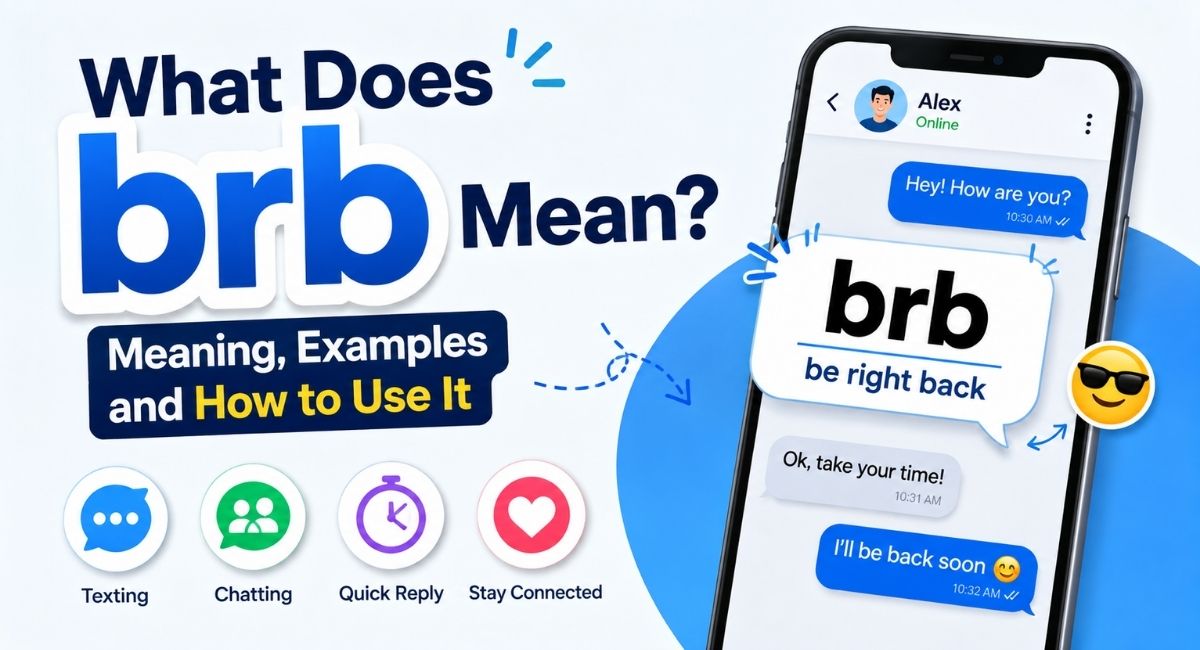
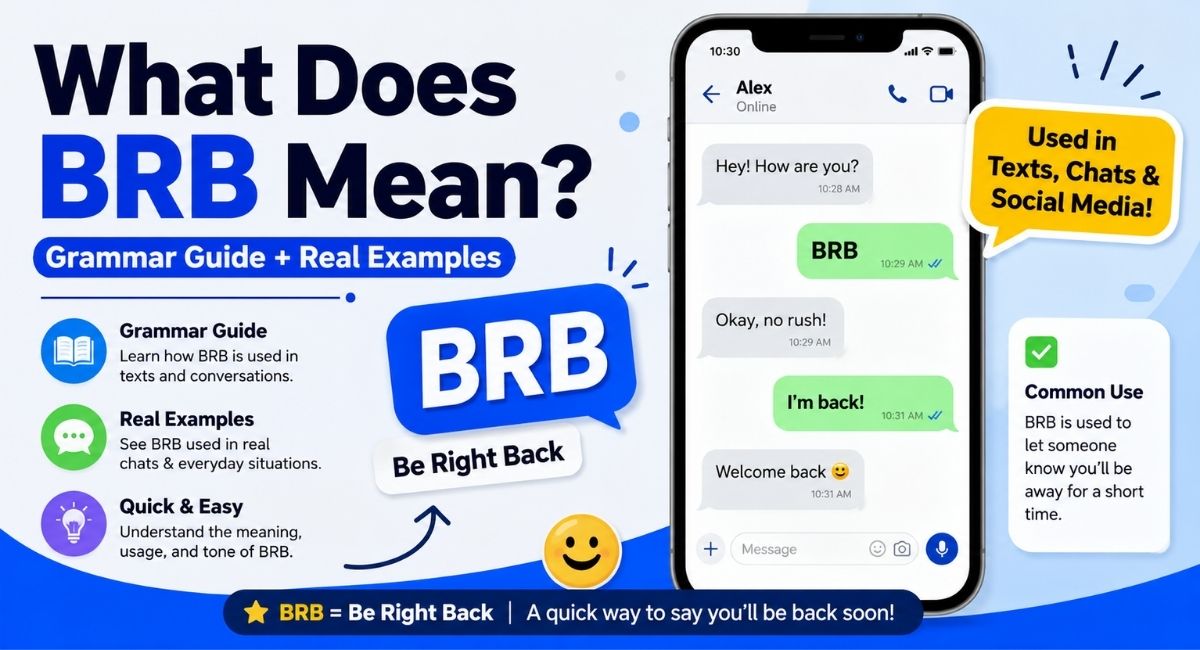
BRB stands for “Be Right Back.” It’s an internet abbreviation used to tell someone you’re stepping away from a conversation briefly but will return soon.
- Full form: Be Right Back
- Type of word: Interjection / short exit phrase
- Used in: Texting, WhatsApp, gaming chats, social media, video calls
- Implies: A short absence (minutes, not hours)
BRB Full Form Breakdown
| Letter | Stands For | Grammatical Role |
| B | Be | Linking verb (base form) |
| R | Right | Adverb (modifies “back”) |
| B | Back | Adverb of place |
Put together, “Be Right Back” is technically a verb phrase functioning as a standalone sentence — it drops the subject “I” because casual speech and texting naturally omit understood pronouns. Compare it to saying “Coming!” instead of “I am coming.” This is called subject ellipsis, and it’s extremely common in spoken and digital English — not a grammar error, even though it looks like an incomplete sentence.
This matters if you’re learning English: dropping the subject is fine in casual texting (“BRB,” “Gotta go,” “Miss you”) but should NOT be copied into formal writing, where full sentences are expected.
How Do You Pronounce BRB?
This trips up a lot of non-native English speakers because BRB is not pronounced as a word — it’s spoken letter by letter, like an acronym, not a blended sound like “NASA.”
Say it as: B-R-B (bee-ar-bee)
Do not try to pronounce it as “burb” or as one syllable. If you say it out loud in a video call or voice note, spell it out. This is different from acronyms like “LOL,” which some speakers do pronounce as a word (“lol” rhyming with “doll”).
Is “BRB” Capitalized? Grammar Rules You Need to Know
This is the part almost every other guide skips — and it’s the part grammar-conscious readers actually search for.
| Style | Example | When to Use |
| BRB (all caps) | “BRB, phone call.” | Standard for texting, chat apps, gaming — the most common and widely accepted form |
| brb (lowercase) | “brb gng to eat” | Casual texting, Gen Z messaging style, informal DMs |
| Brb (title case) | “Brb, be back in 5” | Rare; sometimes auto-capitalized by phone keyboards at the start of a sentence |
The rule: Since BRB is an initialism (each letter is pronounced separately, unlike an acronym pronounced as a word), the traditional grammar rule says it should be capitalized — similar to ASAP, FYI, or ATM. However, internet slang has relaxed this rule, and lowercase “brb” is now equally acceptable in casual chat. The only place you should avoid lowercase is in professional or academic writing, where you shouldn’t be using BRB at all (more on that below).
Punctuation Rules: Where Does the Comma Go?
Because BRB is often followed by a reason, punctuation confuses a lot of English learners. Here’s the simple rule:
- Use a comma between BRB and the reason that follows it.
- ✅ “BRB, getting water.”
- ❌ “BRB getting water.” (missing comma — grammatically incomplete)
- No comma needed when BRB stands alone.
- ✅ “BRB!”
- ✅ “brb”
Think of BRB as functioning like an introductory phrase — the same rule that applies to words like “Actually,” or “Honestly,” at the start of a sentence. A comma signals a brief pause, which mirrors how the phrase is actually spoken.
Common Grammar Mistakes People Make With BRB
- Treating BRB as a complete formal sentence. It works in texting because the subject “I” is implied, but it should never appear in an email, report, or academic paper.
- Dropping the comma before the reason (“BRB doing homework” instead of “BRB, doing homework”), which reads as run-on and unclear.
- Pronouncing it as one word instead of spelling out the letters when speaking aloud.
- Using it and not returning, which — while not a grammar mistake — breaks the actual meaning of the phrase and confuses the other person.
- Confusing BRB with “be right there,” which means you’re heading to someone, not stepping away from a conversation.
How to Reply to BRB (Something Most Guides Never Explain)
Knowing the meaning is only useful if you also know how to respond. Here are natural, grammatically correct replies depending on the situation:
- Casual: “Okay, take your time!”
- Gaming/group chat: “K, we’ll wait.”
- Professional call: “No problem, we’ll pause here.”
- If it’s been too long: “Hey, you still there?”
Notice that in the professional example, the reply avoids slang entirely — matching the same register (formality level) as the situation. Matching tone between message and reply is a small but important grammar-adjacent skill: it’s about register, not just correctness.
BRB vs AFK vs TTYL vs GTG: What’s the Real Difference?
People often use these interchangeably, but each one carries a different grammatical structure and implied duration.
| Abbreviation | Full Form | Grammar Type | Implied Duration | Ends the Conversation? |
| BRB | Be Right Back | Verb phrase (subject dropped) | A few minutes | No — conversation continues |
| AFK | Away From Keyboard | Prepositional phrase | Longer, undefined | No, but less urgency to return |
| TTYL | Talk To You Later | Verb phrase | Hours or more | Yes — signals closing |
| GTG | Got To Go | Verb phrase (perfect tense, subject dropped) | Immediate, often permanent for that session | Yes |
Why this matters: Using TTYL when you mean BRB can accidentally signal to the other person that the conversation is over, when you only meant to step away for two minutes. Choosing the right abbreviation is a small vocabulary decision that changes the entire meaning of your message.
Where and When to Use BRB (Formal vs Informal)
Appropriate:
- Text messages and WhatsApp
- Gaming voice/text chat
- Social media comments and captions
- Casual video calls with friends
Avoid:
- Professional emails
- Business meeting chat (use: “I’ll be back in a moment” instead)
- Academic writing
- Formal reports or cover letters
If you’re writing in a workplace context and want to sound polished, replace BRB with a full sentence: “I’ll step away for a moment and be right back.” It communicates the same intent without the informal tone.
Where BRB Came From
BRB dates back to early internet chat culture in the 1990s, when platforms like IRC, AOL Instant Messenger, and Yahoo Messenger relied on typed conversations with slow connection speeds. Shortening common phrases wasn’t just casual style — it was a practical necessity when every keystroke took time to send. That efficiency habit carried over into modern texting and gaming culture, which is why BRB has outlasted many other chat-era abbreviations.
Key Takeaways
- BRB means “Be Right Back” and signals a short, temporary absence from a conversation.
- It’s grammatically a verb phrase with the subject dropped — normal in casual English, not a “broken sentence.”
- Say it letter by letter (B-R-B), never as one word.
- Capitalize it in most contexts; lowercase is acceptable in casual texting.
- Use a comma before the reason that follows it (“BRB, one sec”).
- Avoid it in formal writing — use a full sentence instead.
- It differs from AFK, TTYL, and GTG in both duration and grammar structure.
Frequently Asked Questions
What does BRB mean in chat? BRB means “Be Right Back.” It’s used to tell someone you’re stepping away from a conversation for a short time and will return soon.
Is BRB grammatically correct to use? Yes, in casual writing. It works because the subject “I” is understood and dropped, the same way people say “Coming!” instead of “I am coming.” It should not be used in formal or academic writing.
Should BRB be capitalized? Traditionally, yes — since it’s an initialism like ASAP or FYI. In casual texting, lowercase “brb” is also widely accepted and won’t be seen as incorrect.
Do you need a comma after BRB? Yes, if a reason follows it. Write “BRB, getting food,” not “BRB getting food.” No comma is needed if BRB stands alone.
What’s the difference between BRB and AFK? BRB implies a short return, usually within a few minutes. AFK (Away From Keyboard) implies a longer or undefined absence and is more common in gaming contexts.