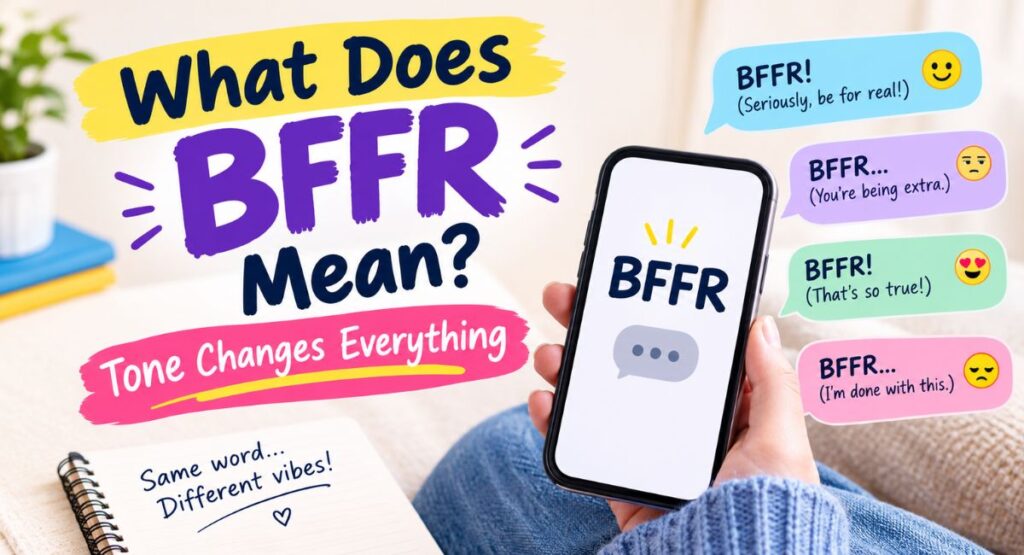
What Does BFFR Mean? Tone Changes Everything: Quick Answer: BFFR stands for “Be For Real” — a cleaned-up version of the original, more explicit “Be F***ing For Real.” It’s used to call out exaggeration, react to disbelief, or ask someone to stop joking around. The tricky part isn’t the definition — it’s that the exact same text can read as playful teasing or genuine annoyance, and the words alone don’t tell you which.
Most guides list the definition and stop there. What actually matters is learning to read which version you’re getting.
Where BFFR Actually Comes From
BFFR is rooted in AAVE (African-American Vernacular English), where the phrase “be for real” has been used for decades to challenge someone’s honesty. The specific four-letter abbreviation, though, only became widely popular around 2022, when it spread rapidly through TikTok and Twitter — noticeably more recent than some guides suggest.
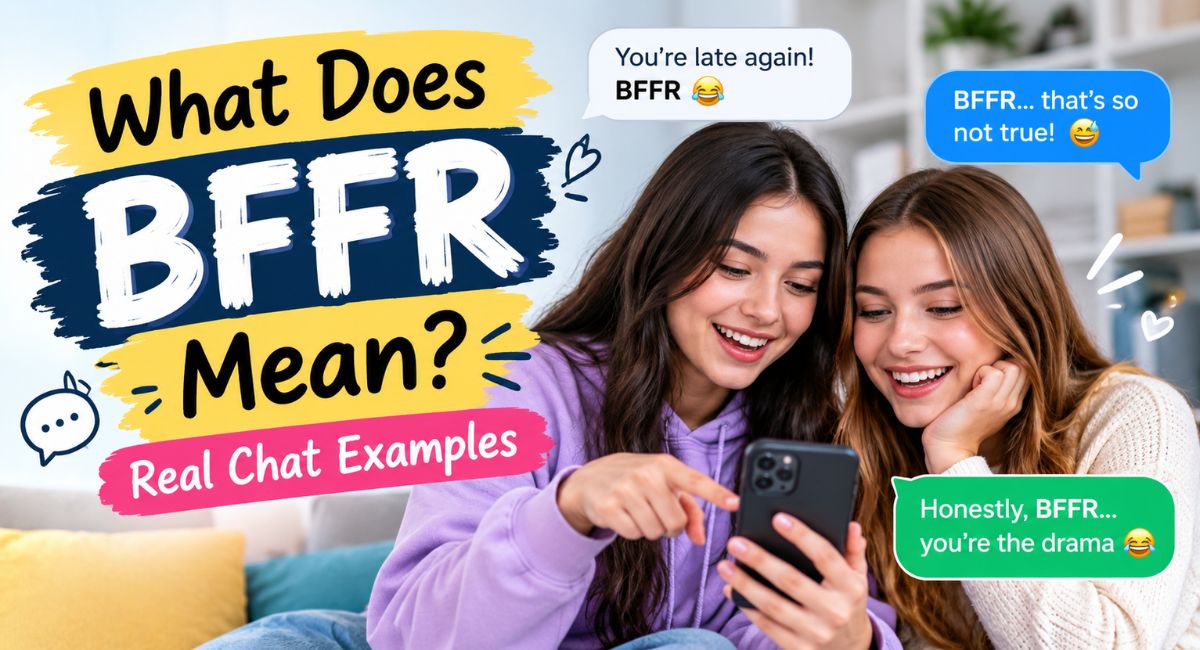
Real Chat Examples
Example 1 — Playful teasing (harmless)
Friend: “I literally ran a 5k before 7am today” You: “bffr 😭 you can barely wake up for class”
Lowercase, an emoji, and an existing joke between friends — this reads as light ribbing, not an accusation.
Example 2 — Genuine disbelief (still light)
Group chat: “the concert tickets are already $400 each” Reply: “BFFR that’s insane”
Caps here just add emphasis to shared shock — everyone in the chat is reacting the same way, so it doesn’t land as aimed at one person.
Example 3 — Confrontational (not playful)
Argument: “I never said that.” Reply: “BFFR. You literally sent a screenshot.”
Short, clipped, no emoji, used mid-disagreement — this version is calling someone out directly, and it can land as harsh.
The rule of thumb: BFFR read between friends reacting to something equally shocking is almost always playful. BFFR aimed at one specific claim during a disagreement, especially without softeners like emojis or lowercase, reads as a real challenge to someone’s honesty.
Grammar & Common Mistakes
- Capitalization: Lowercase “bffr” tends to read softer and more casual; all-caps “BFFR” adds intensity — this alone can shift a message from teasing to sharp.
- Punctuation: A trailing “BFFR” with no punctuation feels open-ended and lighter. “BFFR.” with a period reads more final and pointed — often the difference between a joke and a genuine callout.
- Common mistake: Using BFFR with someone you don’t know well. Since tone depends heavily on shared context and history, strangers or new acquaintances are far more likely to read it as rude than a close friend would.
- Common mistake: Using it in professional or semi-formal messages. Because the phrase is a censored version of profanity, even the clean form can come across as unprofessional in a work chat or email.
When to Use (and Avoid) BFFR
Good fits:
- Reacting to a shared, obviously exaggerated claim among friends
- Group chats where everyone’s reacting to the same surprising news
- Casual TikTok or Instagram comments on unbelievable content
Avoid it:
- Messages to coworkers, clients, or anyone in a professional context
- Conversations with someone you don’t know well — tone can easily be misread
- Mid-argument, unless you genuinely intend to challenge them directly
BFFR vs. Similar Slang
| Slang | Meaning | Intensity | Best Used |
| BFFR | Be For Real | High | Disbelief, calling out exaggeration |
| FR | For Real | Low-medium | Simple agreement or emphasis |
| NGL | Not Gonna Lie | Low | Prefacing an honest opinion |
| SMH | Shaking My Head | Medium | Disappointment or disbelief |
BFFR carries more intensity than FR specifically because of its censored-profanity origin — it’s built to sound stronger, even in its clean form.
Related Reads
What Does BFFR Mean? Tone Changes Everything: FAQs
What does BFFR mean? BFFR stands for “Be For Real,” a cleaned-up version of “Be F***ing For Real,” used to call out exaggeration or ask someone to be honest.
Is BFFR always rude? No. Between close friends reacting to something equally surprising, it usually reads as playful. Aimed at one person during a disagreement, it can come across as confrontational.
When did BFFR become popular? The abbreviation gained mainstream popularity around 2022, spreading quickly on TikTok and Twitter, though the underlying phrase “be for real” is rooted in AAVE and has been used for decades.
Should I use BFFR at work? No — because it’s a censored version of profanity, it’s best avoided in professional or formal messages.
Does capitalization change the meaning of BFFR? It changes the tone, not the meaning. Lowercase tends to read softer and more casual, while all-caps adds intensity and can feel more pointed.