
You get a message: “aight.”
Is your friend fine with the plan, or quietly annoyed? Same five letters, completely different messages. If English isn’t your first language, this is exactly the kind of word that causes awkward replies.
Here’s the good news. Once you know the grammar behind “aight”, the mood becomes much easier to read.
What Does “Aight” Mean?
Aight is an informal, nonstandard spelling of “alright” used in texting and speech to agree, accept, sign off, or sound unbothered. Grammatically it works as an interjection (“Aight, see you”) or a casual adjective (“I’m aight”). Tone depends on punctuation: “aight.” can sound curt, while “aight 😂” reads friendly.
That’s the short version. The rest of this guide covers what the definition alone doesn’t tell you.
How Do You Say and Spell “Aight”?
Most speakers say it as a quick “ite”, close to the end of “night”. Spelling varies a lot online, and all of these carry the same meaning:
- aight (the most common form)
- ight and aite (shorter, very casual)
- a’ight (with an apostrophe marking the dropped letters)
The apostrophe version is the only one that “shows its work” as a contraction of alright. In practice, most people skip it. Pick one spelling and stay consistent within your own writing.
The Grammar Behind “Aight” (The Part Most Guides Skip)
Dictionaries treat “aight” as a variant of alright, so it carries the same flexibility. That means it can play three different roles in a sentence.
1. As an Interjection (Most Common)
An interjection is a standalone reaction word, like “okay” or “well”.
- “Aight, I’ll text you when I’m there.”
- “Aight, that’s enough for today.”
Notice the comma. When “aight” opens a sentence as a reaction, writers usually separate it from what follows.
2. As an Adjective
Here it describes how someone or something is.
- “How was the movie?” “It was aight.” (so-so, not great)
- “I’m aight.” (I’m okay)
Important: as an adjective, “aight” often means average, not good. “The food was aight” is not a compliment. This is one of the easiest ways to misread it.
3. As a Tag Question
Placed at the end, it asks for confirmation.
- “I’ll pick you up at eight, aight?”
Here it works like “okay?” or “right?”. It invites a reply rather than giving one.
Real Chat Examples
Definitions don’t show tone. These three conversations do.
Chat 1: The Friendly Aight
Sam: Can we move dinner to 8?
Rida: aight 👍 see you there
Why it’s friendly: a lowercase “aight” plus an emoji and a continuing sentence. Warm and relaxed.
Chat 2: The Cold Aight
Zain: I forgot to book the tickets. Sorry.
Hira: Aight.
Why it’s cold: capital A, a hard period, no softener, and no follow-up. The reply ends the conversation instead of continuing it. In real life, this is often a sign to apologise properly or call.
Chat 3: The Tag-Question Aight
Coach: Practice starts at 6, aight?
Imran: aight, I’ll be there
Why it works: the coach’s “aight?” asks for confirmation, and Imran’s “aight” gives it. The same word does two jobs, depending on position.
Who Says “Aight” and When?
This is the “who says this and when” part that definition pages usually leave out.
Where it fits naturally:
- Texting with friends
- Voice chat while gaming
- Casual social media comments
- Quick in-person conversation between peers
Where it doesn’t fit:
- Job applications and work emails
- School essays or formal writing
- First messages to someone senior
- Customer support replies
A quick test: if you’d also be comfortable writing “yeah” or “nah” in that message, “aight” is probably fine. If not, switch to something more formal. If you need polished alternatives for professional messages, see our guide on other ways to say “this is noted”.
A Note on Origin
“Aight” is generally traced to African American English, where relaxed pronunciation naturally shortened “alright”. From there it spread through music, then online culture. If you’re learning English, you can freely understand and recognise it. Use it with peers where it fits your natural voice, and avoid forcing it into settings where it sounds like a performance.
Grammar Comparison Table
| Form | Part of Speech | Example | Register | Best Used |
| aight | Interjection, adjective, tag question | “Aight, let’s go.” | Very casual | Texts, voice chat |
| ight / aite | Same roles | “ight, bet.” | Very casual, shorter | Fast chats |
| alright | Adjective, adverb, interjection | “Alright, I agree.” | Neutral | Speech, relaxed writing |
| all right | Adjective, adverb | “The results were all right.” | Formal | Essays, reports |
| okay / OK | Adjective, adverb, interjection | “That’s okay.” | Neutral | Almost anywhere |
Note on alright vs all right: many style guides still prefer the two-word form in formal writing, even though one-word “alright” is widely used day to day.
Common Mistakes With “Aight”
These are the errors that cause real misunderstandings.
- Replying “aight” to something serious. If someone shares bad news or an apology, a one-word “aight” can feel dismissive. Add a sentence.
- Reading “it was aight” as praise. It usually means average.
- Ignoring punctuation. “aight” and “Aight.” are not the same message. A period and capital letter make it feel final.
- Using it in formal writing. It’s nonstandard, so keep it out of professional or academic work.
- Missing the tag-question use. “…aight?” at the end of a sentence is a question that expects an answer.
- Overusing capitals. “AIGHT” usually signals excitement or emphasis, and in some chats it reads as shouting.
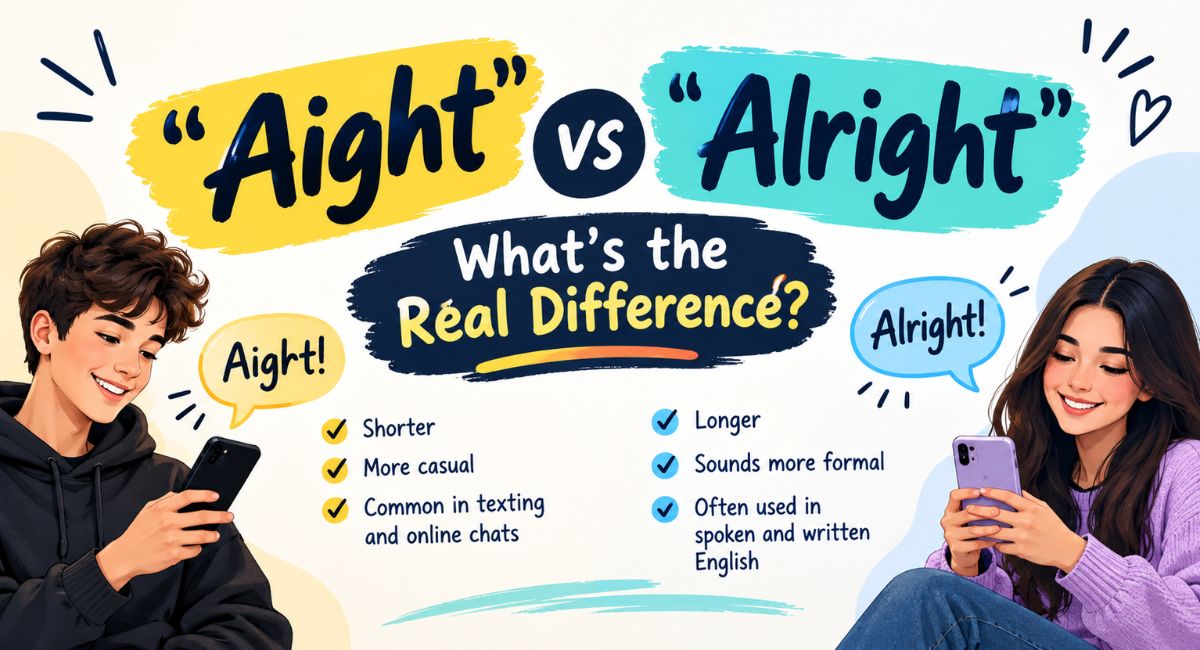
“Aight” vs “Alright”: What’s the Real Difference?
The meaning overlaps, but the social signal doesn’t. “Alright” works almost everywhere. “Aight” tells your reader you’re casual and relaxed, which is helpful with friends and risky with a manager.
So when you’re unsure, “alright” is the safer choice. If you’re replying quickly to a friend and want to match their style, “aight” is the more natural one.
How to Reply When Someone Sends “Aight”
Don’t guess. Read three signals first:
- Punctuation: a hard period suggests less warmth.
- Emoji or follow-up text: a smiley or extra words suggest friendliness.
- What came before: the same word after good news and after bad news means different things.
If it still feels off, ask directly: “Are you okay with that?” That simple question avoids most texting misunderstandings.
Related Reads
- TSSS Meaning in Text: another small sound-word where tone does all the work.
- Other Ways to Say “This Is Noted”: polished alternatives when “aight” is too casual.
Frequently Asked Questions
What does aight mean in a text?
It means “alright” or “okay”. It’s used to agree, accept a plan, or end a conversation casually. The exact feeling depends on punctuation, emoji, and what came before it.
Is aight a real word?
It’s recognised as an informal, nonstandard variant of “alright”. It’s real and widely used in speech and texting, but it isn’t suited to formal writing.
What does “I’m aight” mean?
It means “I’m okay” or “I’m fine”. It can also suggest “nothing special”, so it’s less enthusiastic than “I’m good”.
Is it rude to reply “aight”?
Usually no. But a short “Aight.” after serious or upsetting news can feel dismissive. Add a few words or an emoji to keep the tone warm.
Should I use aight in emails or essays?
No. Use “alright”, “all right”, or “okay” in professional and academic writing, and keep “aight” for casual chats with friends.
Final Thoughts
“Aight” looks simple, but its meaning shifts with grammar, punctuation, and context. Treat it as a mood signal, not just a synonym for “okay”. Check the punctuation, check what came before, and when in doubt, ask.