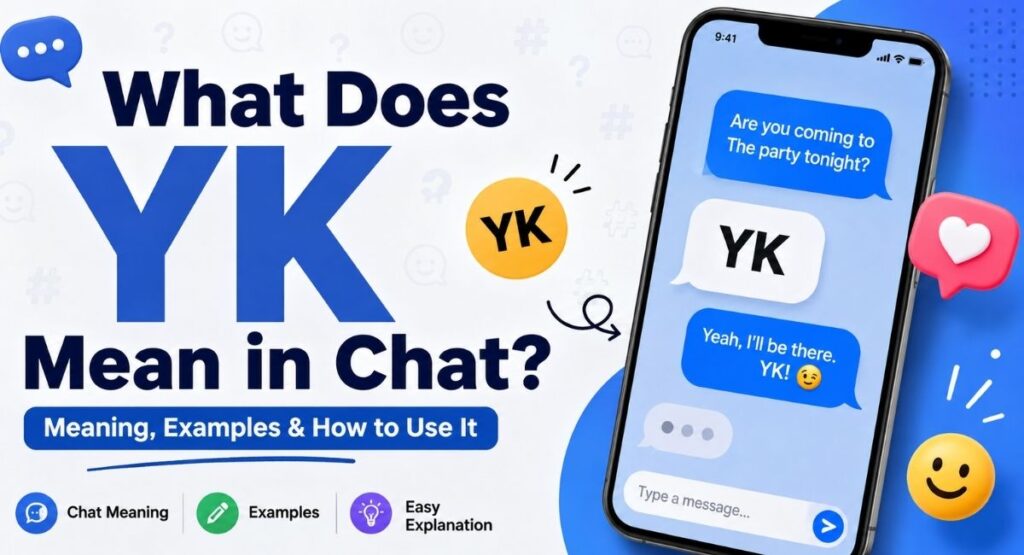
YK Mean : You’re mid-conversation on WhatsApp, and your friend drops: “I was so tired, yk.” No question mark, no explanation — just “yk,” sitting there at the end like it’s supposed to mean something.
If your first instinct was to Google it, you’re not alone. Thousands of people search yk meaning in chat every month, and most of them fall into two groups: casual texters who’ve seen it everywhere but never bothered to look it up, and English learners who genuinely want to understand why it’s used the way it is — grammatically, not just casually.
This guide covers both. We’ll break down what “yk” means, where it fits grammatically in a sentence, and how to use it (or avoid it) without sounding unsure of yourself.
What Does YK Mean in Chat? (Quick Answer)
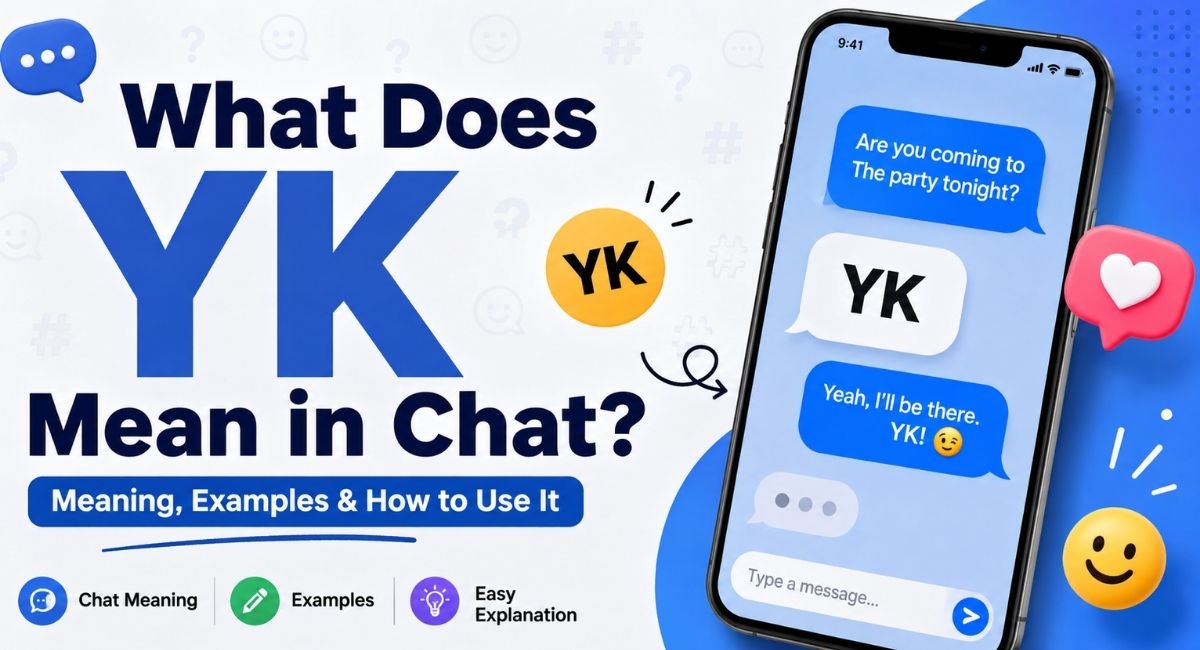
YK stands for “you know.” It’s an informal abbreviation used at the start, middle, or end of a sentence to make a message feel more like natural speech than a written statement.
- “Yk, I actually liked that movie.”
- “It’s just been a rough week, yk.”
- “I mean, yk, it’s complicated.”
It doesn’t add new information. Its job is purely tonal — it softens a statement and invites the reader to relate, almost like a nod you’d give someone while talking in person.
The Grammar Behind YK (This Is What Most Guides Skip)
Here’s the part that actually matters if you’re trying to write or text in correct English, not just recognize slang when you see it.
Grammatically, “yk” functions as a discourse marker — a short word or phrase that doesn’t change the meaning of a sentence but manages the flow of conversation. Other discourse markers you already know include “well,” “I mean,” “like,” and “you see.” “YK” is simply the texting shorthand version of one of these.
This matters for three reasons:
- “Yk” is never a complete sentence on its own. It has no subject or verb of its own — it borrows meaning entirely from the sentence it’s attached to. Typing “Yk.” by itself and expecting it to communicate something specific is a common mistake among newer English speakers.
- It doesn’t need to grammatically agree with anything. Unlike verbs or pronouns, discourse markers don’t conjugate or change based on tense, number, or subject — which is exactly why it feels so easy to overuse.
- Its punctuation changes its function, not its spelling. A comma before “yk” turns it into a soft afterthought. A question mark after it turns it into a tag question — a mini request for agreement, similar to “isn’t it?” in formal English.
Why This Trips Up English Learners Specifically
If English isn’t your first language, “yk” can be confusing precisely because it looks like it should carry meaning — the same way a real word does. But discourse markers behave differently from content words like nouns and verbs. They exist to manage tone, not to add information.
A practical way to check yourself: read the sentence out loud without “yk.” If it still makes complete sense, you’ve used it correctly. If removing it changes the meaning, you’ve probably confused it with a different abbreviation (more on that below).
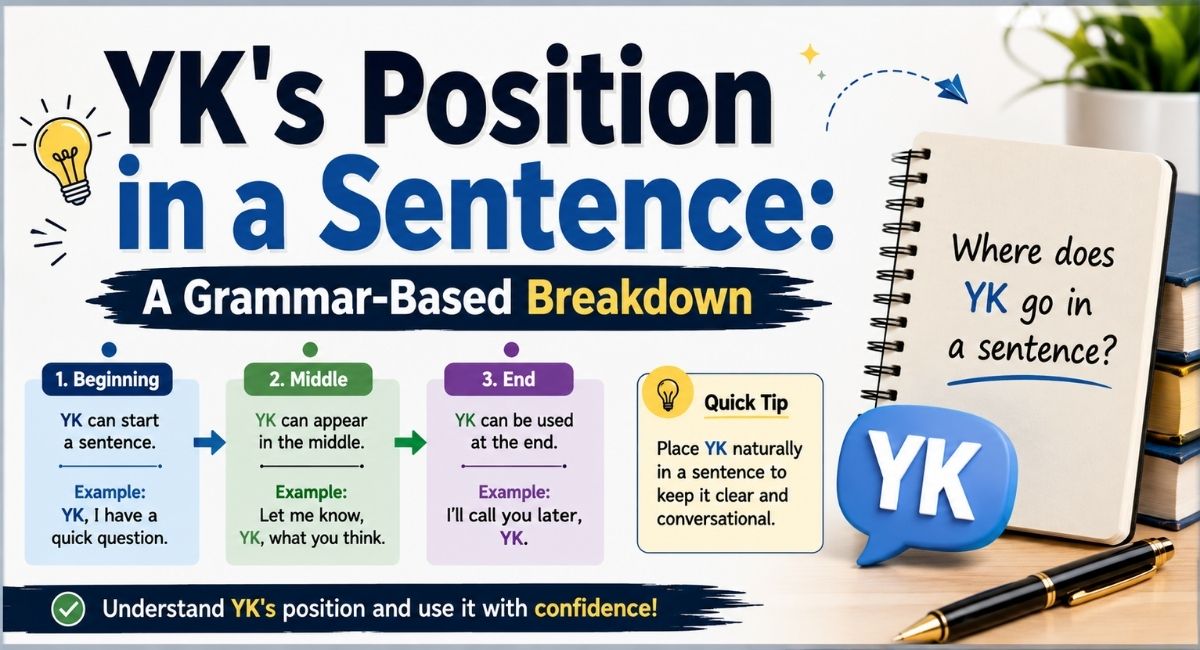
YK’s Position in a Sentence: A Grammar-Based Breakdown
| Position | Example | Grammatical Role | Punctuation Rule |
| Sentence-opening | “Yk, I wasn’t even mad.” | Introductory discourse marker | Followed by a comma |
| Mid-sentence | “It’s, yk, kind of a long story.” | Parenthetical filler | Set off by commas on both sides |
| Sentence-closing (statement) | “I just needed a break, yk.” | Closing tag, soft emphasis | Preceded by a comma, ends in period |
| Sentence-closing (question) | “That was wild, yk?” | Tag question, seeks agreement | Preceded by a comma, ends in question mark |
Notice that “yk” is almost always separated by a comma. Skipping the comma (“I just needed a break yk”) is technically incorrect and is one of the most common small grammar slips people make when texting quickly.
Correct vs. Incorrect Usage
| ✅ Correct | ❌ Incorrect | Why |
| “I’ve been stressed lately, yk.” | “I’ve been stressed lately yk.” | Missing comma before the discourse marker |
| “Yk, I think you’re right.” | “Yk I think, you’re right.” | Comma placed after the wrong word breaks sentence flow |
| “That test was brutal, yk?” | “That test was brutal, YK?” | All-caps changes tone to emphatic/blunt, not casual |
| “Honestly, yk, it’s fine.” | “Honestly yk it’s fine.” | Missing commas make it read as one run-on fragment |
Real-World Example: Where “YK” Gets Misread
A genuinely useful test case: in a customer-facing Instagram DM, a small business once replied to a complaint with “we hear you, yk.” The customer read it as dismissive rather than empathetic — because in a formal-adjacent context, a casual discourse marker can come across as brushing someone off rather than relating to them.
Why this matters: grammar correctness and tone appropriateness aren’t the same thing. “Yk” can be 100% grammatically fine and still be the wrong choice for the context. This is the real-world skill worth building — not just knowing what a term means, but knowing where it belongs.
When to Avoid YK Entirely
Skip it in:
- Job applications and cover letters
- Business or client emails
- Academic writing
- Customer service replies
- Any first-time professional conversation
In these settings, spell out “you know” only if it serves a purpose — otherwise, cut it completely. Formal writing generally avoids discourse markers altogether because they weaken directness.
YK vs. Similar Terms People Confuse It With
| Term | Full Meaning | Grammatical Function |
| YK | You know | Discourse marker / filler |
| IDK | I don’t know | Complete clause (subject + verb) |
| IK | I know | Complete clause (subject + verb) |
| YKWIM | You know what I mean | Discourse marker, extended form |
| JK | Just kidding | Modifier that cancels the prior statement |
| IYKYK | If you know, you know | Standalone idiomatic phrase |
The key grammatical difference: IDK and IK are full clauses with a subject and verb, so they can stand alone as a complete reply. “YK” cannot — it always needs a host sentence to attach to.
Frequently Asked Questions
What does YK mean in chat? YK means “you know.” It’s a casual discourse marker used to soften a statement or invite agreement, and it doesn’t add new information to the sentence.
Is “yk” a complete sentence? No. “Yk” has no subject or verb of its own, so it can’t function as a complete sentence — it always attaches to another statement for meaning.
Do you need a comma before “yk”? Yes, in standard usage a comma goes before “yk” when it closes a sentence, and after it when it opens one. Skipping the comma is a common but avoidable texting error.
Is YK the same as IDK? No. “IDK” (I don’t know) is a full clause and can stand alone as a reply. “YK” (you know) is a filler word that needs a host sentence to make sense.
Is it okay to use YK in a work email? No. “YK” is informal and should be avoided in professional writing — spell out “you know” only if it adds value, or remove it entirely.