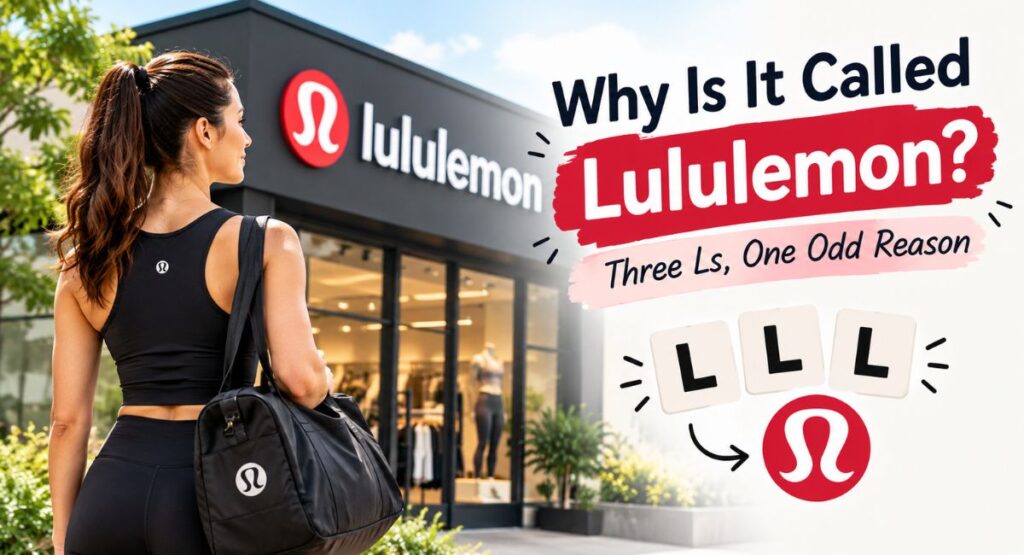
You have probably said it a hundred times without a second thought: loo-loo-LEM-on. Three Ls, a bouncy rhythm, and no obvious meaning.
It is not a place, a yoga term, or a founder’s surname. So why would a Vancouver apparel company choose it?
The answer starts with a skateboard brand and a hunch about Japanese shoppers, not with yoga. There is also a grammar twist that trips up even confident English speakers.
The Short Answer
Lululemon was named by founder Chip Wilson, who built the name around the letter L. He said an earlier brand appealed to Japanese buyers partly because it contained an L, so he planned a future name with three Ls. The word itself has no dictionary meaning; it is an invented brand name.
That is the verified core. The details below show how it happened and which parts of the retelling need care.
The Backstory: Before Lululemon Was Lululemon
Who Named It
Chip Wilson founded Lululemon Athletica in Vancouver in 1998. He opened the first dedicated store in the city in 2000.
Wilson was not new to apparel. He founded Westbeach, a surf, skate, and snowboard clothing company, in 1979 and sold it in 1997.
The name was not a committee decision. Wilson has said he came up with it himself while experimenting with words built around the letter L.
The Homeless Brand and the Japanese Market
Before yoga, Wilson had a skate-wear label called Homeless. In a 2004 interview with National Post Business, he explained why it sold well in Japan.
He said Japanese buyers liked it partly because the name contained an L, something he believed Japanese marketing firms would not invent for their own brands.
His thinking was simple. If one L helped, a future company with three Ls might earn three times as much.
In a 2022 podcast interview he added context. Large Japanese companies were giving their apparel American-sounding names, and young Japanese buyers read Homeless as an authentic North American name.
He also noted that Japanese interest in Homeless continued even after he had stopped using the brand.
What the Founder Actually Said (and What Got Added Later)
The Commercial Logic
Here is what the founder’s own accounts support:
- An earlier brand, Homeless, had real demand in Japan.
- In his view, the L in the name was part of its appeal.
- He compared the repeated-sound effect to alliteration, like Coca-Cola.
- He treated the name as a branding decision, not a meaningful word.
The Retelling
Over the years, the story got shorter and sharper. Some summaries say he chose the Ls because Japanese speakers find the L sound difficult.
That framing drew criticism, and many people found it disrespectful. It is also the version most likely to be repeated without context.
When asked about it again in a 2022 podcast, Wilson said the three Ls were exactly what the name was meant to be. He pointed to his book for the longer story.
What Has No Support
We found no founder statement linking the name to a Sanskrit word, a person called Lulu, or a lemon.
If you see those explanations online, treat them as guesses. A safe way to write about it is to report what the founder said, name the source and year, and let readers judge the framing.
Does “Lululemon” Mean Anything? A Grammar-First Look
A Proper Noun With No Dictionary Entry
“Lemon” is an ordinary noun, and “lulu” appears as informal slang and as a given name. Together they form a coined word, not a compound with a combined meaning.
Grammatically, Lululemon is a proper noun. It names one specific company, so it is capitalized in running text.
Capitalization: Logo vs. Sentence
The company stylizes its name in lowercase. Most style guides still capitalize brand names in running text, so in an essay, email, or article, write Lululemon.
Use lowercase only when you are quoting the brand’s own styling, such as in a logo description.
Possessives, Plurals, and Noun Adjuncts
- Possessive: Lululemon’s name has three Ls.
- Noun adjunct (no apostrophe): She bought a Lululemon jacket.
- Informal plural: “I bought new lululemons” is casual speech for the clothes. Avoid it in formal writing.
How to Say It
The usual pronunciation is LOO-loo-LEM-on. The stress falls on the first and third syllables.
Grammar Table: Right vs. Wrong Forms
| Form | Where it works | Example | Verdict |
| Lululemon | Essays, news, emails | “She works at Lululemon.” | Correct |
| lululemon | Brand logo and stylization | Logo or packaging | Stylized only |
| Lululemon’s | Possession | “Lululemon’s name has three Ls.” | Correct |
| Lululemon jacket | Noun adjunct | “A Lululemon jacket” | Correct |
| lululemons | Casual speech | “New lululemons arrived.” | Informal |
| Lulu Lemon | None | “Lulu Lemon store” | Misspelling |
| Lululemmon / Lulelemon | None | “Lululemmon leggings” | Misspelling |
A quick note on the question itself. “Why is it called Lululemon?” and “Why is it named Lululemon?” are both correct. “Called” is more conversational, and “named” is slightly more formal.
Real Chat Examples
Example 1: Group chat
Maya: wait why is it even called lululemon 😭
Sam: founder wanted a name with three Ls
Maya: that’s it?? no meaning?
Sam: none. it was built around the letter L, not around lemons
Example 2: Writing help
Dev: do I write “Lululemon’s” or “Lululemons” in my essay?
Priya: Possessive is Lululemon’s. “Lululemons” is just casual slang for the clothes.
Dev: and the logo is lowercase?
Priya: The brand styles it that way. In sentences, capitalize it.
Example 3: Work Slack
Lena: drafting a brand-naming slide. Can I say the name was designed to be hard for Japanese speakers to say?
Omar: Safer to say the founder tied it to the letter L and Japanese-market appeal, and that his framing drew criticism. Name the source and year.
Lena: ok, attributing it to him then
Common Mistakes (and Who Says What, and When)
- Treating it as a meaningful compound. Lulu plus lemon does not equal a hidden definition.
- Splitting it into two words. “Lulu Lemon” is a misspelling.
- Using an apostrophe for the plural. Write “lululemons” in casual speech, not “lululemon’s.”
- Presenting a contested claim as plain fact. Say “Wilson said” instead.
- Mixing registers. Use “Lululemon” in formal writing. Customers say “lulu” and “lulus” casually.
Who says what, and when:
- News and brand writing: Lululemon, capitalized.
- Customers and friends: “lulu” or “lulus” in chats and captions.
- Students and essay writers: Lululemon, with attribution for the origin story.
Why an Invented Name Works
Wilson himself called the name good branding through alliteration.
Our read is that a coined word has no competing dictionary meaning, so searching it brings up the brand. Repeated sounds like lu-lu are also easy to remember, which is a common point in brand naming.
Test Yourself
The quiz block below goes here. Paste it into a WordPress Custom HTML block.
Related Reads
FAQs
Why is it called Lululemon?
Founder Chip Wilson built the name around the letter L. He said an earlier brand appealed to Japanese buyers partly because it contained an L, so he planned a future brand name with three Ls. The name itself has no dictionary meaning.
Does Lululemon mean anything?
No. Lululemon is an invented brand name with no dictionary meaning. No founder statement links it to a yoga term, a person called Lulu, or lemons.
Who named Lululemon?
Chip Wilson named it. He founded the company in Vancouver in 1998.
Is Lululemon a real word?
It is a coined brand name and a proper noun, not a standard dictionary word, even though “lemon” is an ordinary English word.
How do you write the possessive of Lululemon?
Write Lululemon’s, as in “Lululemon’s name has three Ls.” For products, use it as a noun adjunct without an apostrophe, such as “a Lululemon jacket.”