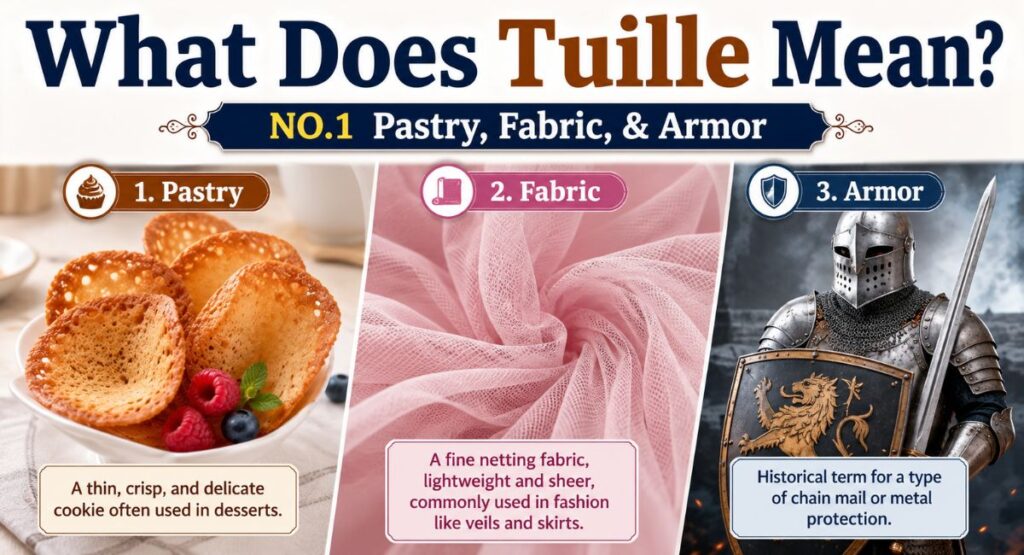
Tuille is a frequent misspelling of two distinct terms: tuile (a thin, crispy French cookie or garnish pronounced tweel) and tulle (a lightweight mesh netting used in bridal veils and tutus pronounced tool). Historically, a tuille also refers to a medieval armor plate protecting the thigh.
E-E-A-T Rich Outline
Decoding “Tuille”: Meaning, Origin
Whether you encountered the word on a high-end restaurant menu, inside a sewing pattern, or in a historical textbook, tuille almost always points to a minor spelling error.
In culinary contexts, adding an extra “l” turns the French pastry tuile into a typo. In fashion and textiles, mixing up the vowels turns tulle into tuille.
Here is how these terms break down side-by-side so you can quickly spot which one fits your context:
| Term | Correct Spelling | Pronunciation | Primary Industry | Primary Definition |
| Culinary Wafer | Tuile | TWEEL | Gastronomy / Baking | A thin, crispy cookie or savory lace garnish curved like a roof tile. |
| Netting Fabric | Tulle | TOOL | Fashion / Textiles | A fine, sheer hexagonal mesh fabric used for veils, tutus, and gowns. |
| Thigh Guard | Tuille (or Tuel) | TWEEL | Medieval History | An armored plate hanging from the waist to protect the upper leg. |
Real-World Context & Sentence Examples
Understanding how to use each word in context prevents miscommunications with bakers, dressmakers, or readers.
1. The Culinary Tuile (TWEEL)
Originating in France, a classic tuile gets its name from French roof tiles. Pastry chefs drape hot, freshly baked butter cookies over rolling pins to cool into curved shapes. Modern chefs also make savory, lace-like coral tuiles in hot oil to add crunch to appetizers.
- Correct Culinary Example: “The chef garnished the lemon sorbet with a golden almond tuile.”
- Incorrect Culinary Example: “She ordered a chocolate tuille with her ice cream.”
2. The Textile Tulle (TOOL)
Named after the French city of Tulle, this fine netting fabric gained fame when Queen Victoria wore it in 1849. Today, fashion designers use nylon, silk, or polyester tulle to build dramatic volume without adding heavy weight.
- Correct Fabric Example: “The veil required six yards of soft ivory tulle.”
- Incorrect Fabric Example: “Her ballet tutu was crafted from layers of tuille.”
Common Mistakes to Avoid
The main driver behind searches for tuille is phonetic confusion. Because both words originate from French and feature double consonants or muted vowels, English writers frequently combine elements of both words.
- The Double-L Trap: People often write tuille when they mean the cookie tuile, assuming French words require double Ls.
- The Phonetic Swap: People sound out tulle (tool) and accidentally insert an “i” because of similar words like “quill” or “guile”.
- Autocorrect Errors: Modern spellcheck tools occasionally auto-correct tuile to tuille or tulle depending on dictionary settings.
Pro-Tip: Memory Trick
Need a fast mental trick to keep your spellings straight?
The Taste vs. Touch Memory Rule:
- TUILE has 1 ‘L’ like Lick (it is food you eat).
- TULLE has 2 ‘L’s like Layers of Lace (it is fabric you wear).
FAQ
Is “tuille” ever a correct spelling?
Yes, but rarely in modern conversation. In medieval arms and armor, a tuille (also spelled tuel) refers specifically to a hinged thigh plate attached to a knight’s harness. In culinary or textile settings, it is considered an error.
How do you pronounce tuile vs. tulle?
Tuile (the crisp cookie) is pronounced TWEEL (rhymes with “wheel”). Tulle (the mesh fabric) is pronounced TOOL (rhymes with “rule”).
What is a savory tuile made of?
Savory tuiles usually consist of a simple emulsion of water, oil, flour, and salt. When poured into a hot pan, the water evaporates rapidly, leaving behind a delicate, edible lace pattern used to garnish savory dishes.