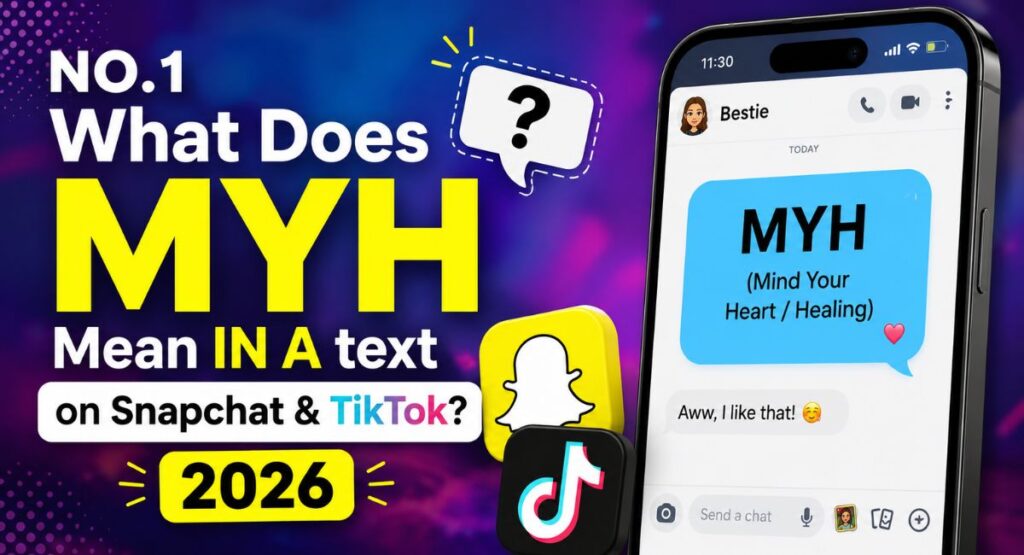
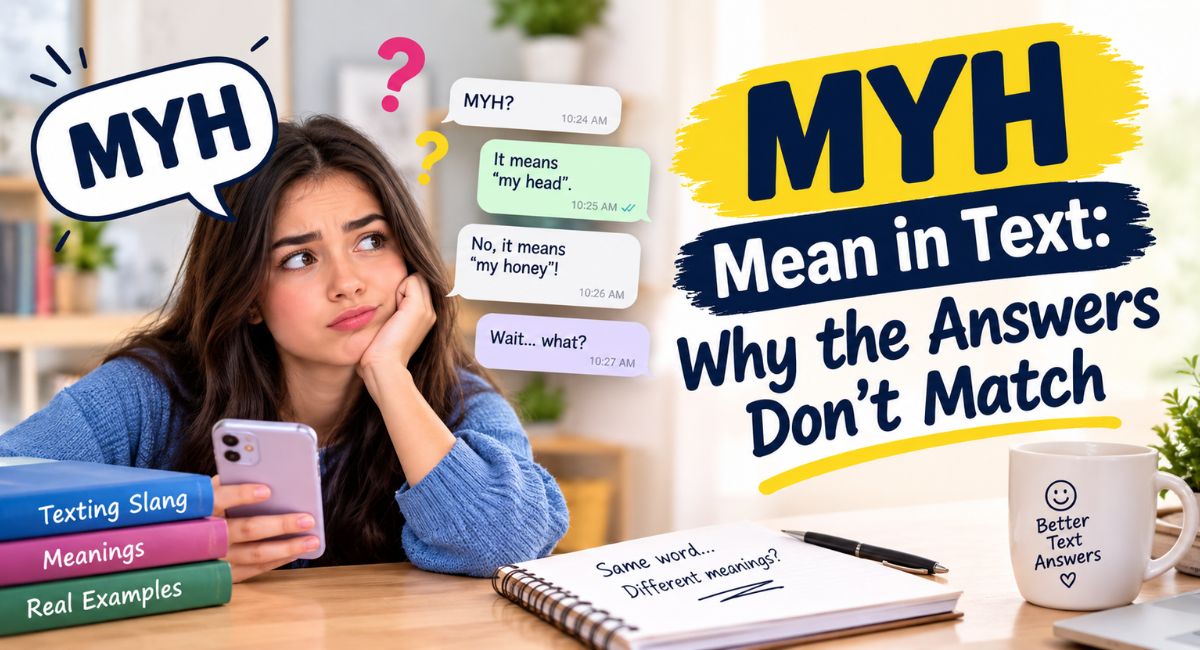
MYH Mean in Text: It is almost midnight and your phone shows one message: “myh 🥺”. No question, no context, just three letters and a pleading emoji. Then you search for it and Google offers science terms, a gene name, and a charity. None of that looks like your chat.
Quick answer: In a warm, personal chat, MYH is read as “miss your hug,” an affectionate way to say you want someone’s comfort or company. It is informal shorthand, not an official dictionary term, and search tools sometimes show science or health meanings instead, so the sender and the setting decide what it means.
This guide shows you how to read MYH by sender, what to reply, and the grammar that explains why it looks the way it does.
MYH Full Form in Texting: “Miss Your Hug” Explained
MYH follows the same pattern as short messages like IMY (“I miss you”). The sender drops “I” and compresses the rest: Miss Your Hug.
People use it to say three things at once:
- I am thinking about you.
- I want your company or comfort.
- I am saying it lightly, without a long message.
Because it is a casual abbreviation, there is no official rulebook. It lives in private chats, captions, and comments. If you are unsure, treat it as a warm message and confirm the meaning with the sender instead of guessing.
Why Google Shows Different Answers for MYH
If you searched “MYH” and saw unrelated meanings, you are not wrong. The same letters are used in several non-texting fields:
- MUTYH (formerly MYH): a gene name used in medical and genetics writing.
- Myosin heavy chain: a muscle protein; MYH is used as a symbol for the genes that make it.
- Muslim Youth Helpline: a UK charity support service.
These appear in medical, science, or charity contexts. A text from a friend with “myh” and an emoji is a different situation. Check where you saw it: a chat, a lab report, and a charity website are three different worlds.
Who Sent It? Reading MYH by Sender
The message is the same, but the right reading shifts with the relationship.
A partner
Warm and personal, often after a few days apart. Expect emojis like 🥺 or ❤️.
A close friend
Usually affectionate, often after a long gap or when someone is far away. It can also be support during a hard week.
A family member
Gentle and nostalgic, often after a trip or a goodbye.
Someone you barely know
Rare, and worth a clarifying question. It may be a friendly slip, a misunderstanding, or a shift in tone you did not expect.
What about “from a guy” or “from a girl”? The sender’s gender does not change the meaning. The relationship and the timing do. Read those two clues first.
4 Real MYH Chats (and the Best Reply for Each)
Chat 1: The long-distance partner
Ali: counting days till Friday 🥹 Sara: me too, myh so much
Best reply: “Aww, I miss you too. Three more days and I will give you the biggest hug.” Why: match the warmth and add a plan, which makes the message feel answered.
Chat 2: The friend who moved away
Noor: Wish we could hang out this weekend Mehak: i know it’s been forever, myh 🤗
Best reply: “Same! Let’s plan a video call this Sunday.” Why: affection plus a concrete next step keeps the friendship active.
Chat 3: The Roman Urdu mix
Zara: yaar myh 🥺 kab mil rahe hain?
Best reply: “Aww, mujhe bhi tumhari bohat yaad aa rahi hai! Is hafte milte hain.” Why: reply in the language they used and answer their question, not only the emotion.
Chat 4: The unexpected one
Colleague: myh! You: ?
Best reply: “Haha, thank you! Is everything okay?” Why: you stay polite and give them space to explain, without assuming anything.
Grammar Corner: Why MYH Looks the Way It Does
Why “your” and not “you”?
In “miss you,” the word “you” is the object: you miss a person. In “miss your hug,” “your” is a possessive that points to something that person gives: the hug. The sender is missing a specific thing, not just a person, which is why MYH feels more physical and warm than a plain “miss you.”
The dropped subject
Full sentence: “I miss your hug.” Texters drop “I” because it is obvious from context. That is common in casual writing and fine in chats, but it would be too informal in an essay or email.
MYH vs IMY vs ILY
| Abbreviation | Stands for | What it expresses | Typical closeness |
| IMY | I miss you | General longing | Friends, family, partners |
| MYH | Miss your hug (as read in warm chats) | Longing for comfort or company | Close relationships |
| ILY | I love you | Strong affection | Partners, close family |
Stretched spellings and punctuation
Variants like myhh or myh?? are common. A stretched spelling usually adds emotion or playfulness, and multiple question marks add urgency or teasing. Lowercase “myh” feels casual. In formal writing, spell the full sentence out.
Clues Hiding Around the Message
The three letters rarely work alone. Before you reply, scan what surrounds them:
- The emoji. Soft faces like 🥺 or 🤗 point to affection. A laughing emoji can mean the message is playful.
- The timing. A message after a goodbye, a trip, or a long silence fits a “miss you” reading. A message in the middle of a work thread does not.
- The last thing you said. If you just mentioned a plan or a distance (“see you Friday”), MYH is probably a reaction to that.
- How they usually write. Someone who always uses abbreviations is more likely to be casual than someone who writes full sentences.
If two or more clues point the same way, you can reply with confidence. If they disagree, use one of the safe replies above.
3 Safe Replies When You Are Not Sure
If you cannot tell the sender’s intent, pick one of these:
- Warm and neutral: “Aww, thank you! How are you doing?”
- Match and move on: “Miss you too! Let’s catch up soon.”
- Ask kindly: “That’s sweet! Just checking, what did you mean by MYH?”
The third option is fine. A short question is better than a wrong assumption.
When to Use MYH (and When to Skip It)
Good places: private chats with a partner, close friend, or family member, and affectionate comments on photos.
Skip it in: work emails, Slack, school messages, customer service chats, and first conversations with someone new. In those settings, write “I miss you” or leave the sentiment out.
A simple test: would you say “I miss your hug” to this person out loud, in this setting? If that sentence would feel strange, the abbreviation will feel just as strange in writing.
Common MYH Mistakes
- Assuming it is always romantic. Friends and family use it too.
- Trusting the first search result. Science meanings are not text meanings.
- Using it at work. It sounds overly personal.
- Replying with a cold “ok”. Match the warmth, even briefly.
- Writing “MY H” or “MYH’s”. Keep it as a single initialism.
Related Reads
- Seeing short abbreviations in comments? Read TT meaning on TikTok.
- Decoding another short text reply? See ING meaning in text.
FAQs
What does MYH mean in text?
In warm, personal chats, MYH is read as “miss your hug.” It is informal shorthand for wanting someone’s comfort or company. It is not an official dictionary term, so confirm with the sender if the context is unclear.
Is MYH romantic?
Not always. Partners use it, but so do close friends and family members. The relationship, the emojis, and the timing tell you more than the letters do.
What does MYH mean from a guy or a girl?
The sender’s gender does not change the meaning. Look at your relationship with the sender and the tone of the chat. If you are unsure, reply warmly and ask what they meant.
What is the difference between MYH and IMY?
IMY stands for “I miss you” and expresses general longing. MYH, as read in warm chats, is “miss your hug,” which points to a specific wish for comfort or closeness.
Why does Google show science meanings for MYH?
The same letters are used in science and charity contexts, such as the MUTYH gene (formerly called MYH), the myosin heavy chain protein, and the Muslim Youth Helpline in the UK. In a text chat, those meanings usually do not apply.