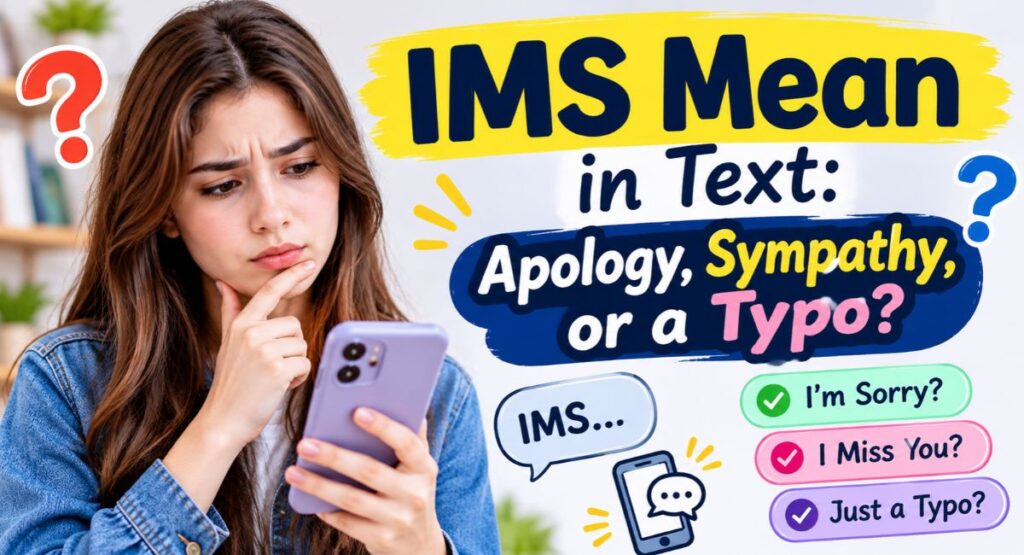
One letter separates “sorry” from “I miss you” in text slang, and a wrong guess makes for an awkward reply. IMS is the kind of abbreviation where the words around it matter more than the letters themselves.
IMS MEAN in text is most often listed as “I’m sorry,” a quick, casual apology. Some sources instead give “I miss you,” and that reading changes the whole message. The safest way to tell them apart is to look at what comes right after the three letters.
How “IMS” Is Built: A Contraction Plus One Initial
Most guides list the meaning and stop. The grammar explains the confusion.
IMS is not a clean acronym. It is described as a hybrid of an acronym and an abbreviation that stands for “I am sorry.” The “IM” part is the contraction I’m with the apostrophe dropped, and the “S” is the first letter of sorry.
Patterns you’ll see
- ims + for + noun or -ing: “ims for being late”
- ims + about + noun: “ims about the mix-up”
- ims + to hear + that: “ims to hear that” (sympathy, not apology)
- Stand-alone: “ims” with nothing after it
Capitals and punctuation
IMS is usually typed in lowercase, with no apostrophe and no full stops between the letters. Capitals (“IMS”) can read as stiffer or louder. That’s an observed pattern, not a fixed rule.
Common mistakes
Because the subject and verb are already inside the abbreviation, adding more of the sentence doubles it up.
- ❌ “I ims about that” (double subject)
- ❌ “ims sorry about that” (the S already means sorry)
- ✅ “ims about that”
Who sends it, and when
It’s casual-only: friends, close contacts, quick chats. In an email to a manager or a message to a teacher, write “I’m sorry” or “apologies.”
“Sorry” Does Two Jobs, and IMS Inherits Both
This is the part that changes your reply. In English, “I’m sorry” can mean:
- An apology: you did something wrong (“ims for the late reply”).
- Sympathy: you feel bad about something that happened to the other person (“ims to hear that”).
IMS carries both jobs, and the word after it tells you which one you have. Replying “no worries” to a sympathy message sounds odd. Replying “thank you” to an apology can sound like you’re skipping it. Match your reply to the job.
One Letter From IMU: When “ims” May Mean “I Miss You”
Some websites list IMS as “I Miss You.” The more usual abbreviation for that phrase is IMU, one letter away. So treat “I’m sorry” as the common reading, not the only one. If a message like “ims so much tonight” has no apology in sight, the sender may mean the second one, or may have mistyped IMU.
Other uses exist, but they’re not texting. In telecoms, IMS is the IP Multimedia Subsystem, and in business it can stand for Inventory Management System. You can ignore both when a friend sends it.
When unsure: ask. A short “sorry or miss you? 😄” costs nothing.
Three Example Chats, Three Different Replies
These are example conversations written for illustration, not real messages.
Chat 1: The small apology
[9:12 am] Dev: ims for the late reply, phone died
Best reply: “No worries! Hope it’s charged now 😄”
Why: A minor slip between friends calls for a light, quick answer. Anything heavier would feel odd.
Chat 2: The sympathy message
[6:40 pm] Ria: my grandma’s in the hospital
[6:41 pm] Sam: ims to hear that
Best reply (for Ria): “Thank you, that means a lot.”
Why: Sam isn’t apologising. This is sympathy, so “no worries” or “it’s okay” would miss the point.
Chat 3: The bare IMS after a fight
[11:48 pm] Kai: ims
Best reply: “Thanks for saying that. Can we talk tomorrow about what happened?”
Why: After a serious argument, three letters alone can feel thin. Acknowledge it, then ask for a real conversation instead of letting the abbreviation close the topic.
IMS vs IMU vs MB vs SRY: Which One Carries the Most Weight?
| Term | Stands for | Tone | Fits best |
| IMS | I’m sorry | Casual, can be warm | Friends, small slips, sympathy |
| IMU | I miss you | Affectionate | Close people |
| MB | my bad | Light, friendly | Minor mistakes |
| SRY | sorry | Very short, casual | Quick one-word apologies |
IMS is slightly more personal than MB. Neither is a substitute for a full apology when something real went wrong.
Five Situations, Five Replies
| What you got | Safe reply |
| Minor delay: “ims for the wait” | “No worries!” |
| Sympathy: “ims to hear that” | “Thanks, I appreciate it.” |
| Joking non-apology: “ims but I was right” | “Ha, noted 😄” |
| Bare “ims” after a serious issue | “Thanks. Can we talk about what happened?” |
| Unclear: IMS or IMU? | “Wait, sorry or miss you? 😄” |
Related Reads
- TIA, another courtesy abbreviation, explained
- A friendly follow-up after an apology: “how’s your day going?”
Frequently Asked Questions
What does IMS mean in text?
IMS is most often listed as “I’m sorry,” a quick, casual apology. Some websites list it as “I miss you” instead, so check the words around it to confirm.
Does IMS mean “I miss you”?
Sometimes, according to a few sources. The more usual abbreviation for “I miss you” is IMU, so a message with no apology in it could be either IMS or a mistyped IMU. If unsure, ask.
Is IMS the same as IMU?
No. IMS is usually read as “I’m sorry,” and IMU as “I miss you.” They are one letter apart, which is why people mix them up.
How do I reply to IMS?
Match the type of “sorry.” For an apology, a light “no worries” works for small things. For sympathy (“ims to hear that”), say “thank you.” After a serious issue, acknowledge it and ask to talk.
Is IMS okay to use at work?
No. IMS is casual slang. In professional messages, write “I’m sorry” or “apologies” in full.