Well Said Meaning: When a text notification pops up with an incredibly insightful point, or a colleague perfectly captures a complex idea in a Slack channel, your instinct is to acknowledge it. But typing out a paragraph feels like over-engineering, while a simple “I agree” feels dry and clinical.
That’s where “Well said” shines. It is short, impactful, and signals both agreement and respect.
Despite its ubiquity, many internet users, content creators, and corporate professionals hesitate before hitting send. Is it grammatically correct? Is it too informal for a LinkedIn comment? Does Gen Z use it, or is it considered “boomer speak”? Let’s break down the exact meaning, the underlying grammar, and how this timeless expression functions across different contexts today.
What Does Well Said Meaning?
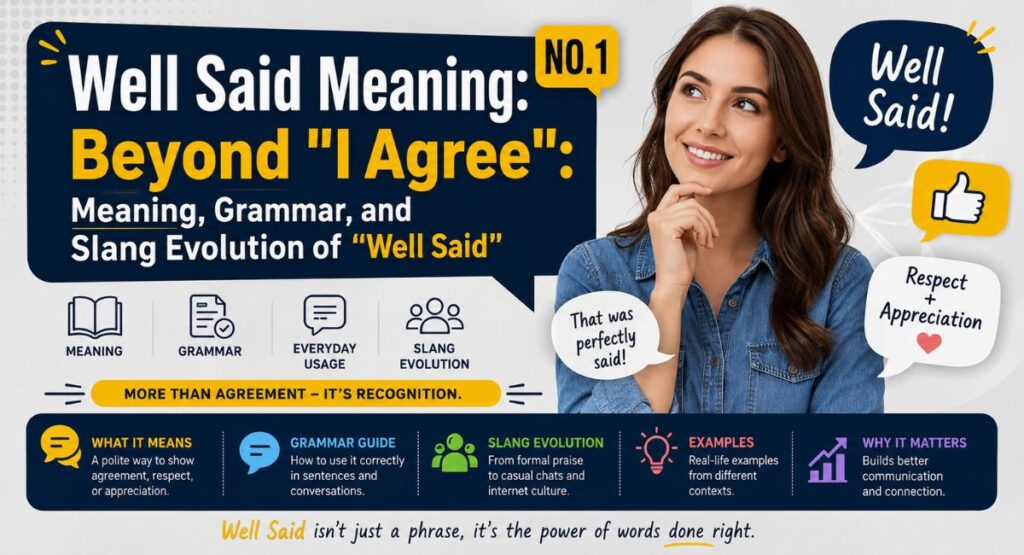
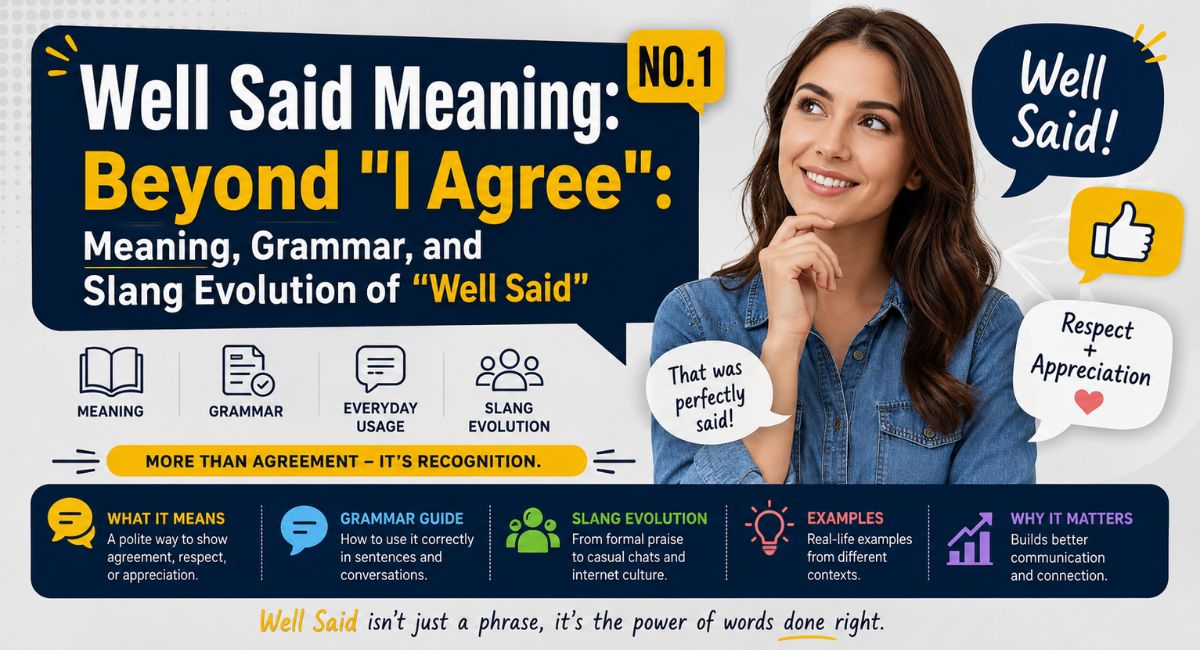
At its core, “well said” is a phrase of praise and validation. It communicates that an idea or argument was expressed with exceptional clarity, elegance, or emotional resonance.
Crucially, “well said” is not a synonym for “I agree.” The distinction lies in what you are praising:
- “I agree” focuses entirely on the substance of the argument (you share the same opinion).
- “Well said” focuses on the delivery and execution of the argument (you admire how it was communicated, regardless of whether you completely align with the worldview).
The Takeaway: When you use this phrase, you aren’t just giving a nod to a concept; you are giving a micro-complaint to the writer or speaker for their linguistic precision.
The Grammar Breakdown: Why It Works
If you’ve ever paused to wonder if “well said” is technically incorrect because it lacks a subject and a verb, you’re looking at an elliptical expression. This is a perfectly legal linguistic shortcut where words are omitted because context fills them in automatically.
When you say “well said,” your brain is short-circuiting the full sentence: “[That was] well said.”
Why It’s “Well” and Never “Good”
The grammar rules dictate that adverbs modify verbs, while adjectives modify nouns.
- Said is the past participle of the verb to say.
- Well is an adverb. Therefore, “well” correctly modifies how the action of saying was completed.
- Good is an adjective. Saying “Good said” is grammatically broken because an adjective cannot modify a verb form.
| Expression | Grammatical Status | Linguistic Reason |
| Well said | ✅ Grammatically Correct | Adverb (“well”) modifies the verb form (“said”). |
| Good said | ❌ Grammatically Incorrect | Adjective (“good”) cannot modify a verb form. |
| Nicely put | ✅ Grammatically Correct | Adverb (“nicely”) modifies the verb form (“put”). |
Workplace Context vs. Digital Slang: Where Does It Fit?
The beauty of the phrase is its fluidity. It sits squarely in the middle of the formality spectrum, making it a valuable tool for both corporate ecosystems and fast-paced digital spaces.
1. In the Workplace (Slack, Teams, LinkedIn)
In professional settings, the phrase is an excellent, low-friction way to show alignment without creating unnecessary digital noise. If a colleague outlines a brilliant project pivot, responding with “Well said, Sarah. Let’s run with that strategy” shows efficient leadership and team validation.
2. On Social Media & Gen Z Culture (X, TikTok, Reddit)
While “well said” is widely understood online, digital slang moves quickly. For text-savvy individuals and Gen Z, the phrase can sometimes carry a slightly older, formal tone. Depending on the platform, online subcultures often swap it out for punchier alternatives:
- “Facts” or “No lies detected”: The ultimate digital stamps of objective agreement.
- “Louder for the people in the back”: Used when someone expresses an important societal or cultural truth elegantly.
- “You dropped this 👑”: Highly visual social media praise for an excellent commentary or take.
What Most Guides Miss: The Hidden Nuances & FAQs
Many grammar blogs look at “well said” purely through the lens of a textbook. In reality, modern communication is messy, tone is easily misconstrued, and digital execution matters.
Can “well said” sound sarcastic?
Yes, absolutely. In digital spaces, brevity can easily be interpreted as passive-aggression or sarcasm if it stands alone. If someone posts a long, emotional, or highly detailed paragraph and you reply with only two words—”Well said.”—it can feel dismissive, as if you didn’t take the time to engage.
- The Fix: Pair it with a specific call-out. “Well said—especially your point about changing the team metrics.”
Is it appropriate for formal academic or legal writing?
No. While it is brilliant for conversational and business-casual communication, it is an elliptical phrase (a fragment). Academic journals, legal briefs, and formal corporate whitepapers require explicit, fully structured syntax. Instead of “well said,” use: “The argument was articulated with precision” or “The data was clearly presented.”
What is the structural difference between “Well said” and “Well done”?
Though they sound identical, they praise entirely different domains of human effort:
- Well said praises communication (the formulation of words).
- Well done praises execution (the completion of an action, task, or physical goal).
Contextual Alternatives: How to Swap It Out
To keep your communication sharp and avoid overusing a single phrase, tailor your response to the environment.
For Professional Emails & Presentations
- “That was exceptionally well-articulated.”
- “Thank you for framing that issue so clearly.”
- “You hit the nail on the head regarding our Q3 goals.”
For Fast Casual Texts & Comment Sections
- “Spot on.”
- “Couldn’t have put it better myself.”
- “Exactly this.”
Final Verdict
Is it correct to say “well said”? 100% yes. It is grammatically clean, professional, yet punchy enough to survive in modern text threads. Just remember to use it when you actually admire how someone brought an idea to life. In a digital world crowded with filler words, a well-timed “well said” delivers maximum impact with minimal effort.