You’re scrolling through comments and someone’s dropped a single “W” under a video. No sentence, no explanation, just one letter. If your first thought was “W… as in, what?” — you’re not the only one who’s had to Google it mid-scroll.
Here’s the thing most guides won’t tell you: knowing that “W” means “win” is only half the picture. The other half — the part people actually mess up — is how to use it correctly in a sentence, when to capitalize it, and where the punctuation goes. That’s what this guide actually fixes.
What Does “W” Mean?
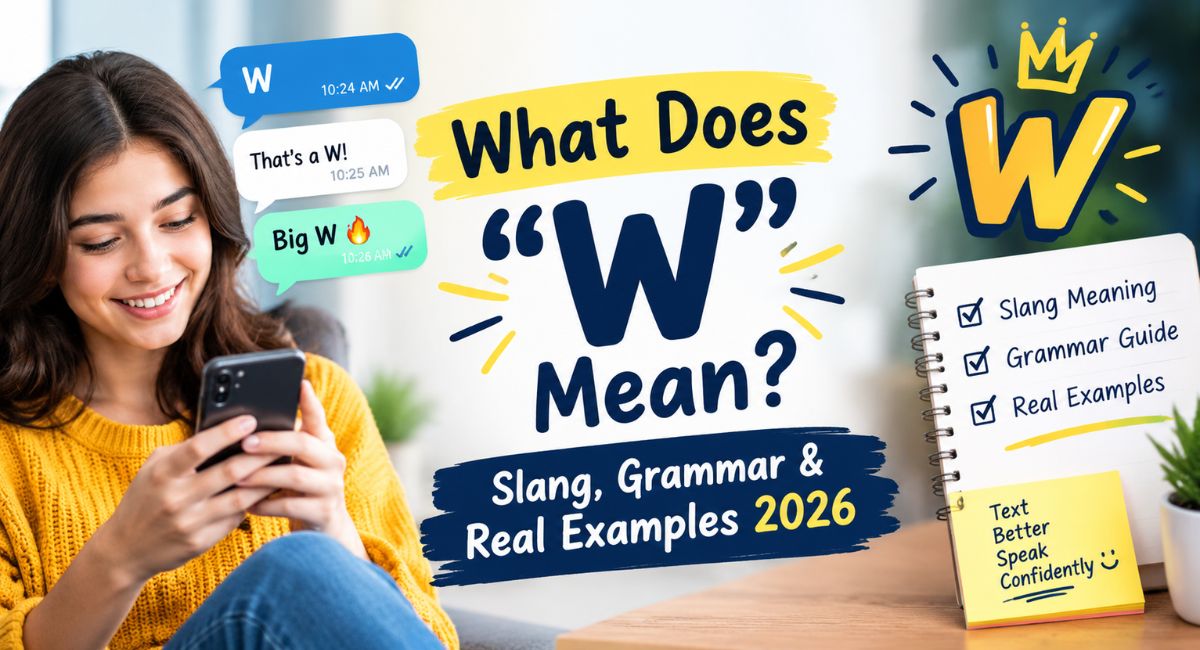
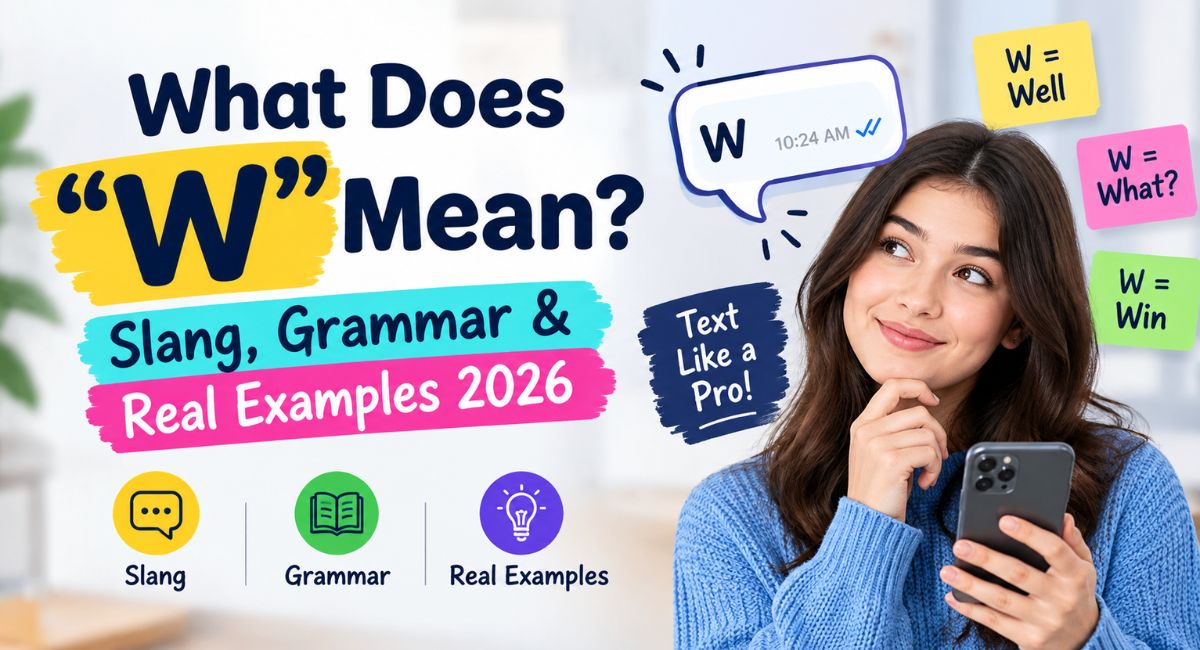
“W” is internet slang for “win.” It’s used to celebrate a success, praise something impressive, or show approval of a situation, person, or post.
- Part of speech: Interjection (sometimes used informally as a noun)
- Pronunciation: Said as the letter name — “double-u” — not spelled out
- Formality level: Casual / informal only — never appropriate in professional writing
- Quick example: “You got the internship? W!”
If someone texts you a lone “W,” they’re telling you something good just happened — nothing more complicated than that.
The Grammar Nobody Explains: Is “W” a Noun or an Interjection?
This is where meaningbyte.com’s readers usually get stuck, and it’s worth slowing down for.
“W” functions as an interjection most of the time — a standalone exclamation that doesn’t need a subject or verb to make sense, similar to “Nice!” or “Wow!” You can drop it into a chat on its own, and it still communicates a complete thought.
But “W” can also act like an informal noun when it follows an article or possessive:
- “That’s a W.” (noun usage — “a” signals it’s being treated as a countable thing)
- “This is his biggest W this year.” (noun usage)
- “W!” (interjection usage — standalone reaction)
Knowing this difference matters if you’re writing captions, replies, or content where grammar consistency actually shows up to readers — even casual writing reads cleaner when the structure is intentional rather than accidental.
Capitalization Rules: Should You Write “w” or “W”?
Here’s a rule of thumb that most slang guides skip entirely:
- Lowercase “w” is standard in casual texting, especially mid-sentence: “ngl that’s a w move”
- Uppercase “W” is more common when it’s standalone or meant to carry more emphasis: “W.”
- “W” in all caps with punctuation (“W!!!”) signals stronger enthusiasm — this is a stylistic choice, not a grammar rule, but it’s consistent across how people actually type it
There’s no strict grammatical requirement either way since this is informal internet language, not formal English — but consistency within your own writing makes captions and replies look more intentional rather than typo-prone.
Common Mistakes People Make With “W”
These are the actual errors that trip people up, based on how “W” gets misused in real conversations:
- Confusing it with “why” or “what.” A lone “w?” as a question is genuinely ambiguous — readers can’t always tell if you mean “win” or you’re asking a question starting with W and got cut off.
- Overusing it in professional contexts. “W” reads as unprofessional in work Slack, email, or LinkedIn comments — save it for casual chats and social platforms only.
- Autocorrect interference. On iPhone and some Android keyboards, a standalone lowercase “w” sometimes gets autocorrected or predictive-texted into a full word like “with” or “we” if you’re typing fast — this is a real, common frustration for people who use “W” often and don’t realize why their message changed after sending.
- Pairing it with the wrong tense. “That was a W” (past) versus “That’s a W” (present) both work, but mixing tenses mid-sentence (“That is a W yesterday”) is the kind of small grammar slip that’s easy to miss when typing quickly.
Where Did “W” Come From?
“W” as slang for “win” traces back to competitive gaming and sports scoreboards, where “W” and “L” have marked wins and losses for decades before the internet got involved. Gamers carried the habit into in-game chat and post-match lobbies, it spread to Twitch and Discord during livestreams, and from there it moved into TikTok and Instagram comment sections as creators and viewers brought gaming habits into mainstream social media.
How “W” Is Used Across Different Apps
| Platform | Typical Tone | Example |
| Personal, warm | “You helped him move? W ❤️” | |
| Public hype, comment culture | “This edit is a W 🔥” | |
| TikTok | Fast, reactive praise | “W video fr” |
| Snapchat | Playful, lightweight | “W reply, lol” |
| Discord/Gaming chats | Original, literal | “GG, that’s a W team” |
Public platforms like TikTok and Instagram tend to use “W” as a badge for strangers’ content — almost a public thumbs-up. Private chats like WhatsApp lean warmer and more personal, since it’s usually between people who already know each other.
“W” vs “L”: The Opposite Pair
- W = Win, success, approval
- L = Loss, failure, disappointment
- Dub = informal variant of “W” (comes from how “W” sounds when said aloud)
Grammatically, both “W” and “L” function the same way — interjections that can also act as informal nouns (“a W,” “an L”).
What “W” Does NOT Mean
- It’s not short for “what,” “why,” or “wow” — even though it’s sometimes used in a similarly excited tone
- It’s not always a typo — context usually makes the “win” meaning clear
- Outside slang, “W” still has its older meanings: Watt (electrical power), West (compass direction), and “w/” as shorthand for “with”
Quick Reference Summary
- Meaning: Win / success / approval
- Part of speech: Interjection, sometimes informal noun
- Case: Lowercase mid-sentence, uppercase standalone
- Formality: Casual only — avoid in professional writing
- Common error: Confusing with “what/why,” or autocorrect changing it mid-message
FAQs
1. What does “W” mean in text? “W” means “win” — used to celebrate success, praise something, or show approval in casual chats and social media.
2. Is “W” a noun or an interjection? It’s mostly used as an interjection (a standalone exclamation), but it can act as an informal noun when paired with an article, like “a W.”
3. Should “W” be capitalized? There’s no strict rule — lowercase is common mid-sentence, while uppercase is typical when it’s used as a standalone reaction for extra emphasis.
4. Why does my phone change “w” to another word? Predictive text and autocorrect can override a standalone lowercase “w” with a full word like “we” or “with” if you’re typing quickly — this is a keyboard behavior, not a spelling rule.
5. Is it okay to use “W” in professional messages? No — “W” is casual internet slang and generally reads as unprofessional in work emails, Slack, or formal writing.