You’ve probably typed it a hundred times without thinking. But someone sends you “ttyl,” and suddenly you’re wondering: is this a warm goodbye, a polite brush-off, or a promise?
The answer depends less on the letters and more on the context around them. Let’s break it down.
Quick Answer
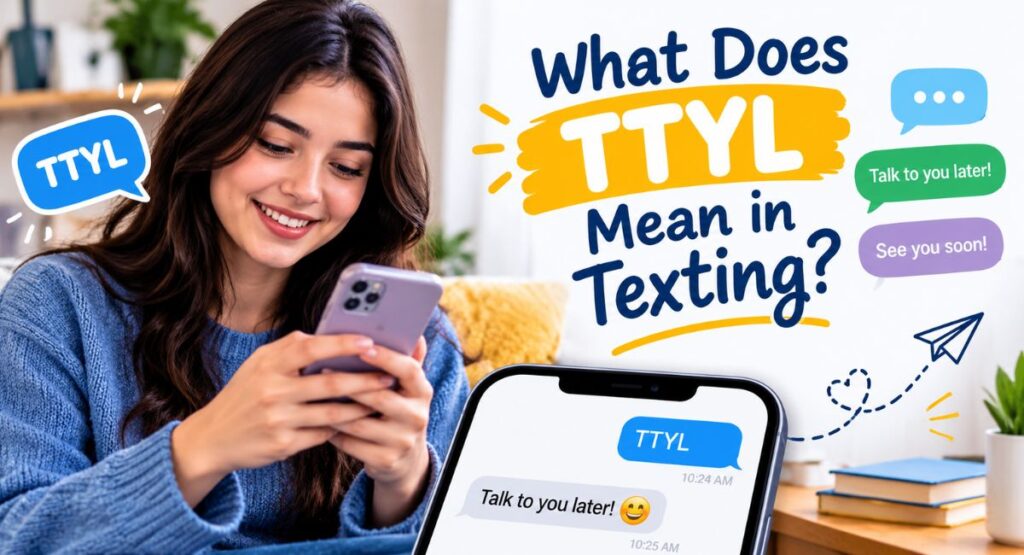
TTYL stands for “talk to you later.” It’s an informal closing used in texts, chats, and social media to end a conversation with the expectation that you’ll speak again. It doesn’t promise a specific time, which is why its tone can change with context.
What Does TTYL Mean in Texting?
TTYL is shorthand people use to wrap up a chat without it feeling abrupt. Instead of typing “I have to go now, but we’ll speak again soon,” you send four letters and move on.
It belongs to the family of chat abbreviations that grew out of early instant messaging and SMS, when typing was slow and message length was limited. It has stayed popular because it solves a real social problem: leaving a conversation politely.
Notice what it does not say. It doesn’t name a time, and it doesn’t ask for a reply. That vagueness is the whole reason the same four letters can feel friendly in one chat and cold in another.
Who Says TTYL, and When?
Here’s a practical way to read it:
- Close friends: A relaxed sign-off. “Gotta run, ttyl!” simply means “I’ll catch you later.”
- Colleagues on chat: Acceptable in casual team channels, but less common in formal threads.
- Someone you’re dating or newly talking to: Can feel warm, or can feel like a soft exit, depending on whether a plan follows it.
- Parents, teachers, or clients: Usually safer to write the full phrase.
A good rule: if you wouldn’t say “catch you later” to that person out loud, don’t send them “ttyl.”
Real Chat Examples
Definitions only help so much. Here is how TTYL actually appears in conversation.
Example 1: The friendly sign-off
Maya: Omg the movie was so good
Zara: Right?? I have to leave for class though
Zara: ttyl, will send you the memes tonight!
Maya: haha okay bye!
What’s happening: A clear reason, a specific follow-up, and an exclamation mark. This is a warm TTYL.
Example 2: The soft brush-off
Sam: Hey, are you free this weekend?
Jordan: not sure yet
Jordan: ttyl
Sam: …okay
What’s happening: No reason, no plan, no punctuation, and a question left unanswered. Here TTYL reads as “I’m done with this conversation for now.” Sam’s pause shows how easily it can land cold.
Example 3: The workplace chat
Lead: Can you share the draft by 5?
Ali: Yes, will do. In a meeting now, will send it shortly. Talk to you later.
Lead: Great, thanks.
What’s happening: Ali used the full phrase instead of “ttyl.” In a task-focused work message, spelling it out sounds more professional.
The Grammar Behind TTYL
This is where most explanations stop short, so let’s go further.
Is TTYL an Acronym or an Initialism?
Technically, TTYL is an initialism, not an acronym. An acronym is pronounced as a word (like NASA). An initialism is pronounced letter by letter (like FBI). Nobody says “tittle.” People either say each letter aloud or just say the full phrase. In practice, most people use the word “acronym” for both, so you’ll see it either way online.
What Part of Speech Is It?
TTYL isn’t a single word with a fixed part of speech. It stands in for a full clause, “(I will) talk to you later,” so it works as a closing expression, similar to an interjection like “goodbye” or “see you.” The subject “I” is dropped, which is normal in casual speech and writing.
Capitalization and Punctuation
- ttyl (lowercase) is the most common and sounds relaxed.
- TTYL (uppercase) is just as correct, though it can feel a little more emphatic or old-school.
- A period isn’t needed. An exclamation mark adds warmth. Ellipses (“ttyl…”) can sound hesitant or sulky.
Formal vs. Casual Use
| Context | Use “ttyl”? | Better option |
| Text to a friend | Yes | ttyl! |
| Casual team chat | Usually fine | Talk soon / ttyl |
| Email to a client | No | Speak with you soon |
| School or job application | No | Looking forward to speaking |
| Message to a senior or stranger | Avoid | Talk to you later |
| Social media comment | Yes | ttyl |
Common Mistakes People Make with TTYL
Even a four-letter abbreviation has traps. Here are the ones we see most.
- Using it in formal writing. Abbreviations signal casualness. Save them for informal chats.
- Assuming it sets a time. “Later” could mean an hour or a week. If a timeframe matters, say it.
- Mixing it up with similar abbreviations. TTYS means “talk to you soon,” and TTYT means “talk to you tomorrow.” They imply different timelines.
- Using it to end a heated or serious conversation. Dropping “ttyl” in the middle of an argument can feel dismissive.
- Over-explaining with the abbreviation. “ttyl later” is redundant, since “later” is already in the phrase.
How to Reply to TTYL
You don’t have to reply, but a short answer is polite. Match the tone you received:
- Friendly: “ttyl!”, “Bye, talk soon!”, “Catch you later!”
- Neutral: “Okay, talk later.”
- If you want a specific plan: “Sure, ttyl. Call me tonight?”
- If it felt like a brush-off: Don’t overthink it. Let it sit, and follow up later if it matters.
TTYL vs. Similar Chat Sign-Offs
| Abbreviation | Meaning | Feels like |
| TTYL | Talk to you later | General, open-ended |
| TTYS | Talk to you soon | A bit closer in time |
| TTYT | Talk to you tomorrow | Specific |
| BRB | Be right back | Short pause, not an exit |
| GTG | Got to go | A direct exit |
| TTFN | Ta-ta for now | Playful, old-fashioned |
The difference to remember: BRB means you’re coming right back, while TTYL means the conversation is over for now.
Is TTYL Rude?
Not by itself. TTYL is a neutral, widely understood sign-off. It becomes rude only when it replaces an answer someone is waiting for, or when it ends a serious conversation too abruptly.
If you want to be considerate, add one small detail: a reason (“heading into a meeting”) or a plan (“ttyl, call you at 8”). That tiny addition turns a vague closing into a clear, kind one.
Quick Recap
- TTYL = talk to you later.
- It’s an informal initialism that closes a conversation.
- Tone depends on context: reason, plan, punctuation, and relationship.
- Avoid it in formal writing; use the full phrase there.
- Don’t confuse it with TTYS, TTYT, or BRB.
Related Reads
FAQs
What does TTYL mean?
TTYL means “talk to you later.” It is an informal way to end a chat while signaling you’ll speak again.
Is TTYL an acronym?
Strictly, it’s an initialism, because each letter is pronounced separately rather than read as one word. In everyday use, people call it an acronym too.
How do you reply to TTYL?
Match the tone. “Talk soon!” or “ttyl!” works for friendly chats. If you want a plan, add one, like “ttyl, call me tonight?”
Can I use TTYL in a professional email?
It’s best avoided. Write “talk to you later” or “speak soon” instead, since abbreviations can seem too casual in formal contexts.