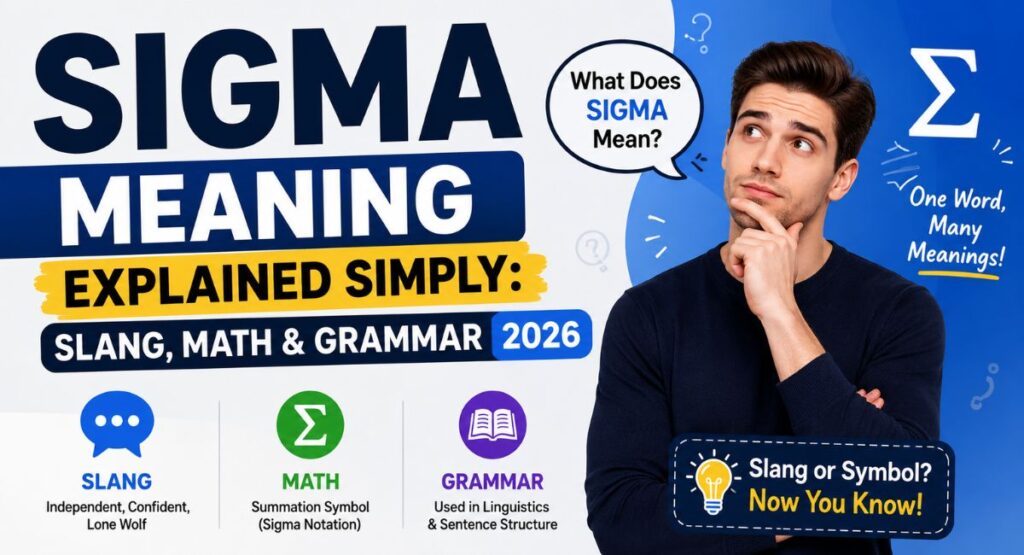
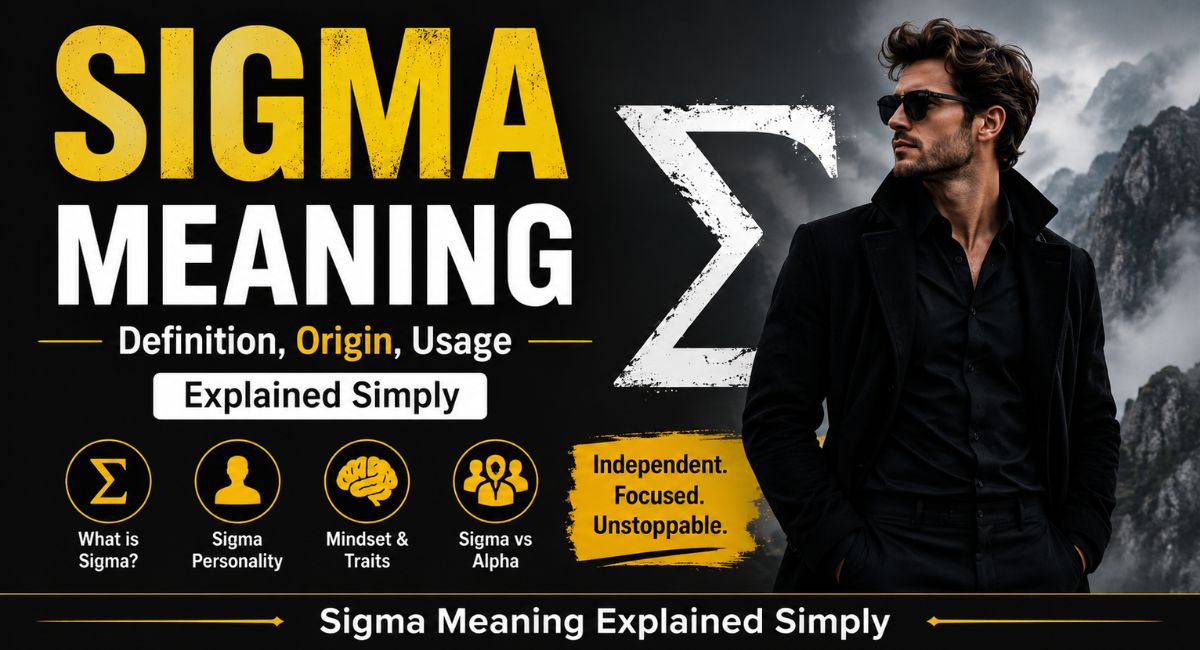
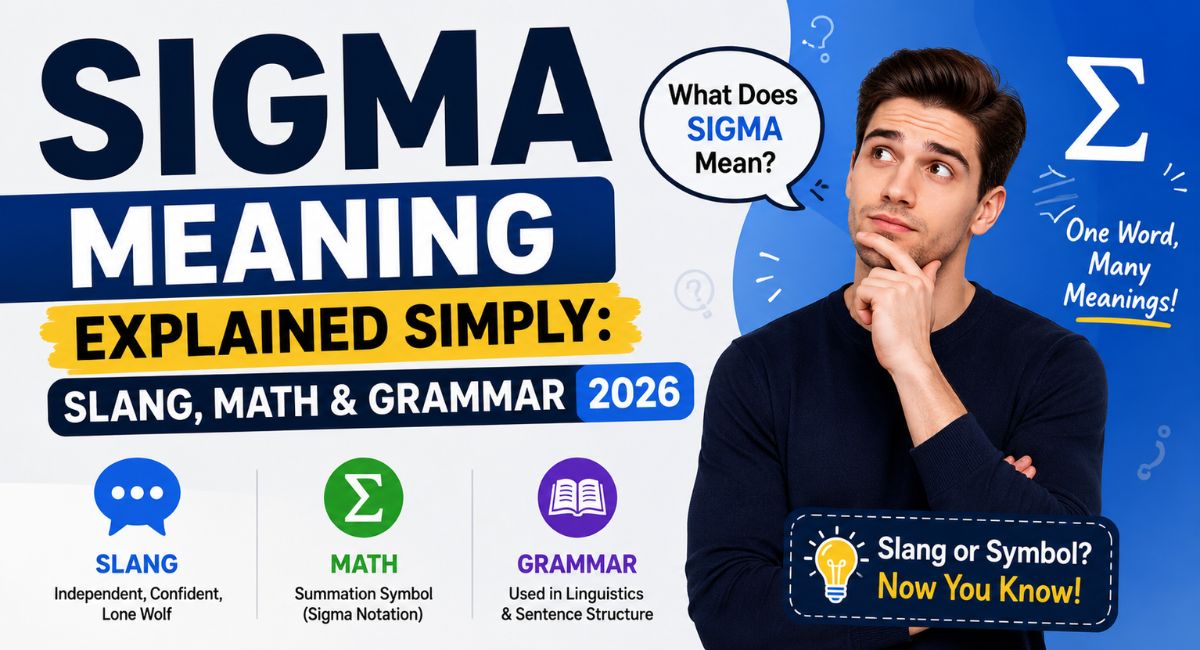
Sigma Meaning Quick Answer: Sigma (Σ, σ) is the 18th letter of the Greek alphabet. In slang, sigma describes a calm, independent person who doesn’t seek social approval — often called a “sigma male.” In math and statistics, sigma stands for summation or standard deviation. The correct meaning depends entirely on where you hear it.
If you’ve seen the word “sigma” pop up in a TikTok comment, a group chat, or your kid’s vocabulary and thought, “Wait, what does that even mean?” — you’re not alone. It’s one of those words that means five different things depending on who’s saying it and where.
This guide breaks sigma down in plain, simple English. No jargon, no confusion — just the real meaning, how to pronounce it, how to use it correctly in a sentence, and the grammar mistakes most people make with it.
Sigma Meaning at a Glance
Before we go deep, here’s the short version you can skim and screenshot:
- Origin: 18th letter of the Greek alphabet (Σ, σ, ς)
- Slang meaning: An independent, quietly confident person who avoids seeking attention
- Part of speech: Noun (and informally used as an adjective — “that’s so sigma”)
- Pronunciation: SIG-muh (/ˈsɪɡ.mə/)
- Math meaning: Σ = summation (adding a series of numbers)
- Statistics meaning: σ = standard deviation
- Business meaning: Used in “Six Sigma,” a quality-control method
Now let’s unpack each of these properly.
How to Pronounce “Sigma” (So You Never Say It Wrong)
A lot of people mispronounce sigma before they even get to using it correctly. Here’s the simple breakdown:
- Phonetic spelling: SIG-muh
- IPA: /ˈsɪɡ.mə/
- Stress: on the first syllable (“SIG,” not “muh”)
Think of it like the word “stigma” without the “t” — that’s the easiest way to remember it.
Sigma: Part of Speech and Grammar Notes
This is the part most sites skip — and it’s exactly where people trip up.
Sigma is grammatically a noun. It names a letter (Σ), a symbol, or a personality type. But online, people bend the rules and use it informally as an adjective too.
Here’s how both forms actually work:
| Usage Type | Example Sentence | Grammar Note |
| As a noun | “Sigma is the 18th letter of the Greek alphabet.” | Standard, correct in formal writing |
| As a noun (slang) | “He’s a total sigma.” | Informal; refers to a type of person |
| As an adjective (slang) | “That was such a sigma move.” | Not standard grammar, but common in casual speech |
| As part of a compound noun | “He has sigma energy.” | Treats “sigma” like a modifier before a noun |
Grammar tip: In formal or academic writing (essays, resumes, professional emails), stick to sigma’s literal meanings — the Greek letter, statistics, or Six Sigma. Save the slang usage for texting, social media, or casual conversation. Mixing slang sigma into formal writing will read as a mistake, not a personality trait.
Sigma Meaning in Slang: The Simple Explanation
In modern internet slang, a “sigma” or “sigma male” describes someone who:
- Doesn’t need social approval or attention
- Prefers working and succeeding on their own
- Stays calm, focused, and hard to read
- Operates outside typical social “hierarchies” (unlike an alpha, who leads a group)
In one line: a sigma is someone who’s successful and confident without needing to be the center of attention.
It became popular around 2020–2021 as an alternative to the “alpha male” stereotype — appealing to people (especially introverts) who didn’t relate to loud, dominant personality types.
Alpha vs. Sigma: Quick Comparison
| Trait | Alpha | Sigma |
| Social style | Leads the group | Works alone |
| Attention | Seeks it | Avoids it |
| Personality | Outgoing | Reserved |
| Energy | Loud confidence | Quiet confidence |
Sigma Meaning in Texting and Social Media
If a friend texts you “bro is sigma” or “that’s so sigma,” here’s what they mean in context:
- “He’s sigma” → He seems independent and unbothered
- “Sigma move” → A clever or confident action
- “Sigma energy” → Calm, unshaken confidence
- “Absolute sigma” → A joking compliment (often sarcastic)
Important: A huge chunk of sigma usage today is ironic or joking, not literal. Someone eating lunch alone might get called “sigma” as a meme, not a serious personality read. Context and tone matter more than the dictionary definition here.
Sigma in Math and Statistics (The Original Meaning)
Before it was slang, sigma was — and still is — a serious mathematical symbol.
Uppercase Sigma (Σ) — Summation
Σ means “add up everything in this sequence.” For example:
Σ (1 to 5) = 1 + 2 + 3 + 4 + 5 = 15
It’s used to compress long addition problems into one compact symbol.
Lowercase Sigma (σ) — Standard Deviation
In statistics, σ measures how spread out a set of numbers is from the average.
- Small sigma → data points are close together
- Large sigma → data points are spread far apart
This shows up constantly in data science, research studies, and even AI model evaluation.
The 68-95-99.7 Rule
| Sigma Range | % of Data Covered |
| 1 Sigma | ~68% |
| 2 Sigma | ~95% |
| 3 Sigma | ~99.7% |
What Is Six Sigma?
Six Sigma is a business methodology used to reduce errors and improve quality in manufacturing and operations. It was popularized by companies like Motorola and General Electric.
Six Sigma certifications work like martial arts belts:
- White Belt (basic awareness)
- Yellow Belt (beginner)
- Green Belt (project-level)
- Black Belt (advanced)
- Master Black Belt (expert/strategic)
If you’ve seen “Six Sigma certified” on someone’s LinkedIn, this is what it means.
Synonyms and Related Words to “Sigma” (Slang Context)
If you’re trying to expand your vocabulary around this word, here are related terms people often use interchangeably or alongside “sigma”:
| Word/Phrase | Closest Meaning |
| Lone wolf | Independent, prefers solitude |
| Stoic | Calm, emotionally controlled |
| Self-made | Achieved success independently |
| Grindset | Obsessive focus on self-improvement/work |
| Unbothered | Not affected by others’ opinions |
Common Mistakes People Make With “Sigma”
Since this site is all about helping you use English correctly, here are the most common errors:
- Mispronouncing it as “SEE-gma” instead of “SIG-muh.”
- Using it in formal writing as slang (e.g., writing “he’s very sigma” in a report).
- Confusing sigma with alpha or beta — they describe different (and honestly, not scientifically real) personality archetypes.
- Assuming it’s a recognized psychology term — it isn’t. No psychologist officially classifies “sigma personalities.”
- Treating every use as serious — most sigma memes today are jokes, not genuine compliments.
Is “Sigma” a Real Personality Type?
Short answer: No.
Psychology doesn’t officially recognize “sigma,” “alpha,” or “beta” as personality categories. These are internet-created labels, not clinical terms. If you want scientifically backed personality frameworks, look into:
- The Big Five Personality Traits
- Myers-Briggs Type Indicator (MBTI)
Sigma is a cultural label, not a diagnosis — useful for describing a vibe, not a fact about someone’s psychology.
Frequently Asked Questions About Sigma Meaning
What does sigma mean in simple words?
Sigma is the 18th Greek letter, but in slang, it means an independent, quietly confident person who doesn’t seek attention or approval from others.
Is sigma a noun or an adjective?
Sigma is officially a noun. Online, people also use it informally as an adjective (e.g., “sigma move”), but this isn’t standard grammar.
How do you pronounce sigma?
Sigma is pronounced “SIG-muh” (/ˈsɪɡ.mə/), with the stress on the first syllable.
What does sigma mean on TikTok?
On TikTok, sigma usually describes a stoic, disciplined, “lone wolf” aesthetic shown through motivational or cinematic-style edits.
What does sigma mean in math?
In math, the uppercase symbol Σ means summation — adding a series of numbers together. In statistics, lowercase σ means standard deviation.
Is calling someone “sigma” a compliment?
Usually, yes — it implies confidence and independence. But it’s often used jokingly, so context matters more than the literal definition.
Final Thoughts
Sigma is one of those rare words that lives in two completely different worlds — one in classrooms and statistics textbooks, and one in memes and group chats. Knowing which meaning applies (and how to use the word grammatically correct in each context) is what actually helps you sound confident using it, instead of confused by it.
Next time someone calls you “sigma,” at least now you’ll know exactly what they mean — and whether they’re serious or joking.