Ever hit send on a text or email, looked at it a second later, and thought, Wait… did I use the right word?
If you’ve ever typed out “Please response to this email” or “I haven’t gotten a respond yet,” don’t sweat it. You are definitely not alone. Millions of people mix up respond and response every single day. They look alike, sound similar, and both deal with the exact same concept: replying to something.
But swapping them can make your writing look a little sloppy. If you want to keep your communication sharp—whether you are emailing a professor, slacking a coworker, or just texting a group chat—mastering the difference is a game-changer.
Here is the good news: the difference is actually incredibly simple once you know the secret trick. Let’s break it down without the boring textbook fluff.
The Golden Rule: Action vs. Object
If you remember nothing else from this article, memorize this one-sentence cheat sheet:
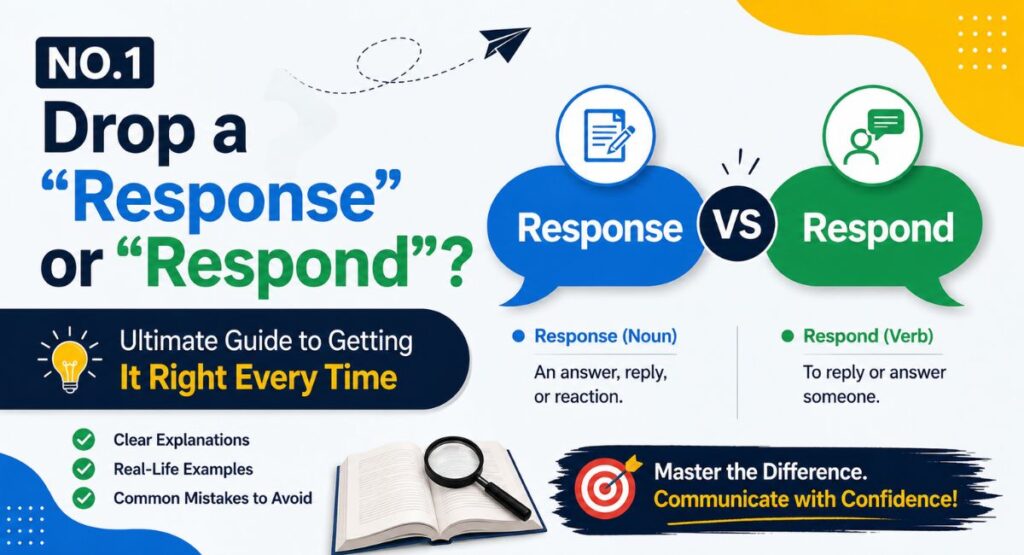
Respond is an action (something you do), while response is a thing (something you give or get).
Grammatically, respond is a verb and response is a noun. But you don’t need a degree in linguistics to make the right choice. Just ask yourself this question before you write: Am I talking about the action itself, or the final result?
1. When to Use “Respond” (The Verb)
Because respond is an action word, it requires someone or something to actually do it. You use it when a person, animal, or even a cell is actively reacting to a stimulus.
- The Blueprint:
[Someone] + [responds] - Real-World Examples:
- “Can you respond to my text before tonight?” (You are asking them to take action.)
- “The dog didn’t respond when I called his name.” (The dog failed to act.)
- “He chose not to respond to the internet drama.” (An active choice to stay quiet.)
2. When to Use “Response” (The Noun)
Because response is a noun, it represents the actual message, reaction, or outcome that was produced. It is a tangible or measurable thing.
- The Blueprint:
[Give/Get/Receive] + [a response]or[The response] + [was/is] - Real-World Examples:
- “I’m waiting for a response from the hiring manager.” (You are waiting for an object—an email or call.)
- “Her blunt response caught everyone off guard.” (The reaction itself was surprising.)
- “The post got a huge response on TikTok.” (It generated a massive wave of comments/likes.)
The Cheat Sheet Matrix
If you’re still feeling stuck, use this quick comparison table to double-check your sentence structure.
| If your sentence looks like this… | …Choose this word | Real-Life Check |
| “Please _____ by Friday.” | Respond | You need an action. |
| “I appreciate your quick _____.” | Response | You are thanking them for a thing they sent. |
| “She didn’t _____ to the medication.” | Respond | The body is or isn’t taking action. |
| “The crowd’s _____ was electric.” | Response | You are naming the collective reaction. |
| “Can you _____ back?” (See note below!) | Respond | You are asking for a reply. |
⚠️ A Quick Side Note on “Respond Back”: While you will hear people say “respond back” all the time in casual conversation, it’s technically redundant! Responding already means replying back. To keep your writing crisp, just use respond on its own.
Real-World Contexts: Beyond Basic Grammar
These two words don’t just live in English essays. They play crucial roles in different professional and scientific fields, changing slightly depending on the room you are in.
1. In Digital Communication & Workplace Slang
In the era of Slack, Discord, and text messaging, these words have morphed into quick cultural shorthand.
- “No response” is the official diagnosis for being left on read.
- “We need to respond” is what your project lead says during a minor company crisis.
2. In Medicine and Biology
Doctors and researchers use these words to track how a patient’s body reacts to an external force.
- The Action: “The patient’s pupils respond normally to light.”
- The Result: “The clinical trial measured a positive immune response to the vaccine.”
3. In Psychology (The Stimulus-Response Loop)
Behavioral psychology revolves entirely around the concept of Stimulus ➔ Response.
- If a loud noise startles you, the noise is the stimulus, and your jump is the response (noun).
- How you respond (verb) to stress over time dictates your overall mental well-being.
What Missed: Hidden Nuances & FAQs
Many quick grammar blogs skip over the weird exceptions and specific edge cases that actual internet users type into search engines every day. Let’s clear those up right now.
Is “responded” a word? What about “responsified”?
Yes, responded is simply the past tense of the verb respond (e.g., “He responded to my email yesterday”). On the flip side, “responsified” is completely made up—avoid it! If you want to say something was made reactive, use words like optimized or adapted.
Can a “response” be non-verbal?
Absolutely. A response doesn’t have to be spoken or written. A shrug, a nod, a slammed door, an elevated heart rate, or a change in a website’s layout (responsive design) are all perfectly valid responses.
What is the plural of response?
The plural form is responses. For example: “We received over 500 responses to our customer survey.” The word respond cannot be pluralized with an “-es” unless you are using the third-person singular present tense (“She responds to every comment”).
The Verdict
Mastering these two words comes down to a simple mind shift. Stop trying to remember complex grammar textbook rules about nouns and verbs. Instead, look at what your sentence is trying to do:
- If something is moving, acting, or replying, use respond.
- If something is sitting there as a result, a message, or a reaction, use response.
Keep this straight, and your emails, texts, and captions will look clean, professional, and sharp every single time.