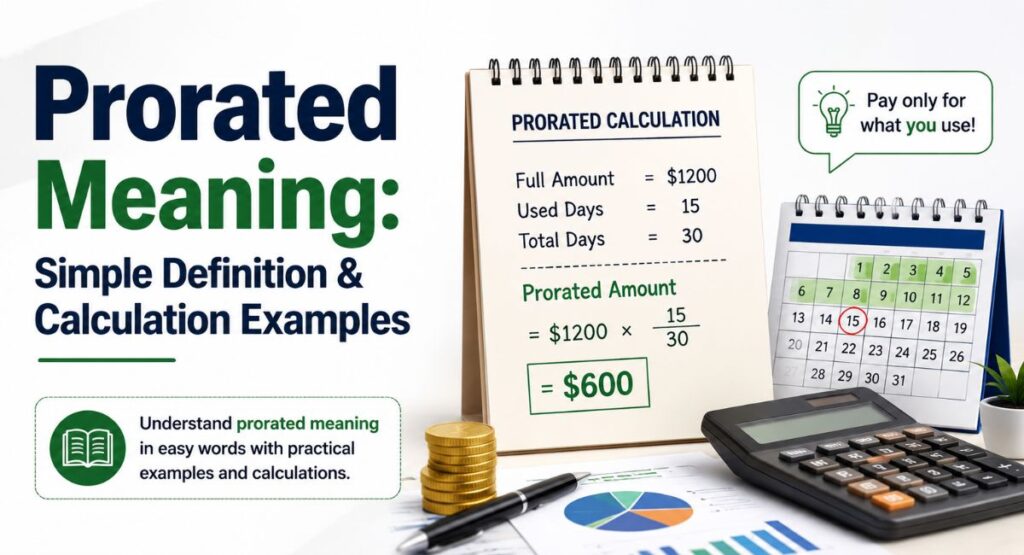
Prorated Meaning: Have you ever looked at a rent invoice, subscription bill, or first paycheck and seen the word “prorated”?
If you were confused or worried you were being overcharged, you are not alone. Financial and legal terms like prorated often sound far more complicated than they actually are.
In simple terms, prorated means adjusted proportionally based on time or usage.
This comprehensive guide breaks down the exact meaning of “prorated,” how it works across different real-world situations, and how you can calculate a prorated charge yourself in just a few seconds.
Prorated Meaning: Quick Definition
Prorated Definition:
Prorated describes an amount (such as a fee, salary, or rent) that is divided proportionally based on the exact amount of time used within a standard billing cycle. Instead of paying the full price for a full month, you only pay for the specific days you accessed the product or service.
Where Does the Word “Prorated” Come From?
The word prorated comes from the Latin phrase “pro rata,” which translates directly to “according to the rate” or “in proportion.”
While grammar and usage can sometimes feel tricky, understanding the distinction between these two terms is simple:
- Pro Rata (Adjective/Adverb): The original Latin phrase used to describe proportional allocation (e.g., “The bonus was split on a pro rata basis”).
- Prorated (Verb/Adjective): The modern English past-participle form used to describe something that has already been proportionally adjusted (e.g., “I received a prorated paycheck”).
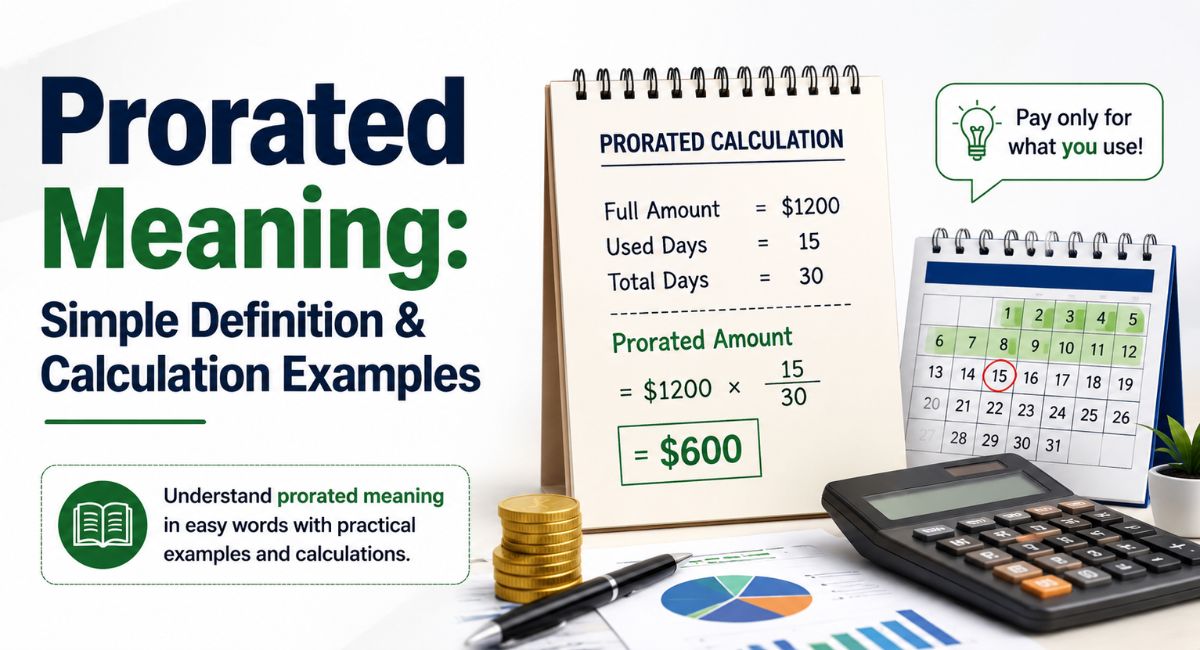
How Prorated Billing Works in Daily Life
Proration exists to ensure fairness and accuracy in financial transactions. It protects buyers from overpaying and prevents sellers from losing revenue when services start or end mid-cycle.
Here are the three most common areas where you will encounter prorated amounts:
1. Prorated Rent
If you move into a new apartment on the 15th of a 30-day month, paying full rent for that entire month would be unfair.
Your landlord prorates your first month’s rent by dividing your monthly rate by the number of days in the month and multiplying it by the 16 days you actually live there.
2. Prorated Salary or Paycheck
If you start a new salaried job halfway through a two-week pay period, your company doesn’t withhold your entire paycheck or give you free money.
Instead, HR calculates a prorated salary payment so you are paid for the exact workdays you completed during that partial pay period.
3. Prorated Subscription Services (SaaS & Utilities)
When you upgrade, downgrade, or cancel a software subscription, streaming service, or gym membership mid-month, companies use prorated charges or credits.
- Prorated Charge: A small fee for the remaining days of a higher-tier subscription.
- Prorated Credit: A refund or account balance credited back to you for unused days on an older plan.
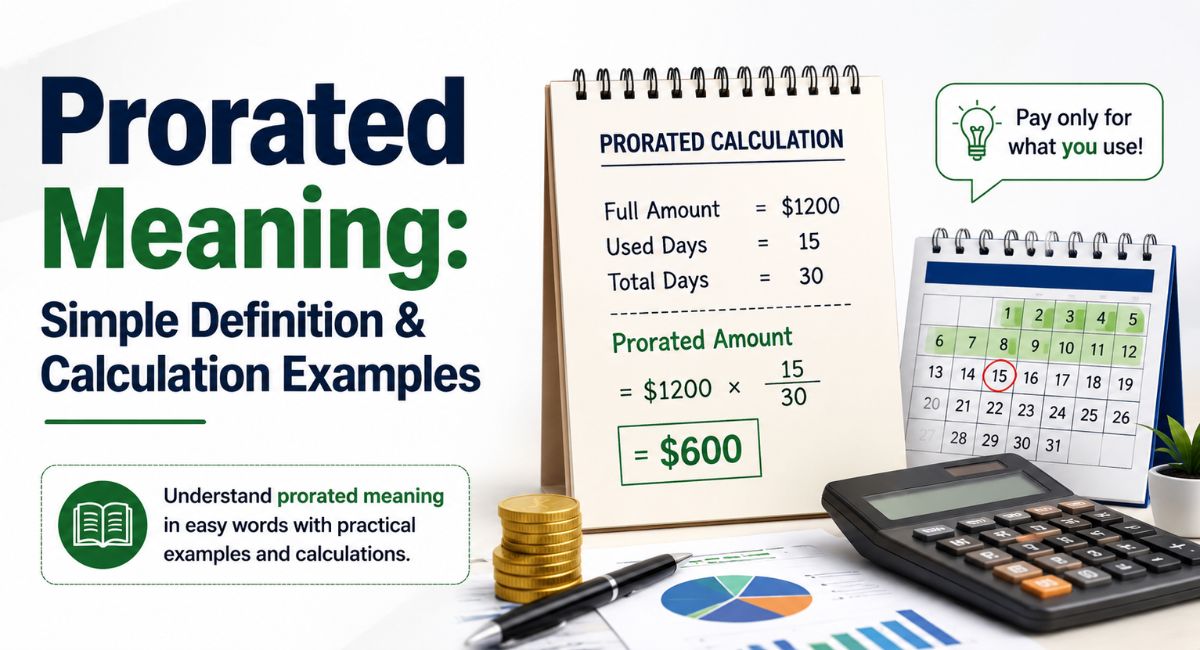
How to Calculate a Prorated Amount (Step-by-Step)
Calculating a prorated charge involves basic arithmetic. Follow this step-by-step formula to check any bill or paycheck.
The Standard Proration Formula
$$\text{Daily Rate} = \frac{\text{Total Cost for Full Period}}{\text{Total Days in Billing Cycle}}$$
$$\text{Prorated Charge} = \text{Daily Rate} \times \text{Days Service Was Used}$$
Step-by-Step Calculation Example
Imagine your monthly office rent is $3,000, and the month has 30 days. You move in on the 16th day of the month, meaning you will occupy the space for 15 days.
- Find the Daily Rate:$$\frac{\$3,000}{30 \text{ days}} = \$100 \text{ per day}$$
- Multiply by Days Used:$$\$100 \text{ per day} \times 15 \text{ days} = \$1,500$$
Your prorated rent for that partial first month is $1,500.
Summary Prorated Meaning: Standard Billing vs. Prorated Billing
| Feature | Standard Billing | Prorated Billing |
| Cost Basis | Fixed fee for a full cycle | Variable fee based on active days |
| Start Date | Typically 1st of the month | Any day of the month/cycle |
| Fairness | May overcharge for partial usage | Guarantees you pay only for what you use |
| Common Uses | Annual contracts, fixed memberships | First month’s rent, mid-cycle plan changes |
Common Grammar & Spelling Confusion around “Prorated”
Because “prorate” is derived from Latin, English learners and readers with grammar questions frequently ask about proper spelling and usage:
- Prorated vs. Pro-rated: Both spellings are understood, but prorated (without a hyphen) is the accepted standard in modern business, legal, and financial writing.
- Is “Prorated” a Word? Yes. It is a recognized transitive verb and adjective in major dictionaries like Merriam-Webster and Oxford.
- Incorrect Usage: Saying “I was pro rata charged” is grammatically incorrect. Instead, use “I received a prorated charge” or “The fee was assessed on a pro rata basis.”
Prorated Meaning (FAQ)
What does “prorated amount” mean on a bill?
A prorated amount on a bill is a partial-period charge. It shows that your service provider adjusted the total monthly price to reflect only the specific days you had active service during that billing cycle.
Is a prorated salary less than full pay?
Yes, for that specific pay period. If you start a salaried job halfway through a pay cycle, your first paycheck will be a prorated amount covering only the days you worked. Your future regular paychecks will reflect your full, standard salary.
Do landlords have to prorate rent?
While prorating rent for mid-month move-ins or move-outs is standard industry practice, local tenancy laws and individual lease agreements dictate the exact rules. Always verify the proration clause in your lease agreement before signing.
What is the difference between a prorated charge and a prorated credit?
A prorated charge is an additional payment billed for extra days or upgraded services used mid-cycle. A prorated credit is money returned to your account balance for unused days when you downgrade or cancel a plan.
Prorated Meaning:Final Thoughts
Understanding the meaning of prorated empowers you to manage your personal finances with confidence. Whether reviewing your apartment lease, checking your first paycheck, or modifying a software subscription, remembering the core principle—paying only for the time you actually use—will help you ensure your bills are always accurate.