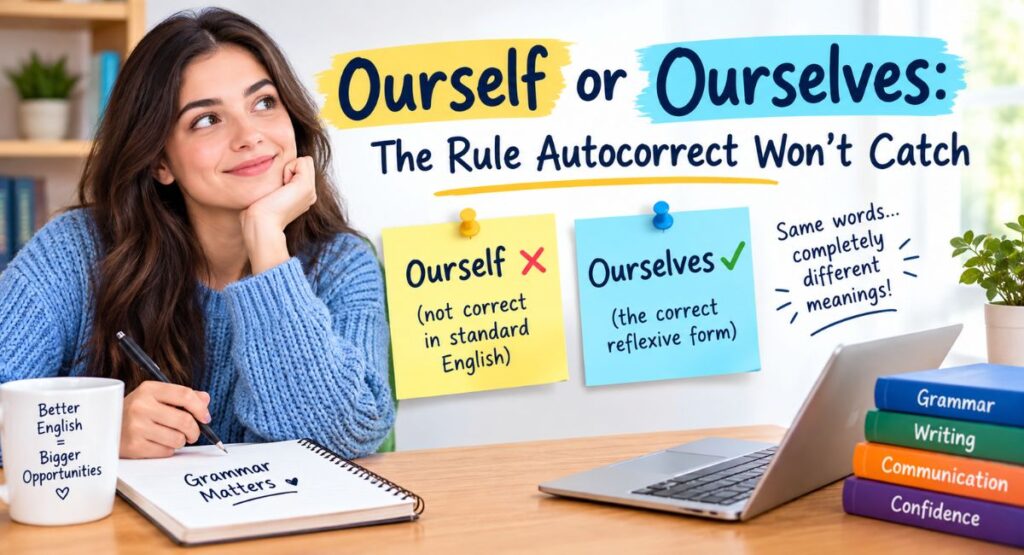
Two friends type the same message. One writes “we should treat ourselves.” The other writes “we should treat ourself.” Neither word gets a red underline. So which one is right?
Ourself or Ourselves : Use “ourselves” for any group: “We surprised ourselves.” “Ourself” is a rare singular form, mainly found in royal “we” writing, where one person speaks as “we.” Spellcheck accepts both because both are real words, so it will not warn you when “ourself” is wrong.
This guide shows when each word belongs, why spellcheck will not save you, and how to decide in three seconds.
Why Spellcheck Misses This Mistake
Spellcheck compares your word with a list of real words. “Ourself” is on that list, so it passes. What spellcheck cannot do is check whether the word matches the subject of your sentence. That is a grammar question, and many phone keyboards do not catch it.
That is why this error survives in captions, emails, and group chats: the word looks fine and the sentence reads smoothly until someone counts the people.
The Core Rule: Match the Pronoun to the Subject
A reflexive pronoun sends the action of the verb back to the person doing it. English gives each subject its own form:
| Subject | Reflexive pronoun |
| I | myself |
| you (one person) | yourself |
| he / she / it | himself / herself / itself |
| we | ourselves |
| you (more than one) | yourselves |
| they | themselves |
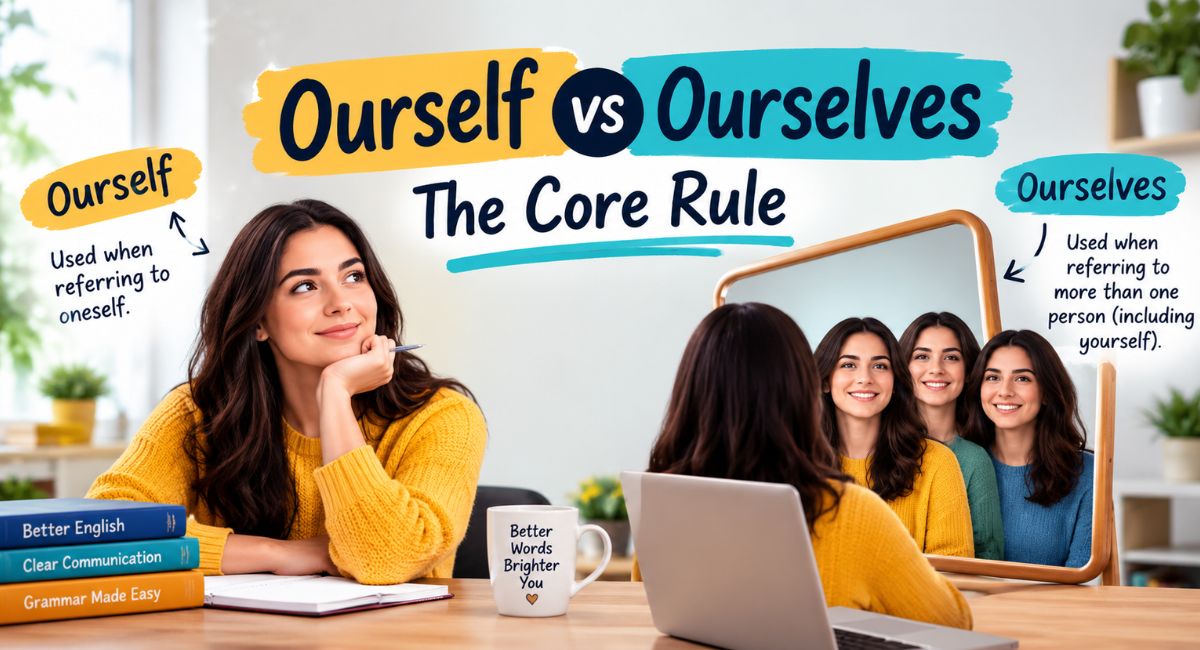
Notice the pattern: singular forms end in -self and plural forms end in -selves. “We” is plural, so it takes ourselves.
When “Ourself” Is Correct (and Why It Is Rare)
“Ourself” survives mainly in the royal “we” (also called the royal plural or nosism). A monarch speaks as “we” but means one person, so the reflexive stays singular: “We are pleased with ourself.”
You can see this old style in literature as well. In Shakespeare’s Macbeth, the king says “Ourself will mingle with society,” using “ourself” as one person speaking with royal authority.
Outside that formal, historical setting, “ourself” has no everyday home. If you are not a monarch speaking as “we,” choose “ourselves.”
4 Real Chats (and the Better Version of Each)
Chat 1: The group plan
Zara: we need to treat ourselves this weekend, we’ve earned it Priya: agreed. spa day?
Why it works: “we” is plural and “ourselves” matches. Nothing to fix.
Chat 2: The team message
Manager: Great sprint, team. Let’s give ourselves a proper break. Dev lead: Seconded. We pushed ourselves hard this cycle.
Why it works: two plural subjects, two correct uses of “ourselves.”
Chat 3: The slip
Sana: we should treat ourself to dinner tonight You: ?
Better version: “We should treat ourselves to dinner tonight.” A friendly reply: “Yes! Quick tip: with ‘we,’ it’s ourselves, plural. Dinner sounds great.” Why: you fix the word gently without making it a lesson.
Chat 4: The joke
Ben: as the official ruler of this group chat, we hereby grant ourself permission to order pizza Maya: lol the royal we has entered the chat
Why it works: Ben is joking in the royal “we,” so the singular “ourself” is deliberate. The joke only lands because the word sounds old-fashioned.
Grammar Corner: Part of Speech, Spelling, and Punctuation
What kind of word is “ourselves”?
It is a pronoun, specifically a reflexive pronoun. It can also work as an intensive pronoun, which adds emphasis:
- Reflexive: “We hurt ourselves.” (the action returns to the subject)
- Intensive: “We ourselves built the table.” (you can remove “ourselves” and the sentence still works)
One word, not two
“Ourselves” is written as one word. Writing “our selves” splits it incorrectly. There is one case where two words are right: when “selves” is a noun, as in “our past selves” or “our better selves.” In that case “our” is a possessive and “selves” means versions of ourselves.
No apostrophes
Neither “ourself” nor “ourselves” takes an apostrophe. If you see “ourselves'” or “ourself’s,” a different structure is being attempted, and it is almost always wrong.
A common spelling error
Some writers form the plural by adding -s to “ourself,” producing “ourselfs.” That is not a word. The plural of “self” is “selves,” so the correct form is “ourselves.”
Capitalization and commas
Capitalize it only at the start of a sentence or in a title. You do not need commas around it in a standard sentence: “We prepared ourselves for the exam.”
Common Mistakes (Wrong, Why, and Fix)
| What people write | Why it is wrong | Correct version |
| “I taught ourselves to cook.” | The subject is “I,” so the reflexive must be singular. | “I taught myself to cook.” |
| “We should treat ourself.” | “We” is plural. | “We should treat ourselves.” |
| “The team congratulated ourself.” | “Ourself” does not match a team talking about itself. | “The team congratulated itself” or “themselves.” |
| “We did it ourselfs.” | “Ourselfs” is not a word. | “We did it ourselves.” |
| “Please send our selves the file.” | “Selves” is a noun here and does not fit. | “Please send us the file.” |
Ourselves in a Sentence: More Examples
Seeing the word in different jobs makes the rule easier to remember:
- After a verb: “We taught ourselves to code.”
- After a preposition: “We kept the secret to ourselves.”
- For emphasis: “We ourselves were surprised by the result.”
- With “by”: “We finished the project by ourselves,” which means without help.
- In a question: “Did we do this to ourselves?”
In each sentence, “we” is the subject, and “ourselves” points back to the same group.
Related Mix-Ups: Yourself, Yourselves, and “Urself”
The same rule works for the second person. “Yourself” is for one person (“Treat yourself”), and “yourselves” is for more than one (“Help yourselves, everyone”). In texting you may also see “urself,” a casual shortening of “yourself.” It is fine in a quick chat, but spell the full word in emails and school writing.
Why do people mix these up? Because “-self” and “-selves” differ by only a few letters, and speech does not always make the difference obvious. A quick habit helps: count the people first, then pick the ending.
A Memory Trick That Actually Works
Remember one pair: we = selves. The word “we” always travels with “selves,” because a group has more than one self. If you ever feel unsure, replace the pronoun with “us” and see whether the group fits. “Treat us” works for a group, so “treat ourselves” is the matching reflexive.
For one person, use “me” and “myself.” For a royal speaker, the old rule says “we” can stand for one person, but you almost never meet that in real life, so treat it as an exception to recognize, not to use.
A Three-Second Checklist Before You Hit Send
- Count the people doing the action. More than one: use “ourselves.”
- Ask who is speaking. Only a monarch or someone using a deliberate royal “we” can use “ourself.”
- Check for -selfs. The plural is always “selves.”
- Do not trust spellcheck to catch a grammar mistake. It only checks spelling.
When to Use Which: Quick Examples
- Ourselves: “We surprised ourselves with how fast we finished.”
- Ourselves (emphasis): “We ourselves wrote the report.”
- Ourself (royal, rare): “We shall see to this matter ourself.”
- Myself (one person): “I wrote this myself.”
Related Reads
- Another word pair that trips spellcheck? Read preform vs perform.
- Writing professional replies? See this is noted: other ways to say it.
Ourself or Ourselves: FAQs
What is the difference between ourself and ourselves?
“Ourselves” is the standard reflexive pronoun for “we” and for any group. “Ourself” is a rare singular form used mainly in the royal “we,” where one person speaks as “we.”
Is “ourself” a real word?
Yes. It is listed in dictionaries, which is why spellcheck does not flag it. It is correct only in a narrow formal or historical setting, so it looks like an error in everyday writing.
Is it “our selves” or “ourselves”?
For the reflexive pronoun, write one word: “ourselves.” Use two words only when “selves” is a noun, as in “our past selves” or “our better selves.”
What part of speech is “ourselves”?
It is a pronoun. It works as a reflexive pronoun (“we hurt ourselves”) and as an intensive pronoun that adds emphasis (“we ourselves wrote it”).
Why doesn’t autocorrect catch a wrong “ourself”?
Spellcheck checks whether a word is spelled correctly, not whether it matches the subject of the sentence. Since “ourself” is a real word, it passes even when the sentence needs “ourselves.”