Two people can send the same “omw” and mean very different things. One is already at your door. The other is still looking for their keys.
The abbreviation is easy. The part worth knowing is what it leaves out, and how to ask for it without sounding pushy. Below you’ll find the grammar behind it, three example chats with best replies, and a quick spot-the-mistake game.
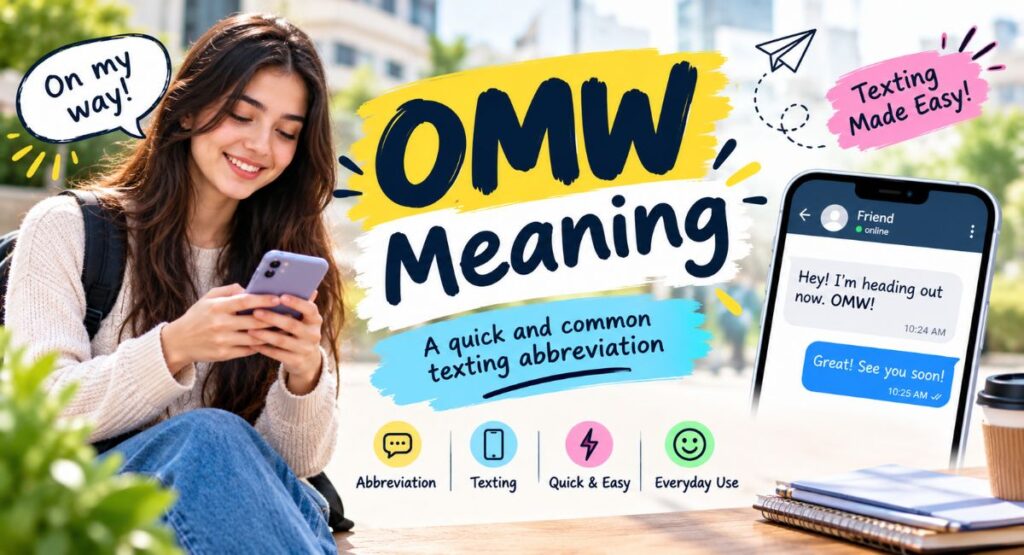
OMW Meaning : OMW stands for “on my way.” People text it to say they’re heading to meet you or reach a place. It’s casual shorthand, not a formal phrase. But it doesn’t say how far away they are: OMW can mean they just left or they’re nearly there, which is why a quick follow-up with a time often helps.
The Gap Inside “OMW”: Status Without a Time
OMW tells you one thing: the sender says they are on their way. It doesn’t tell you three other things:
- whether they have physically left yet
- how long the trip will take
- where they are right now
That’s why “omw” in reply to “where are you?” can feel helpful and unhelpful at the same time. You know they’re coming. You don’t know when.
The fix is a short add-on. Senders can write “omw, 10 min,” “omw, leaving now,” or “omw, parking.” Receivers can ask “how many minutes?” without any awkwardness, because the message itself left that gap open.
What’s Actually Inside Those Three Letters (Grammar First)
OMW is an initialism for the phrase “on my way.” In full, the sentence is “I’m on my way,” so the subject and the verb “am” have been dropped. Grammarians call this ellipsis: leaving out words the reader can easily supply.
A few grammar points follow from that:
- The “my” is built in. Because the possessive is part of the abbreviation, OMW always speaks for the sender. To talk about someone else, write it out: “she’s on her way,” not “she’s omw.”
- “On my way” vs “on the way.” In standard English, “on my way” describes the speaker’s own trip. “On the way” more often describes something located along a route (“the shop is on the way”). Some varieties of English also use “on the way” for the speaker’s own travel, but OMW follows the “my” version.
- Destination: you can add one with “to” (“omw to the station”). Without it, the destination is whatever the chat is about.
- Capitalization and punctuation: “omw” and “OMW” are both common. It needs no punctuation, and an exclamation mark just adds friendliness.
- Register: casual. In formal emails or messages to clients, write “I’m on my way” or “I’ll be there in ten minutes.”
- Who sends it and when: anyone heading to a meetup, pickup, or meeting, usually as a quick answer to “where are you?” in a one-to-one or group chat.
| Form | What it says | What it leaves out |
| omw | I’m traveling toward you or the place | Time and distance |
| omw, 10 min | Traveling, with a time estimate | Exact location |
| ETA 7:30 | A time estimate | Whether the person has left yet |
| be there soon | A soft promise in full words | Any specific time |
Example Conversations, and the Best Reply to Each
These are written examples for illustration, not real user data.
Example 1: Friends, a film at 7
6:40 PM, Ria: where are you? film starts at 7 6:41 PM, Sam: omw
Best reply: “Ok! How many minutes? I’ll hold your seat until 6:55.” Why: OMW gave no time, so asking for one keeps things friendly and the deadline is clear. Casual tone, friends, any messaging app.
Example 2: Family pickup
5:15 PM, Dad: omw 5:16 PM, You: (your reply)
Best reply: “Thanks! I’m at Gate 2 near the bus stop.” Why: A bare “ok” is fine, but sharing where you are helps him find you faster. Warm tone, family, quick mobile chat.
Example 3: A teammate before a meeting
9:48 AM, Teammate: omw, 10 min late 9:49 AM, You: (your reply)
Best reply: “No problem. We’ll start with the agenda and catch you up when you’re in.” Why: The teammate already gave a time, so there’s nothing to ask. Confirm the plan in full words. Colleague, team chat, slightly more formal.
Where OMW Fits and Where to Spell It Out
OMW fits when:
- you’re replying to a friend or family member who’s waiting
- you’re updating a group chat before a meetup
- the message is a quick status, not a promise with consequences
Spell it out when:
- you’re writing to a client, manager, or anyone you don’t know well
- the other person is on a deadline (add a time)
- you’re talking about someone else’s travel
One safety note: if you’re driving, don’t type. A voice reply is the safer way to say you’re on your way.
Four Slips People Make With OMW
- Sending OMW with no time when someone is clearly waiting. It answers “are you coming?” but not “when?”
- Using it in a formal email. It reads as too casual for most professional settings.
- Using it for another person. The “my” means it can only speak for the sender.
- Treating it as a precise update. It’s a status, not a location share. If timing matters, add minutes or a landmark.
Related Reads
OMW Meaning:FAQs
What does OMW mean in text?
OMW means “on my way.” People send it to say they are traveling toward you or a place. It’s casual shorthand for “I’m on my way.”
Does OMW mean the person has already left?
Not necessarily. OMW can mean they’ve just left, they’re halfway, or they’re about to arrive. If timing matters, ask for minutes or a landmark.
Is OMW the same as ETA?
No. OMW is a status (“I’m coming”), while ETA is an estimated arrival time. Many people combine them, like “omw, ETA 7:30.”
How do I reply to OMW?
Keep it short: “Ok, see you soon.” If you’re waiting on a deadline, ask “how many minutes?” or say where you are so they can find you.
Can I use OMW in an email or work message?
It’s better to avoid it in formal messages. Write “I’m on my way” or “I’ll be there in ten minutes” for managers, clients, or anyone you don’t know well.