NPC Meaning : Someone in your group chat just called you an “NPC” and everyone reacted with laughing emojis. You have no idea if you should laugh too or feel insulted.
Here’s the good news: by the end of this page, you’ll know exactly what NPC means, how to say it out loud, how to spell it correctly, and how to use it in a sentence without sounding confused. No guessing games.
This isn’t just another slang list entry. We’re breaking down the grammar behind NPC too — how to capitalize it, whether it’s a noun or an adjective, and the mistakes people make when they type it. That’s the part most slang sites skip, and it’s exactly why people end up using words wrong even after “looking them up.”
Let’s get into it.
What Does NPC Mean in Slang?
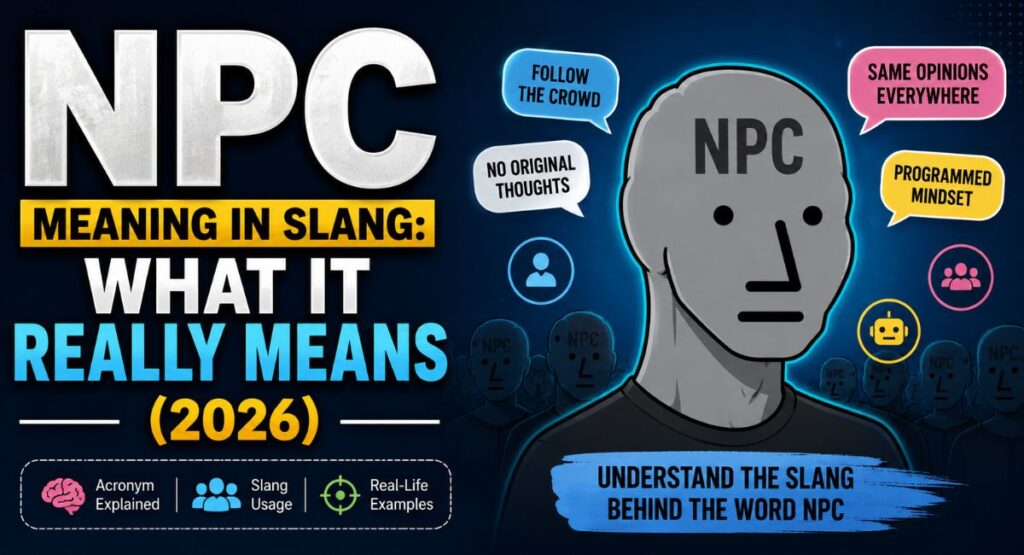
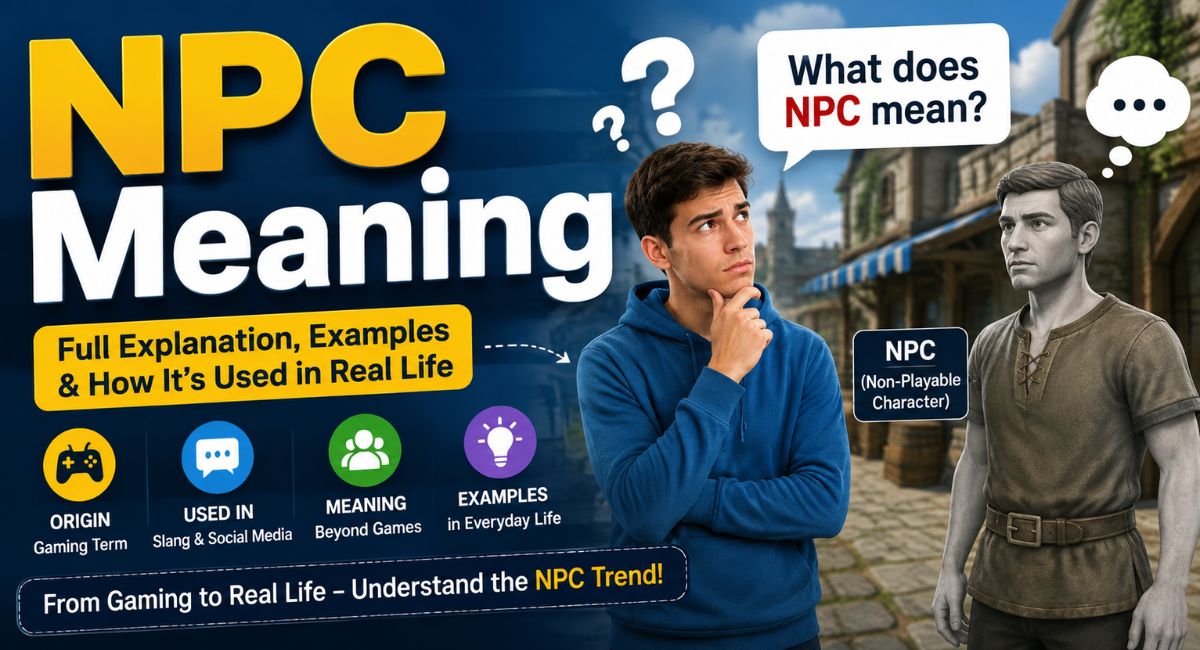
Quick Answer: NPC stands for “Non-Playable Character.” In slang, it’s used to describe a real person who seems boring, predictable, or unable to think for themselves — like a background character in a video game who just repeats the same lines on a loop.
NPC is a gaming term that escaped the gaming world. In video games, an NPC is any character the computer controls instead of a real player — a shopkeeper, a quest-giver, a random villager. They say the same three lines every time you talk to them. They never do anything unexpected.
When someone calls a real person an “NPC,” they’re saying that person acts the same way: no original thoughts, no independent opinions, just following whatever everyone else is doing or saying.
In one sentence: Calling someone an NPC means you think they’re mindless, predictable, or incapable of forming their own opinion.
How to Say NPC (Pronunciation Guide)
This is the part most slang explainers leave out — and it trips people up more than you’d think.
- How it’s spoken: en-pee-see (each letter said separately, like “ATM” or “CEO”)
- Never pronounced as one word. You don’t say “nip-see” or “en-pick.” It’s always three separate letter sounds.
- In writing, it’s typed in all capital letters: NPC
If you’re texting or captioning a post, capitalization matters more than you’d expect — more on that below.
The Grammar Behind NPC (What Most Sites Get Wrong)
Since NPC gets used in so many different ways online, people often use it grammatically incorrectly without realizing it. Here’s how to use it the right way.
Is NPC a Noun or an Adjective?
NPC actually works as both, depending on the sentence:
| Usage | Part of Speech | Example |
| “He’s such an NPC.” | Noun | NPC replaces a person’s identity/role |
| “That’s NPC behavior.” | Adjective (attributive) | NPC describes the noun “behavior” |
| “She’s acting very NPC.” | Adjective (informal, predicate) | Describes how she’s acting |
Quick rule: If NPC comes right before a noun (“NPC energy,” “NPC behavior,” “NPC take”), it’s functioning as an adjective. If it stands alone as the subject or object (“he’s an NPC”), it’s a noun.
Capitalization Rules: NPC vs. npc vs. N.P.C.
- NPC (all caps) — the correct, standard form. This is how it should appear in any formal or semi-formal writing, including captions, articles, and even most texts.
- npc (lowercase) — acceptable in casual texting and comments, especially on TikTok or Twitter/X, where lowercase is a stylistic choice, not a grammar error.
- N.P.C. (with periods) — outdated and rarely used today. You’ll mostly see this in older gaming forums, not current slang usage.
Bottom line: When in doubt, capitalize it. NPC is an acronym (technically an initialism), and acronyms are capitalized by default in standard English — the lowercase version is just internet-casual styling, not the “correct” grammar form.
Common Mistakes People Make With NPC
- Spelling it out unnecessarily. You don’t need to write “non-playable character” in a text — just use NPC. Nobody does this in real conversation, and it kills the joke.
- Using an apostrophe for the plural. It’s NPCs, not NPC’s. The apostrophe version is only correct if you’re showing possession (“the NPC’s dialogue was repetitive”).
- Mixing up NPC with “basic.” They’re related but not identical — see the comparison table below. NPC questions someone’s ability to think independently; “basic” just means predictable taste.
- Pronouncing it as a word. Some new users try to say it like “nip-see.” It’s always three letters, said individually.
Origin and History of “NPC” Slang
NPC has been a gaming term for decades, describing any in-game character a real player doesn’t control. Think shopkeepers, quest-givers, and background townsfolk who repeat the same two lines of dialogue every time you interact with them.
The slang jump happened between 2016 and 2018, when online forums began using NPC to accuse people of not thinking for themselves — often in political arguments. The turning point came with the 2018 “NPC Wojak” meme: a blank, gray, expressionless face representing someone with no independent thoughts. That image made NPC go mainstream.
By 2020, the political edge faded. NPC became general-purpose slang for anyone who seems robotic, predictable, or unoriginal — and it’s stayed that way since, now sitting comfortably alongside terms like sigma and “main character energy” in everyday Gen Z vocabulary.
How “NPC” Is Used in Texting, Captions, and Real Conversation
In texts and captions, NPC is quick and casual. No explanation needed — everyone in the conversation already knows what it means.
Spoken out loud, it hits differently. Saying “you’re such an NPC” to someone’s face feels more direct and personal than typing it. There’s less room to hide behind a joke.
Quick comparison:
| Context | Tone | Example |
| Text/DM | Casual, easy to brush off | “lol you’re such an npc” |
| Social caption | Playful, self-aware | “NPC behavior activated ☕” |
| Said out loud to a friend | Light teasing (with close friends) | “You ordered the same thing again? En-pee-see.” |
| Said out loud to a stranger | Can feel like a direct insult | Avoid unless you know the person well |
Examples of “NPC” Used Correctly in a Sentence
Casual/self-deprecating:
- “I forgot why I walked into this room. Total NPC moment.”
- “I’ve eaten the same lunch three days straight — I’m an NPC at this point.”
Describing someone else (playful):
- “You wore the same outfit as last week? NPC behavior.”
Describing someone else (sharper/critical):
- “Everyone in that meeting just agreed with the boss. Room full of NPCs.”
- “That’s such an NPC take — you just repeated what everyone else said.”
Caption/online use:
- “POV: you’re the main character and everyone around you is an NPC”
- “Me on autopilot at 8am… full NPC mode”
NPC vs. Similar Slang Terms
NPC overlaps with a few other words, but it’s not identical to any of them. Here’s how they differ:
| Term | Meaning | How It Differs From NPC |
| NPC | Someone who seems robotic, unoriginal, or unable to think independently | — |
| Basic | Predictable taste, follows trends | Softer — about taste, not identity |
| Sheep | Blindly follows others | Older term, similar core idea |
| Drone | Mindless, mechanical | Very close synonym to NPC |
| Main character | Someone who stands out, has strong opinions | The direct opposite of NPC |
Is “NPC” Appropriate for Kids and Teens to Use?
Quick answer: The word itself is clean — no profanity, no explicit meaning — but it’s frequently used as an insult, so context matters more than the word itself.
NPC contains no bad language and no adult content, which is why it flies under the radar in classrooms and parental filters. But calling a classmate an NPC to their face — implying they have no real personality — can absolutely be a form of exclusion or bullying.
A simple way to tell the difference:
- Joking about their own NPC moment (forgetting something, repeating a habit) → generally harmless self-deprecation
- Calling other kids NPCs to exclude or mock them → this is bullying, even though the word sounds harmless
If you’re a parent or teacher, it’s worth having a quick conversation about the difference between joking with friends and using it to put someone down.
When to Use (and Avoid) “NPC”
✅ Safe to use when:
- You’re joking about your own predictable habits
- You’re texting close friends who’ll get the reference instantly
- You’re commenting on a fictional character, meme, or pop culture moment
- The context is clearly light and self-aware
❌ Avoid using it when:
- You’re speaking to someone who may not know the reference
- You’re in a professional or formal setting
- You genuinely want to dismiss someone’s opinion (it will come across as harsh, not funny)
- You don’t know the person well enough to predict how they’ll take it
Final Takeaway
NPC means “Non-Playable Character” — and in slang, it describes someone who seems predictable, unoriginal, or unable to think for themselves, like a background character running on a script.
It’s spoken as three separate letters (“en-pee-see”), written in all caps as standard grammar, and works as either a noun (“he’s an NPC”) or an adjective (“that’s NPC behavior”) depending on where it lands in the sentence.
Used with friends, it’s usually a light joke. Used on a stranger, it can land as a real insult — so read the room before you type it.
NPC Meaning : Frequently Asked Questions
What does NPC mean in slang? NPC stands for “Non-Playable Character.” In slang, it describes a person who seems boring, predictable, or unable to think independently — similar to a background character in a video game.
How do you pronounce NPC? NPC is pronounced as three separate letters: “en-pee-see.” It’s never pronounced as a single word.
Is NPC always an insult? Not always. Between close friends, it’s often a light, self-aware joke about a predictable habit. Said to a stranger or used to dismiss someone’s opinion, it usually reads as a genuine insult.
Should NPC be capitalized? Yes — NPC should be written in all capital letters in standard usage, since it’s an acronym. Lowercase “npc” is common in casual texting but isn’t the grammatically standard form.
What’s the opposite of NPC? “Main character” or “main character energy” is the opposite of NPC. It describes someone who stands out, has strong opinions, and doesn’t just follow the crowd.