Ion Mean in Text: Jumped into a group chat and seen someone type “ion” and wondered if they mean the physics term or something else entirely? You’re not alone — it’s one of the more confusing texting shortcuts because it looks like a real word.
The good news: in a text message, it almost always has nothing to do with chemistry. Here’s the full breakdown.
Quick Answer: What Does ION Mean in Text?
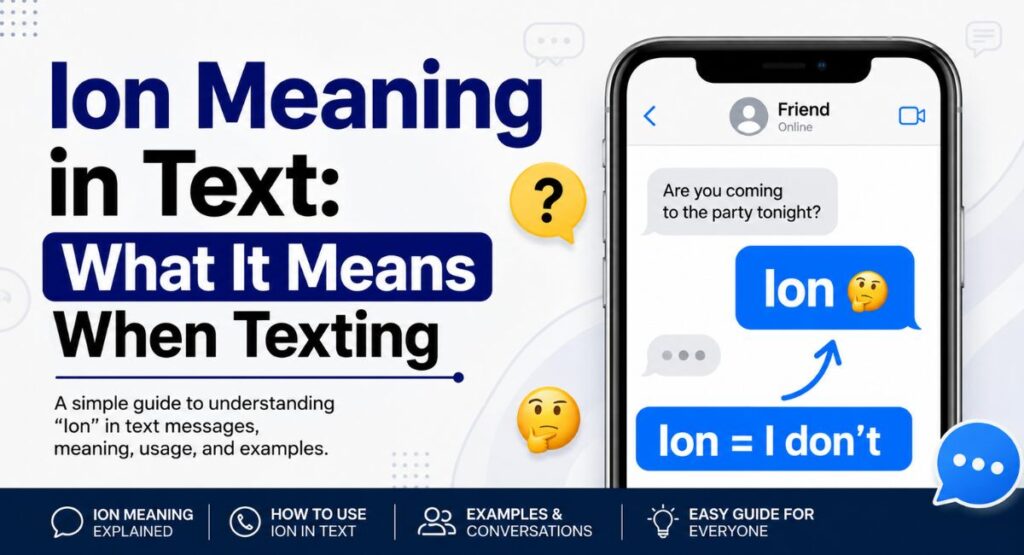
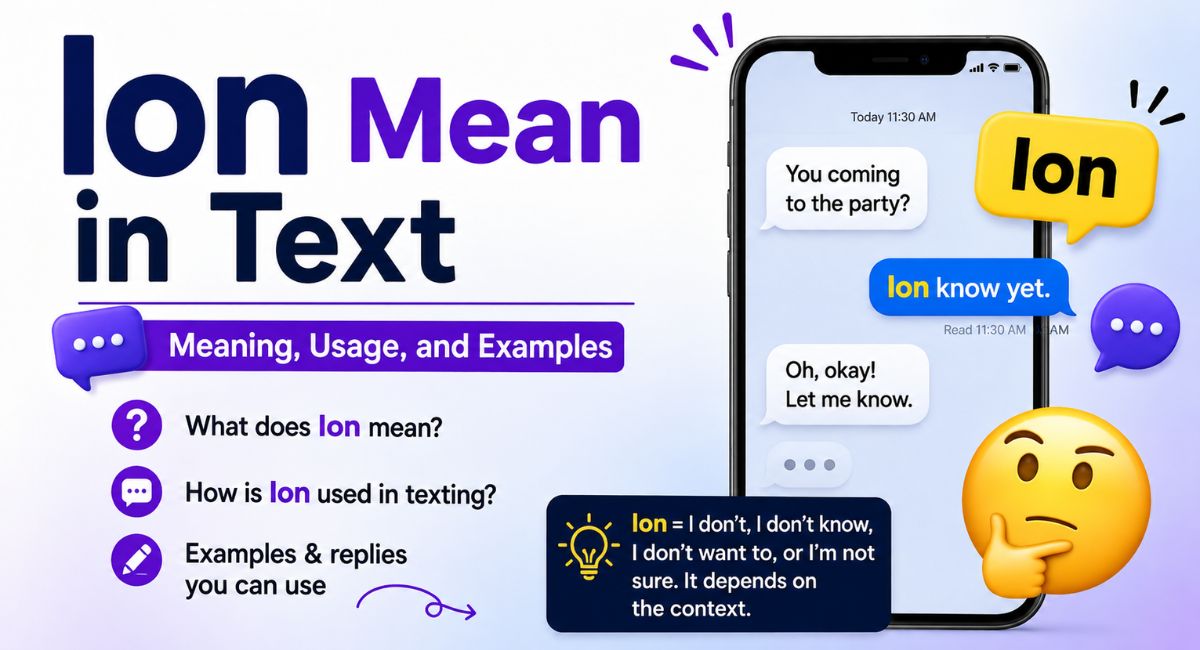
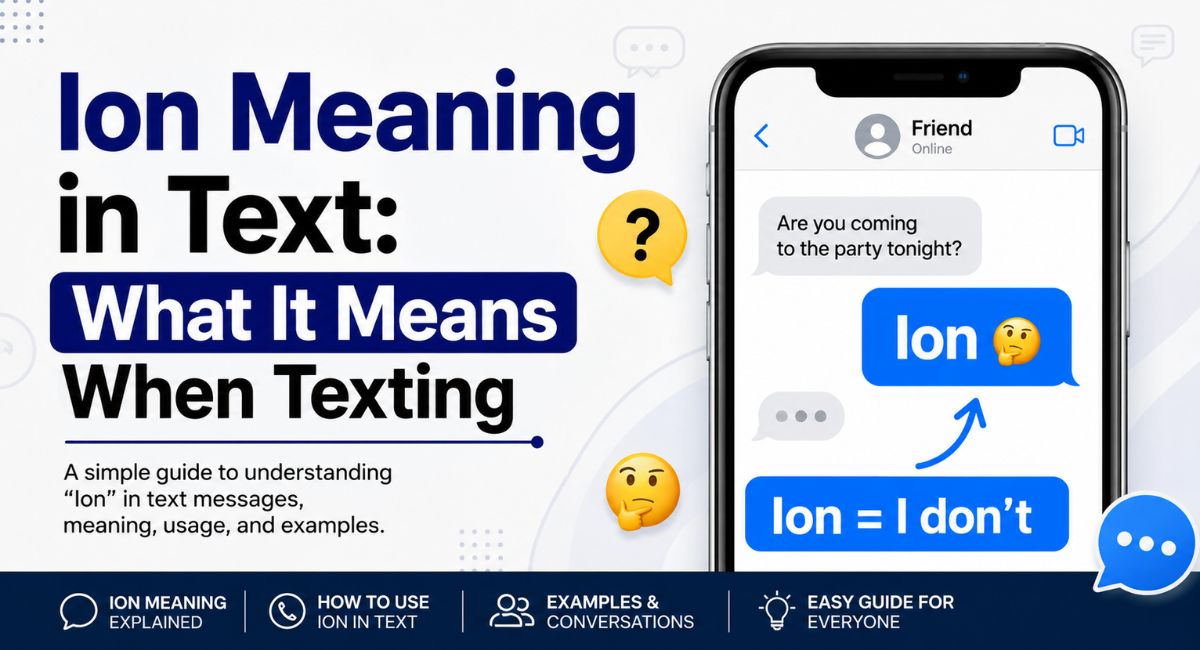
ION means “I don’t.” It’s a phonetic spelling — written the way people actually say it out loud when speaking quickly (“i-on” instead of “I don’t”). It’s used the same way you’d use “I don’t” in a sentence, just faster to type.
- ION = “I don’t”
- Common on WhatsApp, Instagram, TikTok, and group chats
- Comes from phonetic/spoken texting style, not an acronym
- Different from the science term “ion” (a charged particle)
Where ION Comes From
ION grew out of a texting style that spells words the way they sound when spoken casually, rather than how they’re spelled formally. It’s part of a wider pattern rooted in Black internet culture and AAVE-influenced texting, where phrases get shortened to match natural speech rhythm rather than traditional grammar.
This is different from acronyms like “IDK” (I Don’t Know), which are built from first letters. ION is a phonetic contraction — it represents a sound, not a set of initials.
Real Text Message Examples
| Message Sent | Reply Using ION | What It Means |
| “Are you coming to the party tonight?” | “Ion think so, I’m tired.” | “I don’t think so” |
| “Do you like this song?” | “Ion really care for it tbh.” | “I don’t really care for it” |
| “Why didn’t you text back?” | “Ion even see your message lol” | “I don’t (even see)” |
| “You should try the new restaurant.” | “Ion know, heard it’s expensive.” | “I don’t know” |
Notice ION almost always leads into the rest of the sentence naturally — “ion think,” “ion know,” “ion care” — the same way you’d use “I don’t” in normal speech.
ION vs. Ion (the Science Term)
| Texting Slang | Science Term | |
| Meaning | “I don’t” | An atom or molecule with an electric charge |
| Context | Casual chat, social media | Chemistry, physics, medicine |
| Example | “Ion wanna go out today” | “Sodium ions regulate nerve signals” |
If you see “ion” in a casual chat, it’s the slang version. If it shows up in a chemistry textbook, a medical explanation, or discussion of aircraft propulsion systems, it’s the scientific term — an atom that has gained or lost electrons and now carries a charge.
Where You’ll See ION Most
- WhatsApp & texting: used as a quick, casual way to disagree or decline
- Instagram captions/comments: common in memes and casual posts
- TikTok comments and captions: used to sound relaxed and unfiltered
When to Use It (and When to Avoid It)
Use it with: friends, casual group chats, social media captions.
Avoid it in: work emails, school assignments, or any formal writing — it reads as unprofessional outside casual texting.
ION vs. Similar Terms
| Term | Meaning | Formality |
| ION | I don’t | Very casual |
| IDK | I don’t know | Casual |
| IDC | I don’t care | Casual |
| TBH | To be honest | Casual |
FAQs
Is “ion” just a typo for the science term? No. It’s a deliberate phonetic spelling of “I don’t,” used intentionally in casual texting — not a mistake.
Is ION rude to use? Not on its own — it’s simply a fast way of saying “I don’t.” Tone depends on the rest of the message.
Can I use ION in a professional message? No, stick with “I don’t” spelled out fully in emails, school, or work contexts.