Someone texts you “ig” and your brain just… stalls. Is it “I guess”? Are they talking about Instagram? You reread the message twice, still not sure, and now you’re overthinking a two-letter reply.
Here’s the good news: once you know the two rules that separate the meanings, you’ll read “ig” correctly every single time — and you’ll know how to type it back without making a grammar mistake most non-native English speakers don’t even realize they’re making.
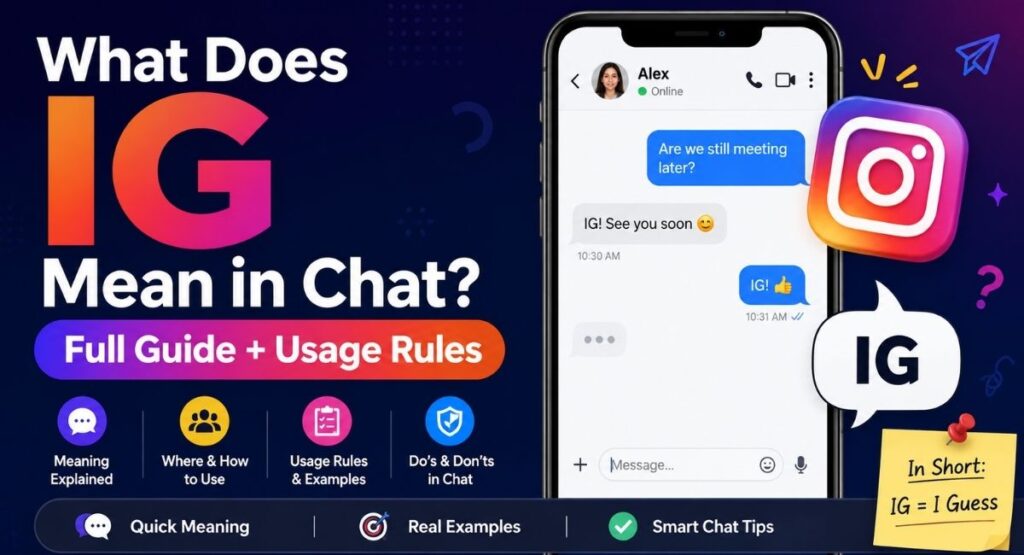
What Does IG Mean in Chat?
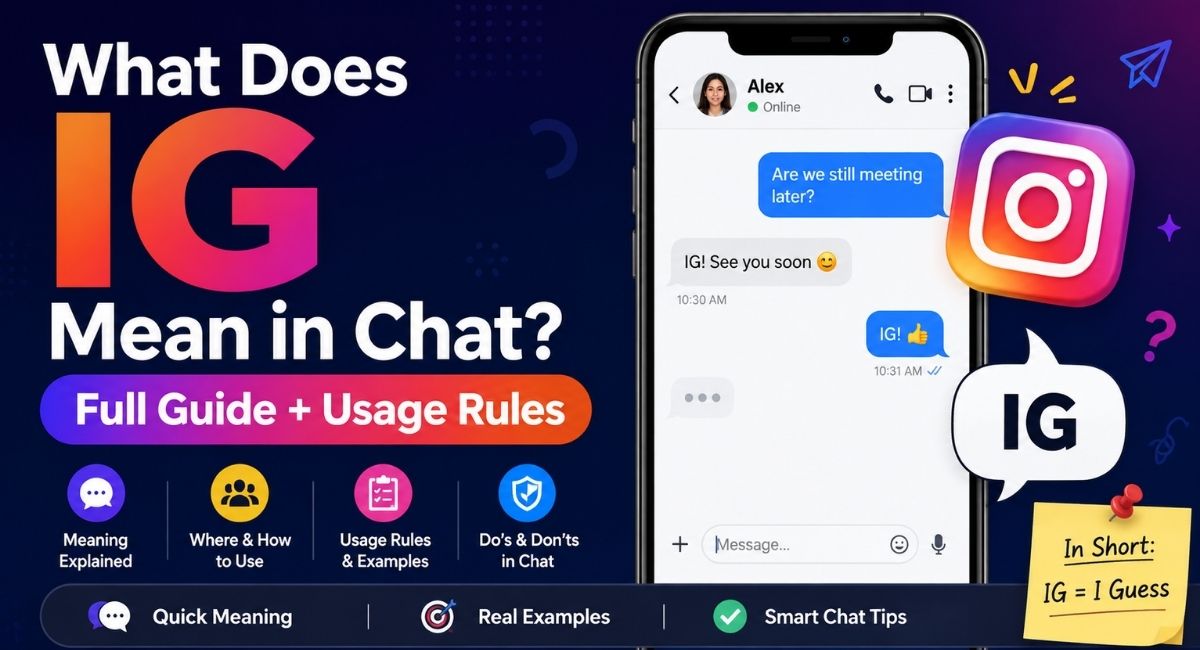
IG has two main meanings in chat: “I Guess” (a casual, low-commitment reply) and “Instagram” (the social media app). Which one applies depends entirely on what the conversation is actually about — not on capitalization, punctuation, or who’s texting.
Quick gut-check:
- Is the message reacting to a plan, opinion, or question? → I Guess
- Is the message about photos, posts, followers, or stories? → Instagram
That single filter resolves the ambiguity almost every time.
The Grammar Problem Nobody Talks About
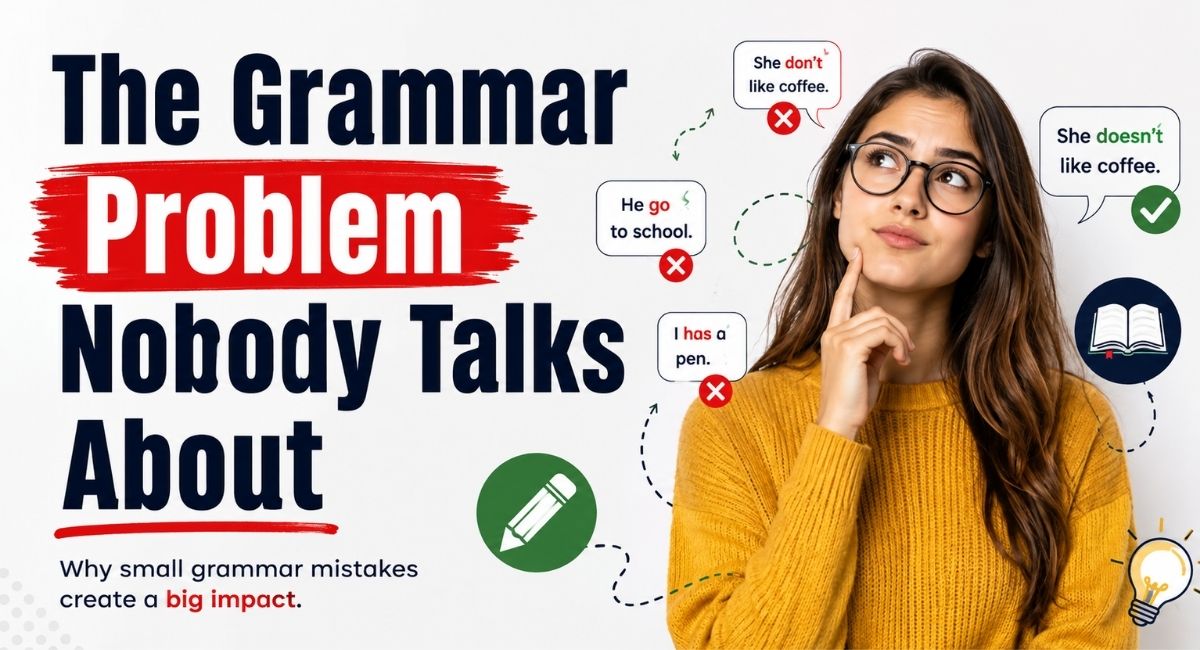
Here’s what most slang guides skip entirely: “ig” is not a proper sentence starter in standard written English, and using it that way in anything beyond casual texting is a common mistake for English learners.
“I guess” is a complete subject-verb clause. “Ig” is its texting shorthand — fine for WhatsApp, wrong for an email, a cover letter, or a school assignment. If you’re learning English and trying to build good writing habits, it helps to know exactly where the line is:
| Situation | Use “IG”? | Correct Form |
| Texting a friend | ✅ Yes | “ig we can go” |
| Instagram caption/bio | ✅ Yes | “check my ig” |
| Formal email | ❌ No | “I suppose that could work” |
| Essay or report | ❌ No | “It is assumed that…” |
| Job application message | ❌ No | “I believe this approach works” |
This is the gap that trips up a lot of grammar-conscious readers: they learn “ig” from chat, then accidentally carry it into formal writing because nobody ever told them it’s register-specific slang, not a grammatical shortcut.
“IG” as I Guess: How It Actually Works in a Sentence
When “ig” means “I guess,” it’s functioning as a sentence adverb — a soft qualifier tacked onto the front or end of a thought to signal mild uncertainty.
Correct usage examples:
- “ig that works” ✅ (natural, casual)
- “ig, I’ll come later” ✅ (comma optional, still reads fine)
- “we can reschedule, ig” ✅ (works at the end too)
Incorrect or awkward usage:
- “Ig. I will attend the meeting.” ❌ — mixing formal punctuation with slang looks inconsistent
- “IG is correct, please advise” ❌ — using slang inside a professional request confuses the tone
- “My ig opinion is…” ❌ — “ig” can’t function as an adjective; it only works as a standalone qualifier
Why this matters: English learners often try to “insert” slang into grammatically formal sentences because they’ve only seen it used loosely. The rule to remember is simple — “ig” replaces the whole phrase “I guess,” it doesn’t modify other words around it.
“IG” as Instagram: When Context Flips the Meaning
When the topic shifts to photos, stories, followers, or the platform itself, “ig” almost always means Instagram — and it works as a proper noun abbreviation, similar to how people write “FB” for Facebook.
Correct usage:
- “Follow me on ig” ✅
- “Did you see the ig story?” ✅
- “My ig is private” ✅
Common mistake: People sometimes lowercase brand-style abbreviations inconsistently, which is technically fine in casual chat (no strict rule enforces capitalization here) but looks inconsistent in anything you’re publishing publicly, like a caption or a bio meant to look polished. If you’re writing content professionally, capitalizing it as “IG” reads slightly more intentional than lowercase “ig.”
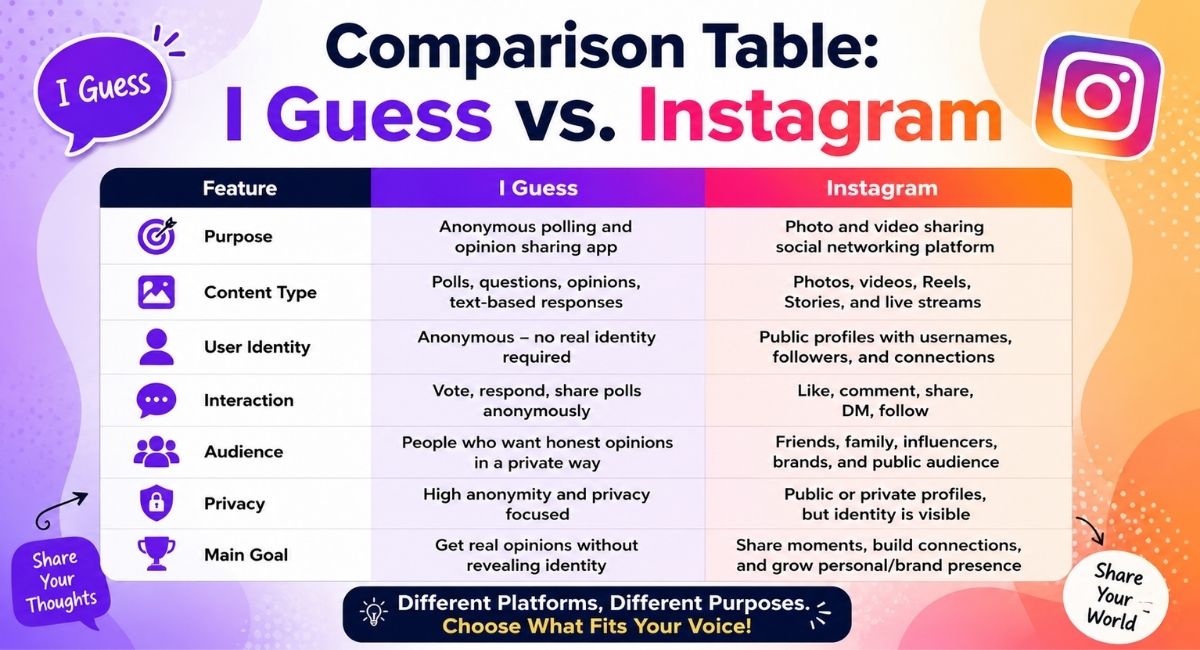
Comparison Table: I Guess vs. Instagram
| Feature | IG = I Guess | IG = Instagram |
| Grammar role | Sentence adverb / filler phrase | Proper noun abbreviation |
| Formal writing use | Never appropriate | Rare, only in casual marketing copy |
| Typical position in sentence | Start, middle, or end | Usually as subject or object |
| Tone conveyed | Mild uncertainty, low commitment | Neutral, factual reference |
| Real example | “ig we’ll see” | “check ig for updates” |
Why “IG” Confuses Non-Native English Speakers Specifically
This is worth calling out directly, since it’s the exact audience searching this term most often: learners who are already unsure about English grammar find abbreviations like “ig” harder than native speakers do, because native speakers rely on tone and instinct, while learners are actively looking for a rule.
The honest answer is there isn’t one fixed rule — but there is a reliable pattern:
- If you could replace “ig” with “I suppose” and the sentence still makes sense, it means I Guess.
- If you could replace “ig” with “Instagram” and the sentence still makes sense, it means Instagram.
Try it yourself: “ig we can go later” → “I suppose we can go later” ✅ makes sense. “did you post it on ig” → “did you post it on Instagram” ✅ also makes sense. This substitution test works almost every time and is a far more reliable method than guessing from tone alone.
Where “IG” Comes From
“I guess” as texting shorthand traces back to early SMS and instant-messenger culture, when character limits and typing speed pushed people to abbreviate common phrases. Instagram’s 2010 launch introduced a second, competing meaning for the same two letters, and both usages have simply coexisted ever since — readers rely on context to tell them apart, exactly as they do with dozens of other overloaded internet acronyms.
IG in Other Fields (Not Slang)
Outside of texting, “IG” carries entirely different, professional meanings:
- Immunoglobulin — antibody proteins, used in medical and lab contexts
- Inspector General — an oversight role in government or military bodies
- Ignition — common shorthand in automotive and mechanical contexts
If a coworker in a clinical or government setting sends “IG levels” or “IG report,” none of the chat meanings apply — professional context overrides slang meaning instantly.
Common Mistakes to Avoid
- Don’t assume IG always means Instagram — most casual texting uses actually skew toward “I Guess.”
- Don’t use “ig” in formal writing — it reads as unpolished in essays, emails, or professional messages.
- Don’t over-punctuate it — adding a period (“ig.”) can unintentionally make a casual reply feel cold or dismissive.
- Don’t confuse tone with rudeness — “ig” is neutral by default; it only reads as short or uninterested when paired with terse punctuation.
Quick Answer (For Skimmers)
IG in chat means “I Guess” when replying casually, or “Instagram” when the topic is about the app. Use the substitution test — swap in “I suppose” or “Instagram” — to know instantly which one fits.
FAQs
1. What does IG mean in chat?
IG usually means “I Guess,” a casual way to show mild agreement or uncertainty. It can also mean “Instagram” when the conversation is about the app.
2. Is it correct to start a sentence with “ig”?
It’s acceptable in casual texting but not in formal writing. In essays or professional messages, use the full phrase “I suppose” or “I assume” instead.
3. How do I know if IG means Instagram or I Guess?
Try substituting “I suppose” or “Instagram” into the sentence — whichever one still makes sense is the correct meaning.
4. Is “ig” grammatically correct English?
“Ig” is informal shorthand, not standard grammar. It’s fine in texting but should be avoided in formal or academic writing.
5. Does capitalizing IG change its meaning?
No. Capitalization doesn’t reliably change meaning — context (what the conversation is about) is the only real indicator.