ICL Meaning: You’re scrolling through a group chat, and someone drops: “icl your last post was actually kind of iconic.” No punctuation. No capital letters. Just three lowercase letters sitting at the start of a sentence like they own the place.
If you paused to figure out whether that was a typo, an inside joke, or a new coding language — you’re not alone. ICL is one of those acronyms that spreads faster than dictionaries can keep up with, and it trips up even confident English speakers because it breaks normal sentence rules on purpose.
This guide doesn’t just tell you what ICL means. It walks through the grammar behind it — capitalization, punctuation, sentence placement — so you can actually use it correctly instead of just recognizing it.
What Does ICL Mean?
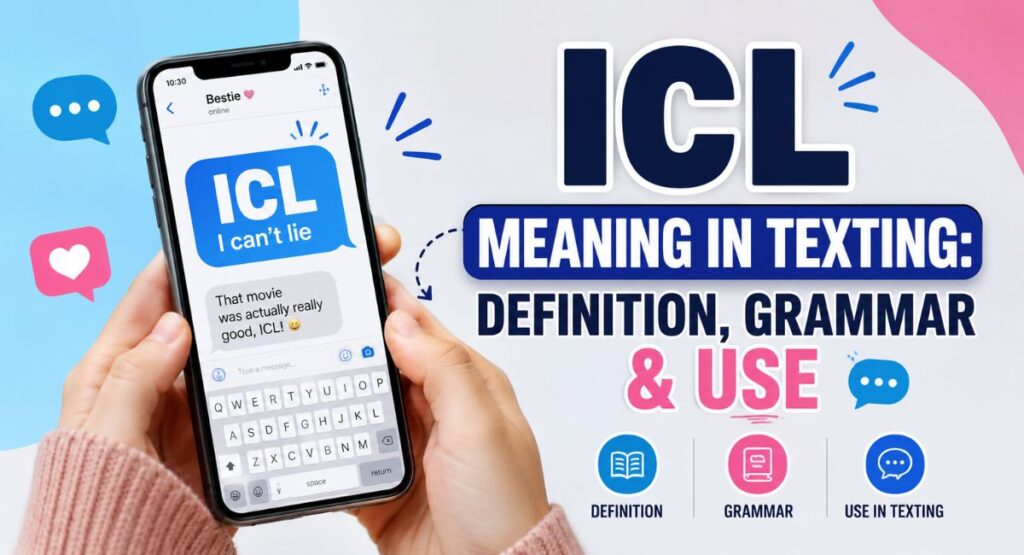
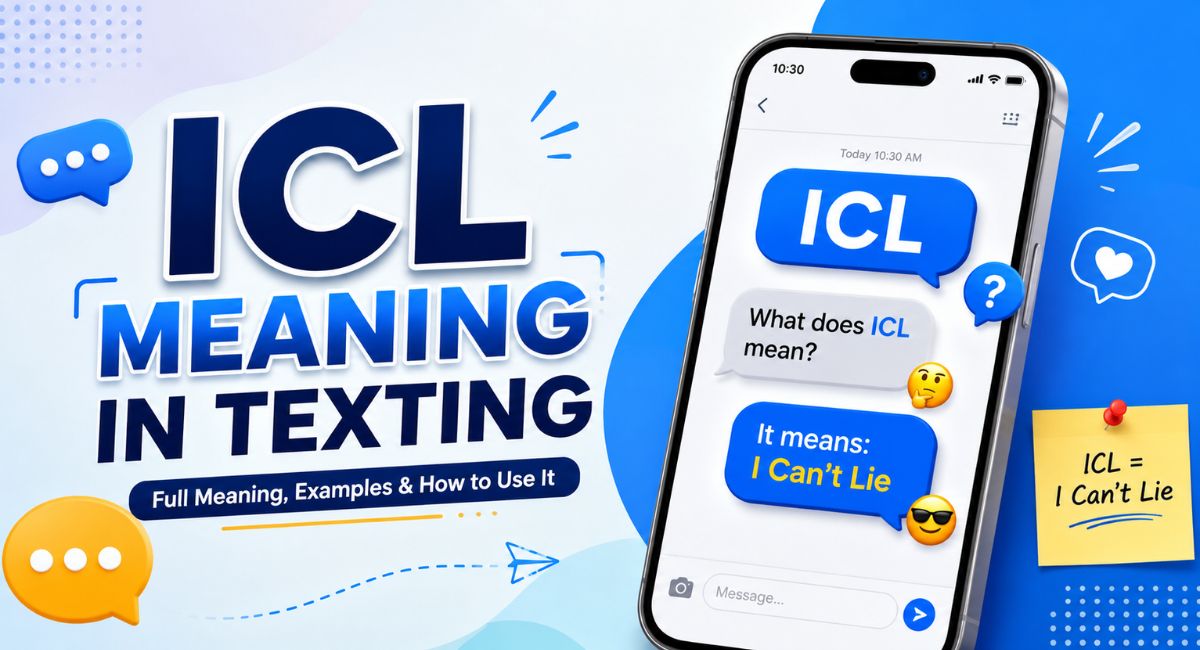
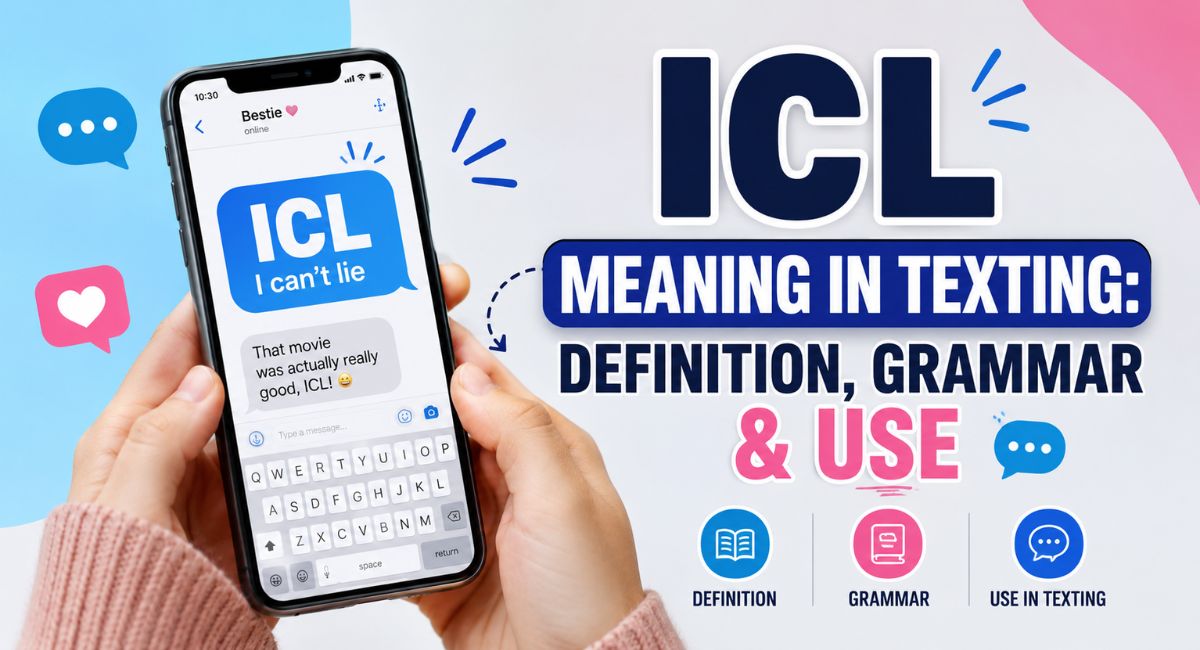
ICL stands for “I Can’t Lie.” It’s used as a sentence opener to signal that what follows is an honest, unfiltered opinion — even if that opinion is a little embarrassing, blunt, or unexpected.
Think of it as a verbal disclaimer. The speaker is telling you: I’m not sugarcoating this, and I’m not exaggerating either.
Quick examples:
- “icl I’ve watched that show four times this month”
- “ICL your cooking has gotten so much better”
- “icl I don’t even remember what happened last night”
Notice something? In real usage, ICL almost never gets a period after it, and it’s usually lowercase. That’s not sloppy writing — it’s a pattern. More on why that matters in the grammar section below.
Part of Speech: What Grammatical Category Does ICL Belong To?
This is where most slang guides stop short, and it’s exactly where confusion starts for non-native speakers and grammar-conscious readers.
ICL is not a noun, verb, or adjective. It functions as a discourse marker — a word or phrase that frames how a sentence should be interpreted, without changing the sentence’s actual grammar.
Discourse markers don’t attach to the sentence structure the way subjects and verbs do. You can remove ICL from any sentence and the sentence still stands grammatically:
| With ICL | Without ICL | Still Grammatical? |
| “ICL that test was hard” | “That test was hard” | Yes |
| “icl I miss my old job” | “I miss my old job” | Yes |
| “ICL she’s right about this” | “She’s right about this” | Yes |
This is the same grammatical role played by phrases like “honestly,” “to be fair,” or “not gonna lie.” ICL just compresses one of those phrases into three letters.
Is ICL Capitalized? The Capitalization Rule Explained
No fixed rule exists — but usage patterns are consistent. Across texting, comments, and captions, ICL appears in lowercase (icl) far more often than in full capitals.
Here’s why that matters grammatically, not just stylistically:
- Standard acronyms (like NASA or FBI) are capitalized because each letter represents a distinct, formal word.
- Texting acronyms like icl, ngl, and tbh have drifted toward lowercase because they function more like casual interjections than formal abbreviations.
The practical rule: Use lowercase (icl) in casual texting, DMs, and comments. Use uppercase (ICL) if you’re writing a caption, heading, or anything meant to be read as a standalone statement. Neither is “wrong” — but lowercase signals casualness, and that’s usually the entire point of using the acronym.
Common Mistakes People Make With ICL
Even fluent speakers misuse this one. Here are the mistakes that come up most often:
- Adding a period after ICL. Writing “ICL. That was rude.” breaks the casual tone the acronym is meant to create. Drop the period; let it flow straight into the sentence.
- Capitalizing it mid-sentence. “That was, ICL, a bad decision” looks awkward. Discourse markers like this sit at the start of a sentence, not buried inside one.
- Using it in formal writing. ICL has no place in an email to a professor, a resignation letter, or a report. It signals informality, and using it in formal contexts undercuts credibility.
- Confusing it with “I can log.” This misreading shows up occasionally in gaming or tech-adjacent chats. Context almost always makes the correct meaning obvious — “I Can’t Lie” fits conversational, opinion-based sentences.
- Pronouncing the letters out loud. Saying “eye-see-ell” in person will get you confused looks. Say the full phrase, “I can’t lie,” instead — the acronym only exists for typing speed.
Where ICL Came From
“I can’t lie” as a spoken phrase has existed in casual English for decades — people have always used it to preface a strong or surprising opinion. The three-letter acronym version, though, is much newer.
ICL picked up momentum online around 2020, growing largely out of UK youth slang and drill-adjacent social media culture before crossing over into broader Gen Z texting habits worldwide. Its spread follows a pattern common to most texting acronyms: a common spoken phrase gets compressed for speed, then the compressed version outlives its original context and becomes its own standalone piece of internet vocabulary.
How ICL Is Used Across Platforms
The core meaning of ICL doesn’t shift by platform, but the tone around it does.
| Platform | Typical Use | Example |
| TikTok comments | Reacting honestly to a video | “icl this edit is actually insane” |
| Replying to stories or posts | “ICL you should post more often” | |
| X (Twitter) | Framing an opinion before a take | “icl the sequel was better than the original” |
| Snapchat / DMs | Casual private confessions | “icl I stayed up till 4am again” |
| Discord | Gaming callouts or compliments | “icl that clutch was actually clean” |
ICL vs. Similar Slang: What’s the Real Difference?
ICL gets grouped with a handful of similar acronyms, but they aren’t perfectly interchangeable. Here’s how they actually differ in tone and grammatical use:
| Term | Full Meaning | Part of Speech | Tone Difference |
| ICL | I Can’t Lie | Discourse marker | Honest, slightly confessional |
| NGL | Not Gonna Lie | Discourse marker | Nearly identical to ICL; used interchangeably |
| TBH | To Be Honest | Discourse marker | Slightly more neutral, less confessional |
| IMO | In My Opinion | Discourse marker | States a view without implying a confession |
| ISTG | I Swear To God | Discourse marker / interjection | Stronger emphasis, closer to an oath than an opinion softener |
Why this matters: ICL and NGL are close enough to swap freely. TBH and IMO, while similar, carry a slightly more neutral tone — they don’t imply the speaker is admitting something. Mixing these up isn’t a grammar error, but it can shift how blunt or vulnerable your message sounds.
Is ICL Appropriate for Kids and Formal Settings?
For casual use, yes — ICL is safe. The acronym itself carries no offensive or explicit meaning. It’s a harmless shortcut for “I can’t lie,” and it shows up in completely everyday contexts like “icl I hate Mondays.”
For formal use, no. Avoid ICL in:
- Emails to teachers, professors, or employers
- Academic writing or essays
- Professional Slack or workplace messages
- Any communication where slang undermines credibility
The content following “ICL” is what actually needs checking for appropriateness — the acronym itself isn’t the concern; what someone admits after it might be.
When to Use ICL (And When to Skip It)
Use it when:
- You’re softening a blunt or mildly unpopular opinion
- You’re giving a genuine, unfiltered compliment
- You want a casual text to feel more personal and less flat
- You’re admitting a small, low-stakes mistake
Skip it when:
- You’re writing anything formal or professional
- You’re speaking out loud (say “I can’t lie” instead)
- The person you’re texting doesn’t use or recognize internet slang
- You’re delivering serious news that needs a respectful, non-casual tone
ICL Meaning: FAQs
What does ICL mean in a text message? ICL means “I Can’t Lie.” It’s used at the start of a sentence to signal that the opinion or statement that follows is honest, even if it’s a little blunt or surprising.
Is ICL the same as NGL? Yes, ICL and NGL are essentially interchangeable. ICL stands for “I Can’t Lie” and NGL stands for “Not Gonna Lie” — both function as discourse markers that introduce an honest opinion.
Should ICL be capitalized? There’s no strict rule, but lowercase (icl) is far more common in casual texting and comments. Capitalizing it (ICL) is fine for captions or headings but reads more formal than typical usage.
Does ICL need a period after it? No. Adding a period after ICL (“ICL. That was harsh.”) breaks the casual, flowing tone the acronym is meant to create. It typically runs directly into the sentence without punctuation.