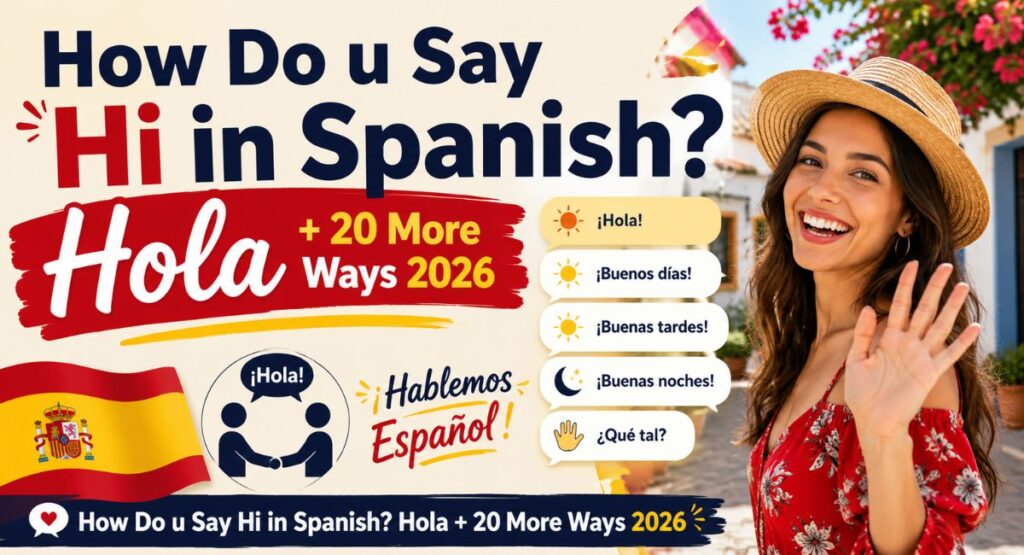
Quick Answer: The most common way to say hi in Spanish is “Hola” (pronounced OH-lah). It works in almost every situation — casual, formal, spoken, or written — and it’s the one word every beginner should learn first.
If grammar rules make your head spin, you’re in the right place. This guide skips the confusing textbook jargon and breaks down exactly how do u say hi in Spanish, step by step, with pronunciation you can actually follow.
No verb conjugations to memorize. No complicated sentence structure. Just one simple word that opens the door to real conversations.
Let’s start there.
How Do u Say Hi in Spanish?
The direct translation of “hi” in Spanish is:
- Hola = Hi / Hello
That’s it. One word. No gender agreement, no verb changes, no plural form to worry about — “Hola” stays exactly the same no matter who you’re talking to. This makes it one of the easiest Spanish words for beginners to learn correctly on the first try.
Key facts about “Hola”:
- The H is silent — you pronounce it “OH-lah,” not “HO-lah”
- It works for both formal and informal situations
- It doesn’t change based on who you’re speaking to (unlike many Spanish words)
- It’s used in speech, texting, email, and even business settings
How to Pronounce “Hola” (So You Don’t Sound Like a Beginner)
Pronunciation trips up more English speakers than grammar does. Here’s the breakdown so you get it right immediately.
The Silent H Rule
In Spanish, the letter H is always silent. This is one of the first grammar rules beginners should lock in, because it applies to dozens of common words, not just “hola.”
| Word | Looks Like | Sounds Like |
| Hola | HO-la | OH-lah |
| Hasta | HAS-ta | AHS-tah |
| Hombre | HOM-bre | OHM-bray |
Breaking It Down Phonetically
- H = silent (don’t pronounce it at all)
- O = “oh” sound
- L = soft “l,” same as in English
- A = “ah” sound
Put together smoothly: OH-lah. Avoid choppy pronunciation like “ho…la” — Spanish flows in one connected sound.
Formal vs. Informal Ways to Say Hi in Spanish
This is where a lot of English speakers get confused, because English doesn’t really separate “formal you” from “casual you” — but Spanish does. Understanding this one grammar concept will instantly make your greetings sound more natural.
Informal Greetings (Friends, Family, Peers)
Use these with people your own age, friends, and family:
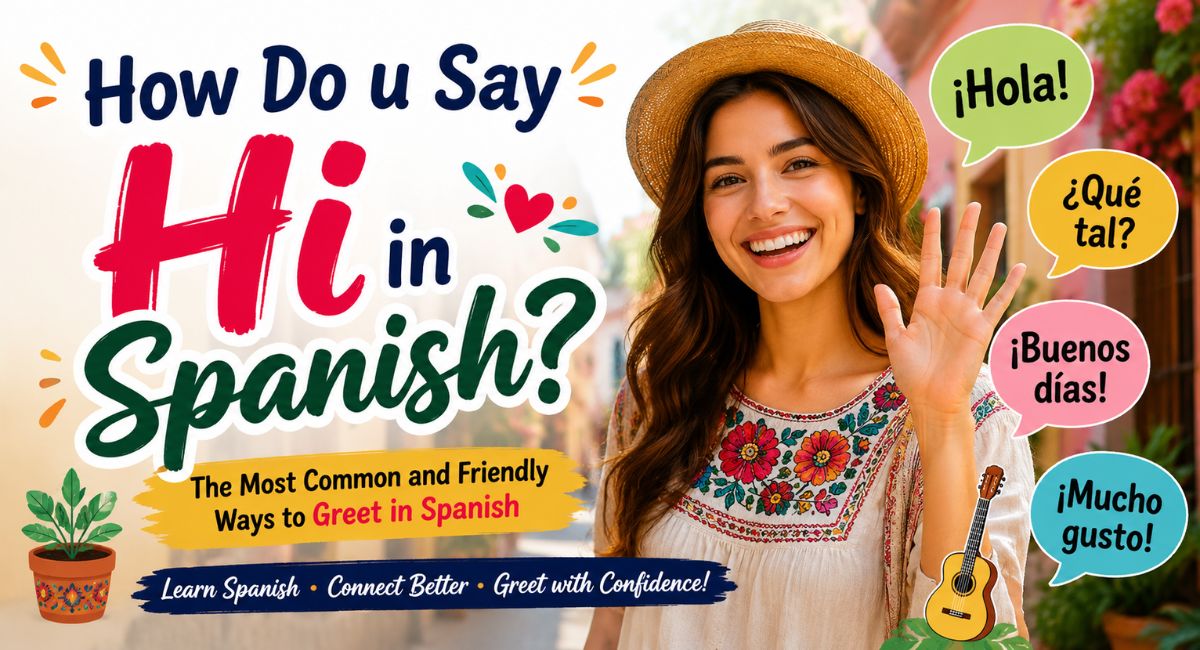
- Hola – Hi
- ¿Qué tal? – How’s it going?
- ¿Cómo estás? – How are you? (informal “you”)
- ¿Qué pasa? – What’s up?
Formal Greetings (Strangers, Elders, Professionals)
Use these with people you don’t know well, older adults, or in business settings:
- Buenos días – Good morning
- Buenas tardes – Good afternoon
- Buenas noches – Good evening/night
- ¿Cómo está usted? – How are you? (formal “you”)
Grammar tip: Notice the difference between estás and está. This small verb change signals respect — using the wrong form isn’t “wrong” grammatically, but it can sound too casual for the situation. As a beginner, if you’re unsure, default to the formal version with strangers.
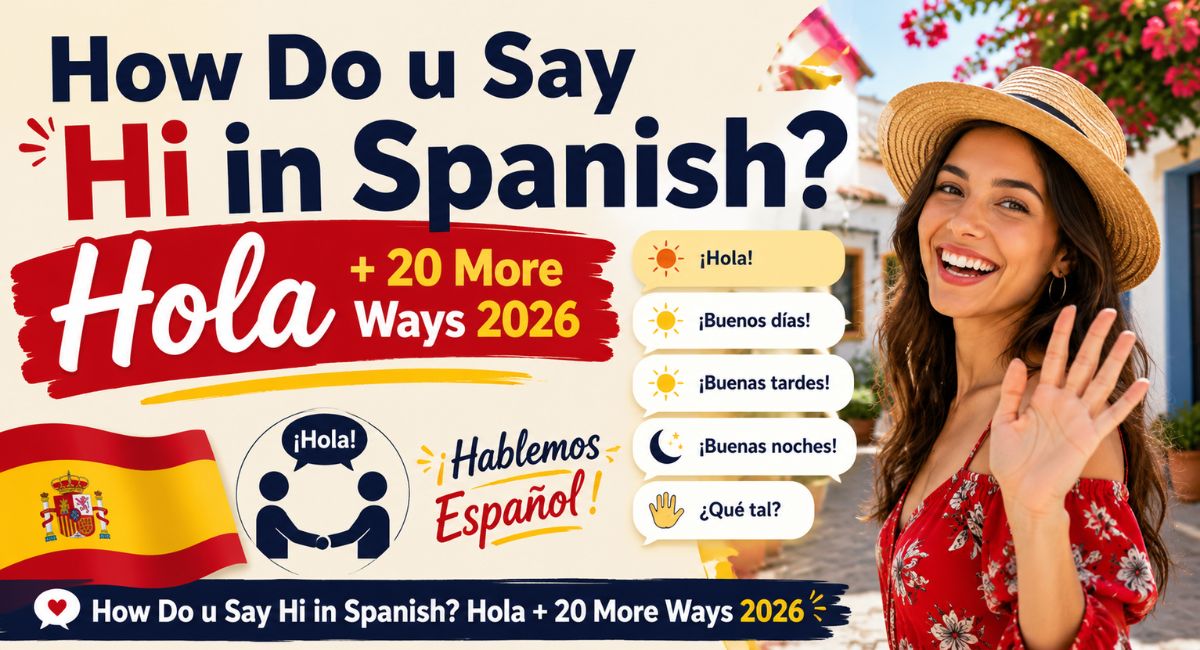
Quick Comparison Table: Every Common Way to Say Hi in Spanish
| Greeting | Meaning | When to Use It | Formality |
| Hola | Hi / Hello | Anytime, anywhere | Neutral |
| ¿Qué tal? | How’s it going? | Friends, casual chats | Informal |
| ¿Cómo estás? | How are you? | People you know | Informal |
| ¿Cómo está usted? | How are you? | Elders, professionals | Formal |
| Buenos días | Good morning | Before noon | Formal |
| Buenas tardes | Good afternoon | Noon–evening | Formal |
| Buenas noches | Good evening/night | Evening, or as goodbye | Formal |
| Buenas | Hi (shortened) | Shops, elevators, casual | Semi-formal |
| ¿Qué onda? | What’s up? | Mexico, close friends | Slang |
| ¿Qué más? | What’s up? | Colombia, casual | Slang |
The Grammar Behind “¿Cómo Estás?” (Explained Simply)
Since estás is technically a conjugated verb, it can look intimidating. Here’s the plain-English breakdown so it actually makes sense.
The verb is estar (to be — used for temporary states, like feelings or location). When you greet someone with “How are you?”, the verb changes based on who you’re talking to:
| Person | Verb Form | Example |
| You (informal, singular) | estás | ¿Cómo estás? |
| You (formal, singular) | está | ¿Cómo está? |
| You (plural, Latin America) | están | ¿Cómo están? |
You don’t need to memorize the full verb conjugation to greet someone — just remember: estás = casual, está = polite. That’s the practical rule beginners actually need.
Punctuation Rule Beginners Always Miss: The Upside-Down Question Mark
If you’ve ever seen ¿Cómo estás? and wondered why there’s a backward question mark at the start, here’s the grammar explanation:
- Spanish uses an opening inverted question mark (¿) at the start of a question and a normal one (?) at the end.
- This rule also applies to exclamations, using ¡ at the start.
- It exists to warn the reader that a question is coming — helpful since Spanish sentence structure doesn’t always flip word order the way English does.
Example:
- ¿Cómo estás? → “How are you?”
- ¡Hola! → “Hi!”
You’ll see this constantly, so recognizing it (even if you don’t type it perfectly) will help your reading comprehension a lot.
Common Grammar Mistakes English Speakers Make
Since many learners come from an English grammar background, these are the mistakes that show up most often.
- Mixing formal and informal in the same sentence
- ❌ “¿Cómo estás usted?” (mismatched)
- ✅ Either “¿Cómo estás?” (informal) or “¿Cómo está usted?” (formal)
- Pronouncing the H
- ❌ “HO-la”
- ✅ “OH-la” (H is silent)
- Forgetting the greeting equivalent of “you”
- Spanish separates “tú” (informal you) and “usted” (formal you) — English doesn’t. This affects verb endings, not just vocabulary.
- Overusing slang before mastering the basics
- Terms like “qué onda” are regional and casual. Learn “Hola” and “Buenos días” solidly first, then branch out.
- Treating “Buenas noches” as only “good night”
- It also means “good evening” when used as a greeting, not just a farewell. Context tells you which one it means.
How to Respond When Someone Greets You
Knowing how to say hi is half the skill — responding naturally is the other half.
| They Say | You Can Reply |
| Hola | Hola |
| ¿Cómo estás? | Bien, gracias. ¿Y tú? (Good, thanks. And you?) |
| ¿Qué tal? | Todo bien (All good) |
| Buenos días | Buenos días |
Simple beginner exchange:
Person 1: Hola, ¿cómo estás? Person 2: Bien, gracias. ¿Y tú? Person 1: Muy bien.
Short, natural, and grammatically safe for beginners.
Hi in Spanish by Country (Slang Variations)
Spanish greetings shift by region, similar to how “hi” vs. “howdy” vs. “yo” vary across English-speaking countries.
- Mexico: ¿Qué onda? (What’s up?)
- Spain: ¿Qué tal? / Buenas
- Colombia: ¿Qué más?
- Argentina: Che, ¿todo bien?
These are useful to recognize, but as a beginner focused on grammar accuracy, stick to “Hola” and the formal/informal basics until you’re comfortable — slang breaks standard grammar rules on purpose, which can confuse new learners.
Texting and Casual Written Spanish
Spanish greetings look a little different in text messages and social media:
- Holaaa – Hii (extra vowels add warmth/casualness)
- Holi – a cute, playful version of hola
- Ey – Hey (borrowed from English)
These aren’t “correct” formal grammar, but they’re common in real conversations — good to recognize even if you don’t use them yet.
5-Day Practice Plan for Beginners
If you want to actually retain this instead of forgetting it tomorrow, spread it out:
- Day 1: Hola, Buenos días
- Day 2: ¿Cómo estás? / Bien, gracias
- Day 3: Buenas tardes, Buenas noches
- Day 4: ¿Qué tal? and how to respond
- Day 5: Put it together in a full mini-conversation
Small, consistent repetition beats cramming — especially for grammar patterns like tú/usted, which need practice to become automatic.
Frequently Asked Questions
How do u say hi in Spanish?
The most common way is “Hola,” pronounced OH-lah with a silent H. It works in nearly every casual or formal situation.
Is “Hola” formal or informal?
“Hola” is neutral — it works in both casual and formal settings, unlike many other Spanish greetings that change based on politeness level.
What’s the difference between “Hola” and “Buenos días”?
“Hola” simply means “hi” and works anytime. “Buenos días” specifically means “good morning” and is used before noon, often in more formal settings.
Why is there an upside-down question mark before Spanish questions?
The inverted question mark (¿) signals to the reader that a question is coming, since Spanish sentence structure doesn’t always rearrange words the way English does for questions.
Do I need to conjugate a verb just to say hi?
No. “Hola” requires zero conjugation. Verb changes (like estás vs. está) only come into play with follow-up phrases like “How are you?”
Final Thoughts
You don’t need perfect grammar to say hi in Spanish — you just need “Hola.” Everything else in this guide (formal vs. informal, verb endings, punctuation rules) is there to help you grow after you’ve mastered that one word with confidence.
Master these five first:
- Hola
- Buenos días
- Buenas tardes
- Buenas noches
- ¿Cómo estás?
Then build from there. Every native speaker started with exactly the same word you’re learning today.