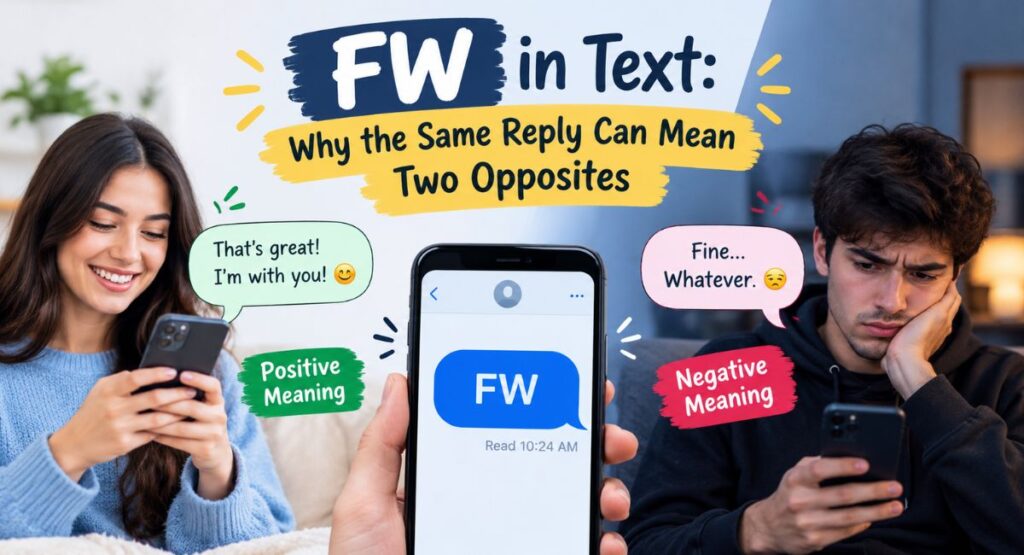
FW IN TEXT: Someone sends you: “I fw you.”
Is that a compliment, a flirt, or a threat? Now imagine the same two letters in your inbox: “FW: Invoice March.” Nobody is flirting there.
That is the problem with FW. It is short, it is everywhere, and it changes meaning depending on punctuation, capitalization, and what comes after it. Let’s sort it out.
What Does FW Mean?
In texting and social media, FW usually means “f*** with,” used to say you like, support, trust or get along with someone or something. In email, FW means “forward.” Context and punctuation decide which one applies: an “FW:” with a colon in a subject line is email, while a lowercase “fw” in a chat is slang.
The full phrase is profane, but the abbreviation is mostly used casually and positively. It is still informal, so keep it out of work chats, school writing, and anything you’d show a parent or a boss.
What FW Stands For in Slang
The slang meaning comes from the phrase “f*** with.” The phrase is widely traced to African American Vernacular English and spread further through hip-hop and social media. In that phrase, “with” carries the meaning of association: to fw something is to be on its side.
In practice, it covers four shades of meaning:
- Like or enjoy: “I fw this song.”
- Support or respect: “I fw her content.”
- Get along with or hang around: “Do you still fw him?”
- Trust: “That’s someone I fw.”
FW Is Not “Friends With”
A common guess is that FW means “friends with.” It doesn’t. The confusion is understandable because “Do you fw him?” can sound like “Are you friends with him?” But the abbreviation stands for “f*** with,” and it can describe a song, a food, or a trend just as easily as a person.
The Grammar of FW (Why It Behaves the Way It Does)
This is where most guides stop, and where the confusion actually gets solved. FW follows predictable grammar rules, and knowing them helps you read any message correctly.
FW works like a verb
Because it stands for a verb plus a preposition (“f*** with”), it acts like a verb and takes an object. “I fw that outfit.” “She fw my playlist.” Whatever follows FW is the thing being liked, supported, or trusted.
Don’t add “with” again
Since the “with” is already inside FW, writing “fw with” is redundant. “I fw with him” repeats itself, much like saying “I like of him.” You will still see it in real chats, but “I fw him” is the cleaner form.
Negation uses the normal helper verbs
To say the opposite, people use the usual helpers: “I don’t fw that,” “I ain’t fw it,” “we don’t fw drama.” The meaning flips to dislike, distrust, or refusal to take part.
Ending letters rarely change
Slang abbreviations usually stay fixed. You’ll typically see “she fw him” rather than a version with an added -s. That is a usage habit, not a formal rule, so don’t treat it as an error either way.
Capitalization and punctuation are the giveaway
- Lowercase “fw” with no colon, inside a sentence: slang.
- Uppercase “FW:” with a colon, at the start of a subject line: email forward.
If you remember only one thing from this article, remember the colon.
Real Chat Examples
Here is how FW shows up in real conversations. Notice how the meaning shifts each time.
Example 1: The compliment
Zara: Did you hear the new EP?
Hamza: yeah i fw it heavy
Zara: told you 😂
Meaning: Hamza likes it a lot. Positive, casual, no hidden edge.
Example 2: The friendship check
Areeba: you still fw Danish?
Sana: not really, he stopped replying after the trip
Areeba: ah ok
Meaning: Areeba is asking whether Sana still gets along with or talks to Danish. It is a question about the relationship, not about liking a song.
Example 3: The warning
Bilal: he keeps posting about me
Usman: bro don’t fw me, I’ll tell him to stop
Meaning: Here “don’t fw me” is closer to “don’t mess with me” or “don’t test me.” Same letters as the compliment, opposite tone.
That third example is the one most beginners miss. Depending on the sentence, “f*** with” can mean “I’m on your side” or “I’m not to be provoked.”
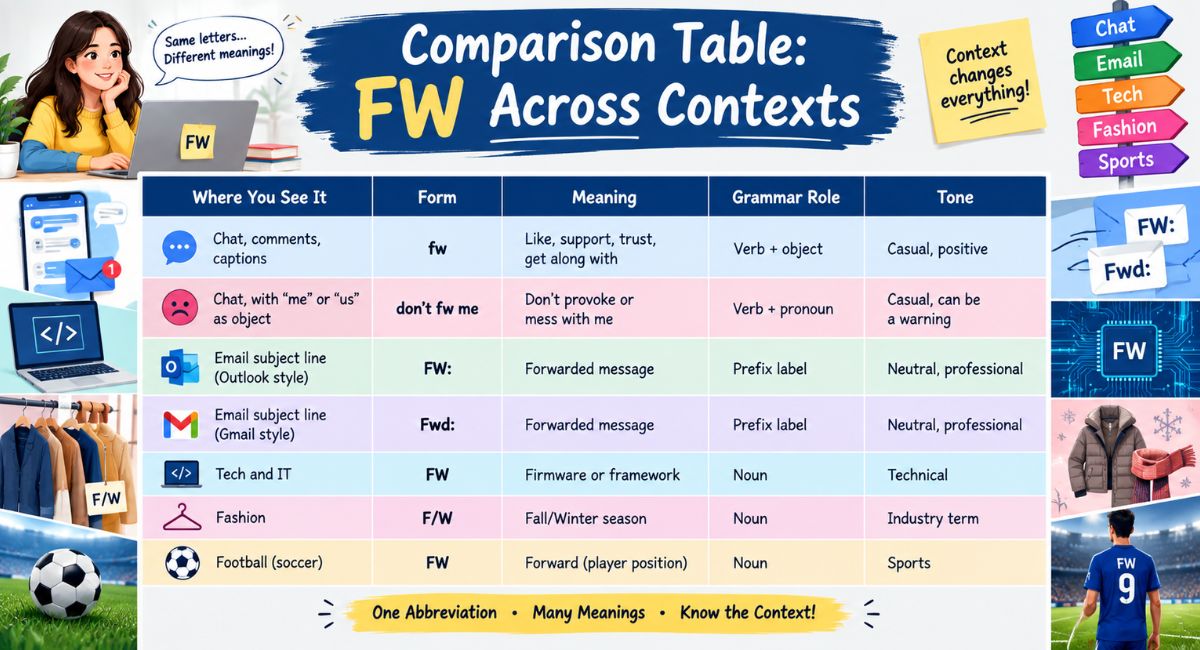
Comparison Table: FW Across Contexts
| Where you see it | Form | Meaning | Grammar role | Tone |
| Chat, comments, captions | fw | Like, support, trust, get along with | Verb + object | Casual, positive |
| Chat, in a negative sentence | don’t fw / ain’t fw | Dislike, refuse, avoid | Negated verb | Casual, firm |
| Chat, with “me” or “us” as object | don’t fw me | Don’t provoke or mess with me | Verb + pronoun | Casual, can be a warning |
| Email subject line (Outlook style) | FW: | Forwarded message | Prefix label | Neutral, professional |
| Email subject line (Gmail style) | Fwd: | Forwarded message | Prefix label | Neutral, professional |
| Tech and IT | FW | Firmware or framework | Noun | Technical |
| Fashion | F/W | Fall/Winter season | Noun | Industry term |
| Football (soccer) | FW | Forward (player position) | Noun | Sports |
Who Says FW, and When?
FW tends to appear among people who chat informally and quickly: friends messaging on WhatsApp, commenters on TikTok and Instagram, and gamers on voice or text chat. It fits best when the mood is relaxed and the relationship is friendly.
Here is a simple way to judge the situation:
- Talking about a thing (song, outfit, café): almost always “like.”
- Talking about a person: “like,” “get along with,” or “trust.” Read the tone before assuming anything romantic.
- Aimed at you with “me”: slow down. It might be a warning.
- In a work or school setting: if it isn’t an email prefix, it is probably out of place.
Common Mistakes People Make With FW
- Reading every FW as “forward.” “I fw that song” does not mean “I forwarded that song.” Slang sits inside sentences; the email label sits at the start of a subject line with a colon.
- Assuming it is always rude. The source phrase is profane, but the abbreviation is used mostly as approval. Tone matters more than the spelling.
- Assuming it is always friendly. “Don’t fw me” is not a compliment. Check the pronoun and the mood.
- Writing “fw with.” It is redundant, as explained in the grammar section.
- Using it in formal writing. In essays, reports, or client emails, write “I appreciate” or “I support” instead.
Other Meanings of FW
- Email prefix: Outlook typically adds “FW:” to a forwarded message, while Gmail uses “Fwd:”. Both mean the same thing.
- Firmware: Software stored inside a device, such as a router or a camera.
- Framework: Developers sometimes shorten it to FW in documentation and file names.
- F/W (fashion): Fall/Winter, as in a fall/winter collection.
- FW (football): The forward position on a team sheet.
The rule of thumb: technical and sports contexts use capitals and stand alone as labels, while slang FW sits in the middle of a casual sentence.
How to Reply When Someone Says FW
Match the tone of the original message.
- They liked something you shared: “Glad you like it!” or “Knew you would.”
- They asked if you still get along with someone: Answer directly: “Yeah, we’re good” or “Not really anymore.”
- They said “don’t fw me”: Stay calm. Ask what they mean if it’s unclear, or step back if the mood is tense.
- You’re not sure which meaning applies: Just ask. “Wait, do you mean you like it?” costs nothing and avoids a misunderstanding.
Related Reads
FW IN TEXT: Frequently Asked Questions
What does FW mean in text?
In text messages and social media, FW usually means “f*** with.” It expresses that you like, support, trust, or get along with someone or something. For example, “I fw this song” means “I like this song.”
What does FW mean in email?
In email, FW stands for “forward.” It appears at the start of a subject line, usually with a colon (“FW:”), to show that the message was sent on from someone else. Gmail uses “Fwd:” for the same purpose.
Is FW a rude word?
Not usually. The full phrase contains profanity, but the abbreviation is mostly used casually and positively. It is still informal, so avoid it in professional or school writing.
Does FW mean “friends with”?
No. FW does not stand for “friends with.” It stands for “f*** with,” though it can describe friendships, as in “Do you still fw him?”
What does “don’t fw me” mean?
It usually means “don’t provoke me” or “don’t mess with me.” Unlike the friendly use of FW, this form works as a warning, so read the tone of the conversation.