Someone dropped FAFO in a text, a comment section, or a TikTok caption — and now you’re staring at your screen wondering if you just got threatened, roasted, or complimented.
You’re not alone. This four-letter acronym has exploded across social media, group chats, and even the news, and its tone changes completely depending on who’s saying it and how.
Here’s the good news: once you understand the FAFO meaning, the grammar behind it, and the context clues that separate a joke from a genuine warning, you’ll never have to guess again. This guide breaks it all down in plain English — full form, pronunciation, correct usage, and real examples you can actually learn from.
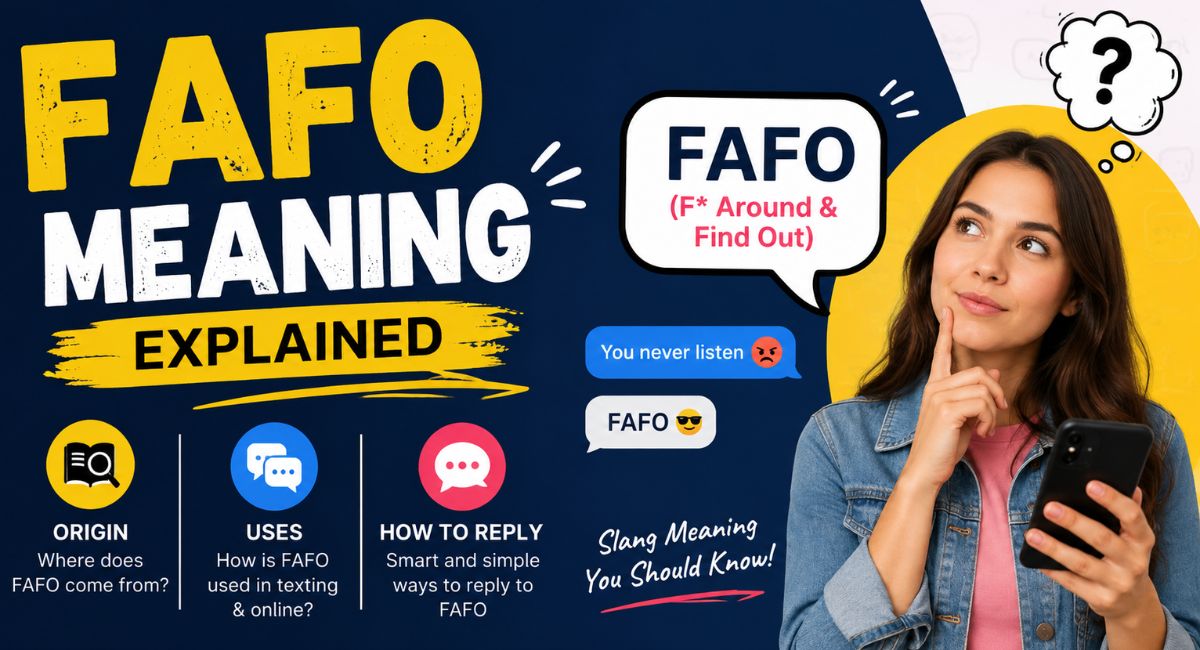
Quick Answer: FAFO Meaning
FAFO stands for “F* Around and Find Out.”** It’s a slang warning that means: if you keep behaving recklessly or ignoring advice, you’re going to face consequences — and you’ll “find out” the hard way.
Quick facts:
- Full form: F*** Around and Find Out
- Pronunciation: Said as individual letters — “F-A-F-O” — or occasionally as one word, “fay-foh”
- Part of speech: Functions as a noun, verb, adjective, and interjection
- Tone: Can be playful, sarcastic, or genuinely confrontational
- First appeared in print: Early 2000s, rooted in African American English
What Does FAFO Mean? (Breaking It Down)
At its core, FAFO meaning is built on cause and effect. It’s shorthand for a simple idea: actions have consequences, and you’re about to learn that the hard way.
The phrase works so well because it’s vague on purpose. It never spells out what the consequence will be — it just implies one is coming. That uncertainty is exactly what makes FAFO feel intimidating in a heated argument, yet completely harmless when your friend uses it as a joke.
People generally reach for FAFO in one of three ways:
- As a warning — “Stop pushing your luck, or FAFO.”
- As a boast or dare — “Try me and see what happens.”
- As commentary — reacting to someone who clearly brought consequences on themselves (“That’s a classic FAFO moment.”)

How to Use FAFO Correctly (Grammar Guide)
This is where most people trip up, because FAFO doesn’t behave like a normal acronym — it shifts its grammatical role depending on the sentence. Here’s how to use it without sounding off.
FAFO as a Verb
Used to describe the act of doing something reckless and facing the outcome.
- ✅ “Keep ignoring the warning label and you’re going to FAFO.”
- ✅ “He FAFO’d and lost his deposit.”
FAFO as a Noun
Used to describe the situation or moment itself.
- ✅ “That entire situation was a FAFO.”
- ✅ “This is a classic case of FAFO.”
FAFO as an Adjective
Used to describe an energy, mindset, or vibe.
- ✅ “She’s got serious FAFO energy today.”
FAFO as an Interjection or Standalone Warning
Used on its own, usually in caps, as a direct warning.
- ✅ “Don’t test me. FAFO.”
Common grammar mistakes to avoid:
- Don’t write it as “FAFOed” — the accepted informal past tense is FAFO’d (with an apostrophe) or simply “found out.”
- FAFO is always written in capital letters since it’s an acronym — avoid lowercase “fafo” in formal writing, though it’s common and acceptable in casual texting.
- It’s an informal/slang term, so it should never appear in professional emails, reports, or academic writing.
Where Did FAFO Come From?
The FAFO meaning has roots in African American English, where the full phrase has appeared in print since at least the early 2000s. Language references note that the term functions across multiple parts of speech and carries a strong undertone of schadenfreude — satisfaction at watching someone face self-inflicted consequences.
The acronym picked up a military and law-enforcement association over time, largely through tough-talk culture in those communities, though it only entered official, on-record military use in September 2025. From there, it spread rapidly through gaming, politics, sports commentary, and everyday social media, evolving from a niche phrase into a mainstream internet staple.
FAFO vs. Similar Phrases: How It Compares
If you’re trying to understand where FAFO fits among other slang and idioms, this comparison makes it clearer:
| Phrase | Meaning | Tone | Best Used |
| FAFO | Reckless actions lead to consequences | Blunt, warning or teasing | Arguments, reactions, dares |
| YOLO | You only live once — do it anyway | Encouraging, carefree | Justifying risky/fun choices |
| “Play stupid games, win stupid prizes” | Same core meaning as FAFO | Slightly more formal, still blunt | Written commentary, captions |
| TAFO (“Try and Find Out”) | A softer variant of FAFO | Less aggressive | When avoiding profanity |
| “Consequences will never be the same” | Meme-ified warning phrase | Sarcastic, ironic | Reaction posts, memes |
How Do People Use FAFO Today?
The FAFO meaning shifts slightly depending on where you see it. Here’s a breakdown by platform and context:
- TikTok & Instagram: Captions reacting to someone facing the fallout of their own bad decision — think a viral clip of someone getting “called out.”
- Arguments & debates: A short, sharp warning meaning “keep going and see what happens.”
- Political & news commentary: Applied to public figures or policies, implying an action will backfire.
- Gaming & sports communities: Used as trash talk — more of a challenge than a real threat.
- Between friends: Mostly playful teasing with zero real hostility behind it.
Is FAFO a Threat or a Joke?
This is usually the real question people are asking — and honestly, it comes down to context and tone. Use these signals to read the room:
- Playful: Sent with laughing emojis, memes, or between close friends → almost always lighthearted.
- Serious: Written in all caps, mid-argument, or paired with insults → leans toward a genuine warning.
- Sarcastic/observational: Used to comment on someone else’s situation (“that’s a FAFO moment waiting to happen”) → not aimed at anyone directly.
If a message makes you genuinely uncomfortable, trust that instinct regardless of the sender’s “intended” tone.
Is FAFO Offensive or Rude to Say?
FAFO carries implied profanity, so it’s not appropriate for formal, professional, or academic settings. In casual conversation among friends or online, most people read it as bold or blunt rather than genuinely offensive.
That said, it can cross into rude or harmful territory when it’s used to intimidate, provoke, or escalate conflict — especially toward strangers. When in doubt, treat it the way you’d treat any phrase with built-in profanity: fine casually, unsuitable formally.
Workplace-Safe Alternatives to FAFO
If you want to convey the same idea without the profanity or slang, try:
- “Continuing down this path may have consequences.”
- “I’d reconsider that approach if I were you.”
- “Actions have consequences — just something to keep in mind.”
How to Respond to FAFO
If someone sends you FAFO and you’re not sure how to take it, de-escalation almost always works better than matching the energy. A few safe responses:
- “All good, no drama here.”
- “I’m not testing you, just asking a question.”
- “Fair enough, let’s move on.”
Staying calm defuses a tense exchange far faster than escalating ever does.
FAFO Meaning: Quick Reference Card
| Question | Answer |
| What does FAFO stand for? | “F*** Around and Find Out” |
| Is it a real word? | No — it’s an acronym/slang phrase |
| Can I use it at work? | No, it’s informal and contains implied profanity |
| Is it always an insult? | No — tone and context decide that |
| How do I use it in a sentence? | “Keep ignoring the warnings and you’re going to FAFO.” |
FAQs About FAFO Meaning
What is the FAFO meaning? FAFO stands for “F*** Around and Find Out.” It’s slang used to warn someone that reckless or risky behavior will lead to consequences.
Is FAFO a military term? It has associations with tough-talk military and law-enforcement culture, but it only became formally documented in an official military context in September 2025 — its roots go back much further into everyday slang.
Is FAFO a threat? It depends entirely on tone. In arguments, it often reads as a warning; among friends, it’s usually just teasing.
Is FAFO grammatically correct to use in a sentence? Yes, when used informally. It functions as a noun (“that was a FAFO”), a verb (“he FAFO’d”), or a standalone warning (“FAFO.”). It should be avoided in formal writing.
What does FAFO mean on TikTok? On TikTok, FAFO usually appears in captions or comments reacting to someone facing consequences for their own actions.
How do you use FAFO in a sentence? Example: “Keep ignoring the warnings, and you’re going to FAFO.”
Is there a polite way to say FAFO? Yes — try phrases like “actions have consequences” or the softer acronym “TAFO” (Try and Find Out) if you want to avoid the implied profanity.
Conclusion: The Real FAFO Meaning
The FAFO meaning comes down to one blunt idea: reckless actions carry consequences, and you’re about to find that out. It traces back to African American English and everyday slang, later picking up military-culture associations, and has since spread into gaming, politics, and everyday social media — where its tone now depends entirely on context.
Once you understand not just what FAFO means but how to use it grammatically — as a noun, verb, or standalone warning — the phrase stops being confusing and becomes just another tool in your everyday texting vocabulary.