Have you ever found yourself typing out a quick text response to show agreement, only to pause with your thumb hovering over the keyboard? You want to say “me too” or “same here,” but you aren’t sure if the word is spelled diddo or ditto.
If this has tripped you up, you are not alone. In casual messaging and Gen Z text slang, phonetic slip-ups happen all the time. But when it comes to keeping your communication clear—whether you are dropping a comment on TikTok or writing a professional Slack message—getting the spelling right matters.
Let’s cut straight to the chase and break down exactly which word you should use, why the confusion happens, and the hidden history behind this everyday shortcut.
The Short Answer: Is It Diddo or Ditto?
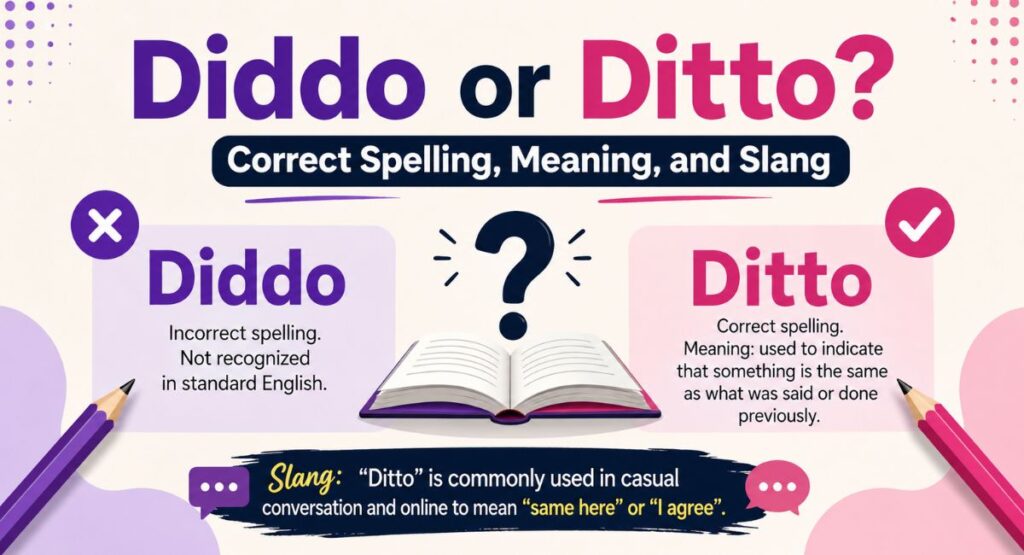
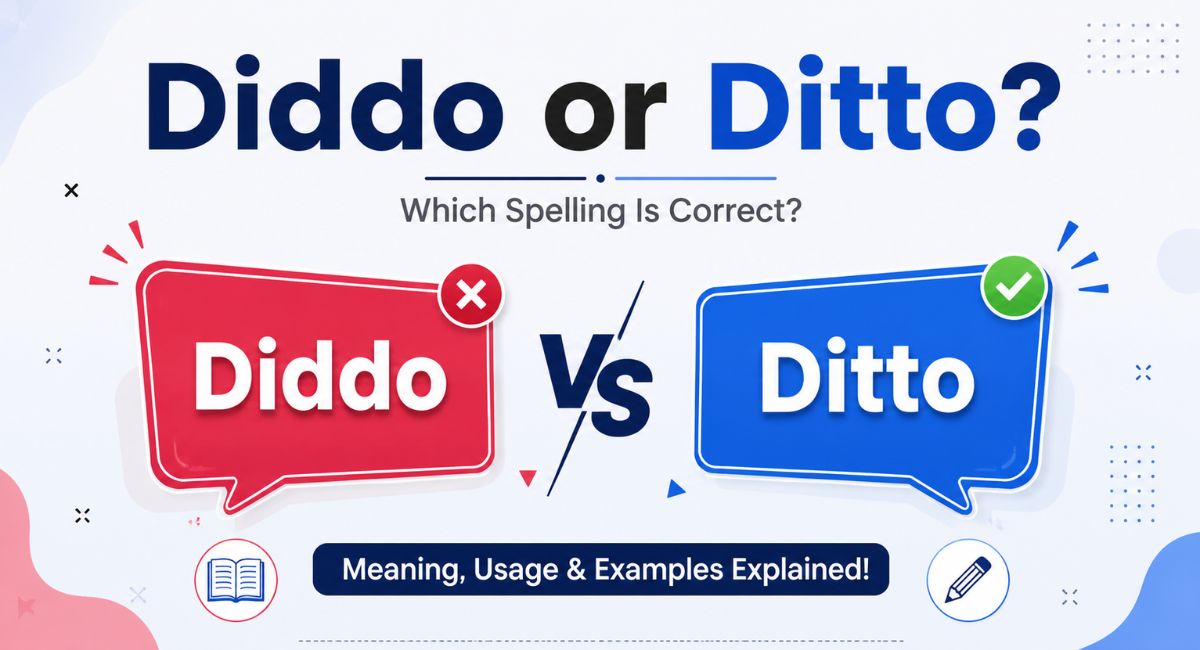
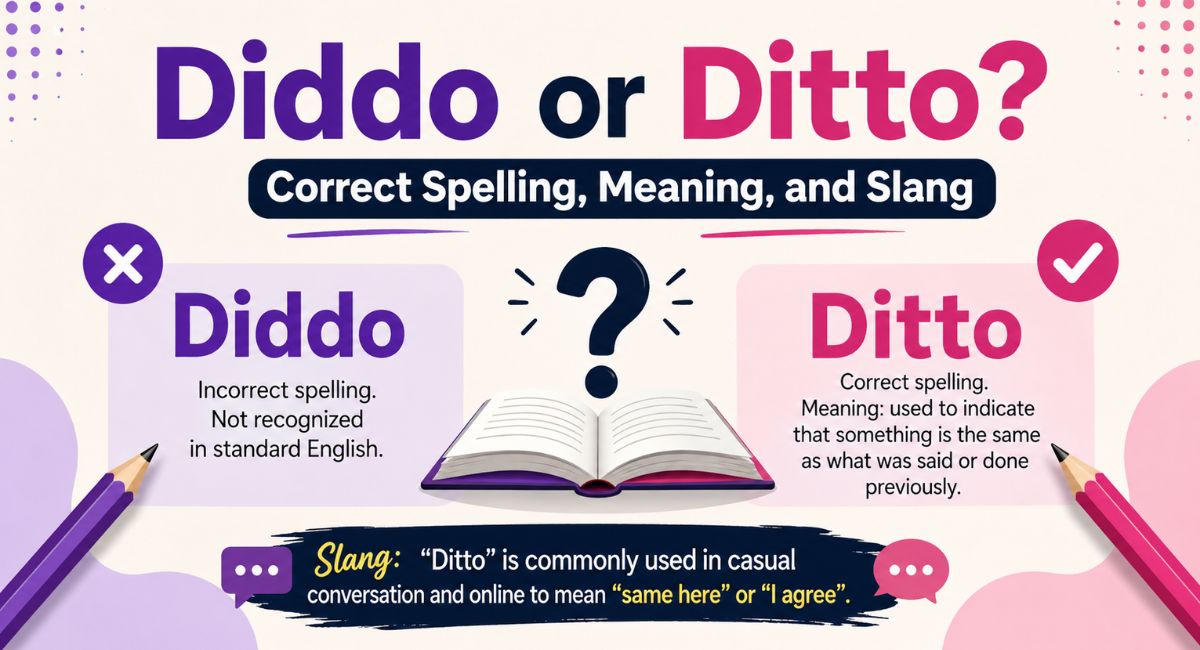
The definitive answer is simple: “Ditto” is the correct spelling and the only real word.
“Diddo” is a common misspelling that has evolved online due to casual typing habits and phonetic confusion. It is not recognized in standard English dictionaries.
- Ditto (Correct): An established English word meaning “the same as stated above” or “me too.”
- Diddo (Incorrect): A non-standard, phonetic misspelling of ditto.
Quick Memory Hack: Think of the iconic purple Pokémon, Ditto, who copies the exact appearance of other characters. Just like the character, the word ditto always means a perfect copy of what came before it!
What Does Ditto Actually Mean? (Origin & Slang Context)
To understand why we use the word today, it helps to look at where it came from. The word ditto traces its roots back to the 17th century, originating from the Tuscan/Italian word detto, which literally means “said”.
Historically, clerks and accountants used the abbreviation “do.” or ditto marks (“) in ledgers to avoid rewriting the exact same items on consecutive lines. For example:
- 1 dozen eggs
- 1 ” ” (meaning 1 dozen eggs)
Over time, this written shorthand leaped into spoken language.
How We Use Ditto in Casual Conversation & Texting
Today, ditto acts like a verbal copy-and-paste shortcut. It is highly popular in texting, DMing, and casual conversations to signal instant agreement or duplication.
Example 1: Showing Agreement
- Friend A: “I am absolutely exhausted after that shift.”
- Friend B: “Ditto. Let’s order takeout instead of cooking.” (Meaning: “I am also absolutely exhausted.”)
Example 2: Group Logistics
- Alex: “I’m ordering the iced matcha latte.”
- Jordan: “Ditto for me!” (Meaning: “I will also have the iced matcha latte.”)
Why Do So Many People Type “Diddo”?
If ditto has been around for hundreds of years, why is diddo constantly showing up on our screens? The confusion boils down to a few modern linguistic habits:
- Flapping (Phonetic Accents): In standard American and casual spoken English, a double “t” in the middle of a word often gets pronounced softly, sounding almost exactly like a “d.” Think of how words like butter sound like budder, or water sounds like wader. When people say ditto out loud, it naturally rolls off the tongue as “did-oh,” causing people to type it phonetically.
- Rapid Texting Culture: We type fast, and autocorrect doesn’t always catch everything. In fast-paced, thumb-typed chats, the proximity of keys and casual typing leads to errors that slip through the cracks.
- The “Kiddo” Influence: The word kiddo (an endearing term for a child) is very common and spelled with a double “d.” Subconsciously, our brains map that visual spelling pattern onto ditto, resulting in diddo.
How to Choose the Right Word: Ditto vs. Likewise vs. Same
While ditto is great for quick texts, it isn’t always the perfect fit for every situation. Depending on your audience, you might want to swap it out for a cleaner alternative.
| Word | Tone | Best Used For… | Example |
| Ditto | Informal / Casual | Friends, casual group chats, family texts. | “I love this track.” “Ditto.” |
| Likewise | Semi-Formal / Professional | Emails, networking, responding to clients or bosses. | “It was a pleasure working with you.” “Likewise.” |
| Same | Neutral / Modern | Versatile; works across social media and casual chats. | “I have no idea what’s going on.” “Honestly, same.” |
| Me Too / So Do I | Neutral / Conversational | Direct agreement regarding personal feelings or actions. | “I need a vacation.” “Me too.” |
What Most Guides Miss: Frequently Asked Questions (FAQs)
Is “dido” (with one ‘d’) a real word?
Yes, but it has completely different meanings! Capitalized, Dido is the name of the legendary queen of Carthage in Greek and Roman mythology (and the famous British singer-songwriter). In older sailor or old-school English slang, a dido can mean a shrewd trick or a mischievous prank (as in the phrase “cutting didoes”). It has nothing to do with repeating text or agreeing with someone.
Can I use “ditto” in a professional or academic setting?
Generally, no. While it is structurally useful in formal tables or inventories to indicate repeated values, using the word “ditto” in an essay, business proposal, or formal email can sound too conversational or lazy. Opt for words like likewise, correspondingly, or similarly instead.
What is a “ditto machine”?
If you talk to anyone who went to school before the 1990s, they might remember the distinct smell of a “ditto machine” (spirit duplicator). This was an early printing method used by schools and offices to make cheap, purple-inked copies of worksheets before modern photocopy machines took over.
Is there a specific word if a third or fourth person agrees?
Linguistically, no. You don’t say “tritto” or “quadritto.” Regardless of whether you are the second, third, or tenth person to echo a sentiment, ditto remains the universal term for repeating what has already been established.
The Takeaway
Keep it simple: skip the “d’s” and stick to the “t’s”.
Whenever you want to echo someone’s thoughts without typing out a novel, ditto is the exact tool you need. Leave diddo behind in the graveyard of phonetic text typos, and your written English will remain sharp, clean, and entirely correct.