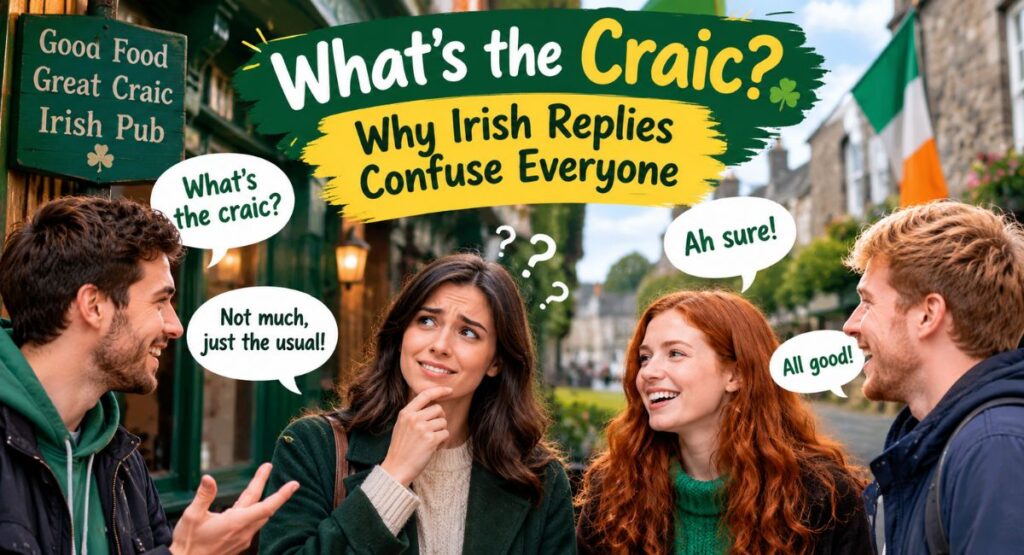
You see the word in a message from an Irish friend, or in a pub scene on TV, and you hesitate. It looks like it should be pronounced “crake” or “cray-ick.” It isn’t, and that gap between spelling and sound is where most of the confusion starts.
This guide covers what the word means, how it behaves grammatically, and the mistakes that make learners sound off. You will also find real chat examples and a short quiz to test yourself.
Craic Meaning in Short
Craic (pronounced “crack”) is an Irish English noun meaning fun, lively conversation, or good company. Asked as “What’s the craic?”, it means “What’s happening?” or “How are things?” Used as “great craic,” it describes an enjoyable time. It is informal, uncountable, and often paired with “the” or an adjective.
How to Pronounce Craic
Say it exactly like the English word “crack.” There is no extra vowel sound, and the “ai” is silent. If you say it aloud in Ireland, nobody will notice the spelling difference, but in writing the spelling matters (more on that below).
Where the Word Comes From
The word started as English “crack,” used in Scots and northern English for chat, news, and gossip. It travelled into Irish English, and the spelling “craic” became widespread later, giving the word a more Irish look. So the word is Irish English in use, but not a native Irish-language word that was simply written down.
That detail matters because many sites claim it is “ancient Irish.” It is better described as an English word with a strong Irish life.
The Three Meanings of Craic
Craic changes its meaning depending on the sentence around it. Think of it as one word doing three jobs.
1. Craic as “Fun”
This is the most common meaning. If a night out had great craic, everyone enjoyed themselves. The fun is usually social, which is the key difference from general “fun.”
- “The wedding was great craic.”
- “We had a bit of craic on the bus home.”
2. Craic as “Conversation and News”
Here the word means lively talk, jokes, and updates. Someone who is “good craic” is someone entertaining to talk to.
- “He’s great craic, that fella.”
- “Any craic from the match?”
3. Craic in the Greeting “What’s the Craic?”
This is a casual greeting, not a request for a fun time. It means “What’s new?” or “What have you been up to?” A natural answer is “Not much, yourself?” or “Ah, no craic.”
Real Chat Examples: How Craic Actually Appears
Definitions only go so far. Here are three realistic snippets that show how context changes the word.
Chat 1: The greeting
Ciara: Hey, what’s the craic?
Dan: Not a whole lot, just finished work. You?
Ciara: Same. Fancy a coffee later?
Ciara is not asking about fun. She is opening a conversation, like “what’s up.”
Chat 2: Describing an event
Niall: How was the gig?
Orla: Unreal. The band was brilliant and the craic was ninety after.
Niall: Ah, sorry I missed it.
“The craic was ninety” is a common Irish phrase for a very enjoyable time. Orla means the after-gig fun was excellent.
Chat 3: The negative use
Sean: Going to that Tuesday quiz?
Aoife: No craic in it these days. Same six people every week.
Sean: Fair enough. Pub instead?
“No craic” means nothing exciting is happening. Notice it describes the atmosphere, not a person’s mood.
The Grammar Side of Craic (Where Learners Slip)
This is the part most meaning sites skip, and it is where you can sound natural instead of translated.
Part of Speech
Craic is a noun. It does not work as a verb (“I craic with friends” is wrong) or as an adjective on its own (“the party was craic” sounds odd without “good” or “great”).
It Is Mostly Uncountable
Like “music” or “fun,” craic is usually uncountable. You say “great craic,” not “three craics.” You can say “a bit of craic” or “some craic,” but avoid plurals.
Common Phrases and Their Grammar
| Phrase | Structure | Meaning | Register |
| What’s the craic? | Question greeting | What’s new? | Casual |
| Great craic | Adjective + noun | Very enjoyable | Casual |
| Having the craic | Verb + “the” + noun | Enjoying yourself | Casual |
| No craic | “No” + noun | Boring, nothing happening | Casual |
| Good craic (person) | Adjective + noun | Entertaining company | Casual |
| Ceol agus craic | Irish-language pair | Music and fun | Cultural/casual |
Formal vs Casual Usage
Craic belongs to spoken, friendly language. It suits texts, social posts, and conversation. In an essay, a job application, or a business email, use “enjoyable,” “lively,” or “good company” instead.
Common Mistakes People Make with Craic
Mistake 1: Writing It as “Crack” in Irish Contexts
In many places the spelling “crack” refers to something else entirely, so the spelling difference protects you from a very awkward misreading. If you mean the Irish word, write craic.
Mistake 2: Using It as a Plural or Verb
“We had many craics” and “let’s craic tonight” are not used. Say “we had great craic” or “let’s have some craic.”
Mistake 3: Using It in Formal Writing
Keep it out of reports, applications, and professional emails. It reads as too informal there.
Mistake 4: Treating It as Generic “Fun”
Craic usually involves people. Playing a video game alone is fun, but it is rarely described as craic. If other people and conversation are involved, the word fits better.
Mistake 5: Pronouncing It “Kray-ik”
This is the most common spoken mistake. The word rhymes with “back.”
Who Says Craic, and When
You will hear it across Ireland, both in the Republic and in Northern Ireland, and among Irish communities abroad. It appears in pubs, family gatherings, group chats, and social media captions.
It is warm and friendly. It is not slang that carries any offense. Visitors often use it back to locals, which is usually received with good humour as long as the grammar is right.
Related terms you may hear nearby include banter (playful teasing), fair play (well done), and gas (hilarious). They sit in the same social family but are not interchangeable.
Craic vs Fun vs Banter
| Word | Focus | Needs other people? | Example |
| Craic | Social fun and talk | Usually yes | “Great craic at the party.” |
| Fun | General enjoyment | No | “Painting is fun.” |
| Banter | Playful teasing | Yes | “Good banter in the group chat.” |
Quick Ways to Use Craic Naturally
- Greeting a friend: “What’s the craic?”
- Praising an event: “That was great craic.”
- Complimenting a person: “She’s brilliant craic.”
- Describing a dull night: “No craic in town tonight.”
- Planning: “We’re going for a few drinks, should be good craic.”
Match the register to the setting, and keep it to speech or casual texting.
Related Reads
Frequently Asked Questions
What does craic mean?
Craic means fun, lively conversation, or good company. It is an informal Irish English noun, and “What’s the craic?” is a greeting that means “What’s new?”
How do you pronounce craic?
It is pronounced exactly like “crack.” The “ai” is silent, and the word rhymes with “back.”
What does “what’s the craic?” mean?
It is a casual greeting asking “What’s happening?” or “How are things?” A normal reply is “Not much, yourself?”
Is craic a countable noun?
Mostly no. Say “great craic” or “a bit of craic,” but avoid plurals like “craics.
Can I use craic in formal writing?
It is best avoided there. Use “enjoyable,” “lively,” or “good company” in formal or professional writing.