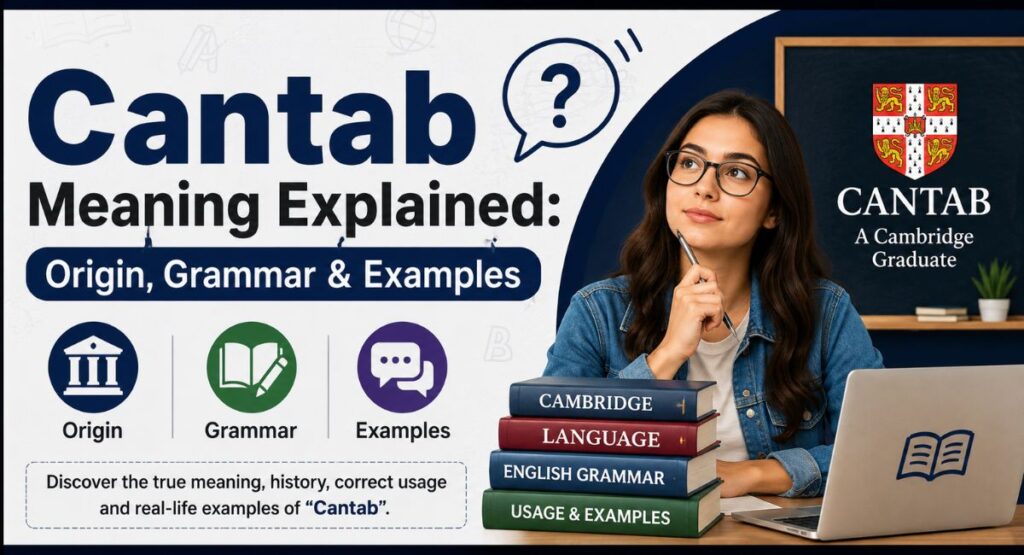
Cantab Meaning: You saw “Cantab” printed after someone’s name — maybe on a CV, a book jacket, or a LinkedIn bio — and now you’re stuck wondering if it’s a typo, a title, or some kind of code.
It isn’t a typo. It’s also not something you’ll find explained clearly in most dictionaries, because it’s a post-nominal abbreviation, not a regular English word. That single fact is exactly why so many people get its grammar wrong, even after they’ve figured out what it means.
This guide covers the definition first, then goes further than most explainers by breaking down how to actually write, punctuate, and capitalize it correctly — because getting the meaning right but the grammar wrong is how a polished CV starts looking careless.
What Does Cantab Mean? (Quick Answer)
Cantab is a shortened form of the Latin word “Cantabrigiensis,” meaning “of Cambridge.” It’s used after an academic degree — for example, “MA (Cantab)” — to show the degree was awarded by the University of Cambridge, England.
In one line: if you see “Cantab,” someone is telling you where their degree came from, not what the degree is.

Cantab Meaning in English: Breaking It Down in Plain Words
In plain English, “Cantab” simply means “Cambridge” or “belonging to Cambridge.” It isn’t an English-origin word at all — it’s a Latin adjective that British academia adopted and never fully translated, the same way “curriculum vitae” stayed in Latin instead of becoming “life course.”
So “PhD (Cantab)” reads, in everyday English, as “a PhD from the University of Cambridge.”
One practical thing worth knowing: nobody actually says “Cantab” in casual conversation. It’s a written-only term — you’ll find it in CVs, formal biographies, book jackets, and academic correspondence, but almost never in spoken British English, even among Cambridge graduates themselves.
The Grammar of “Cantab” — What Most Guides Skip
This is where “Cantab” trips people up the most, and it’s the part general definition sites tend to gloss over. Here’s the grammar broken down properly.
Part of Speech: Is “Cantab” a Noun or an Adjective?
“Cantab” functions as an adjective when it’s attached directly to a degree (“MA Cantab” = a Cambridge MA). It can also work informally as a noun referring to a person connected to Cambridge (“he’s a Cantab”), though the more grammatically correct noun form is Cantabrigian.
A simple way to remember the split:
- Cantab (adjective) → describes the degree or institution: “BA Cantab”
- Cantabrigian (noun/adjective) → describes the person: “She’s a Cantabrigian”
How to Pronounce “Cantab”
It’s pronounced KAN-tab (stress on the first syllable), rhyming with “fan cab.” There’s no silent letter and no French-style softening — it’s read exactly as it’s spelled, which is unusual for a Latin-derived academic term and one reason people often mispronounce it by guessing at a fancier sound.
Capitalization Rules
“Cantab” is always capitalized, because it functions as a proper adjective — it’s derived directly from the proper noun “Cambridge.” Writing it as “cantab” in lowercase (common in casual online posts and forum threads) is technically a capitalization error, even though search engines and readers will still understand it.
If you’re publishing anything formal — a CV, an author bio, a professional directory listing — capitalize it every time: Cantab, never cantab.
Punctuation: Do You Need a Period?
This is genuinely inconsistent across style guides, and it’s worth settling with a clear rule instead of leaving it ambiguous:
- “MA (Cantab)” — parentheses, no period. This is the cleanest, most common modern format.
- “MA Cantab” — no punctuation at all. Also widely accepted.
- “MA Cantab.” — with a trailing period. Older style, less common in modern CVs.
Our recommendation: use parentheses — “(Cantab)” — because it visually separates the abbreviation from the degree title, which reduces ambiguity for readers unfamiliar with the convention. Whatever you choose, stay consistent throughout the same document.
Common Mistakes People Make With “Cantab”
- Pluralizing it incorrectly — writing “Cantabs” to mean multiple Cambridge graduates is informal at best and grammatically shaky; “Cantabrigians” is the correct plural form for people.
- Using it as a standalone word — “Cantab” almost never appears on its own in formal writing; it needs a degree or name attached to make grammatical sense.
- Confusing it with “Cantabile” — a musical term (explained below) that looks similar but has zero grammatical or etymological overlap in modern usage, beyond a shared Latin root.
- Attaching it to a non-Cambridge degree — using “(Cantab)” after a degree from any other university is factually incorrect, not just a style choice; the abbreviation is institution-specific.
- Skipping capitalization — as covered above, lowercase “cantab” reads as a grammar slip in formal contexts, even if the meaning is still clear.
Where Does “Cantab” Come From? A Quick Timeline
The Latin Root
Cambridge’s Latin name is Cantabrigia. From it, the adjective Cantabrigiensis was formed, meaning “of Cambridge.” Over centuries, academic writers shortened this four-syllable Latin word down to a four-letter abbreviation for practical use: Cantab.
How the Tradition Started
Latin was the working language of European scholarship for centuries, and British universities kept the habit of marking degrees with Latin post-nominal tags long after everyday academic writing switched to English. Cambridge → Cantabrigiensis → Cantab follows the exact same naming pattern as Oxford → Oxoniensis → Oxon.
| Era | What Happened |
| Medieval period | Cambridge referred to in official Latin documents as Cantabrigia |
| 16th–18th century | Latin remains the formal language of academic record-keeping |
| 19th century | English replaces Latin in daily academic use; “Cantab” becomes the standard shorthand |
| Today | “Cantab” survives in formal, ceremonial, and biographical writing |
How “Cantab” Is Actually Used Today
After an Academic Degree
This is the use case behind most searches for this term. When you see “MA Cantab” or “PhD (Cantab),” it confirms the degree was awarded by the University of Cambridge. Accepted formats include:
- MA (Cantab)
- MA Cantab
- MA Cantab.
Referring to a Person
Beyond degrees, “Cantabrigian” (the fuller, grammatically correct form) describes a person connected to Cambridge — a student, graduate, or resident. Journalists and biographers tend to prefer “Cantabrigian” over the clipped “Cantab” when writing about a person rather than a degree, since it reads more naturally as a noun.
Real Examples in a Sentence
- “Dr. Priya Sharma, MA (Cantab), presented her research at the conference.”
- “He signed the letter simply as ‘Ahmed Raza, Cantab.'”
- “The author’s bio notes: educated at Cambridge (Cantab), now based in Lahore.”
- “As a Cantabrigian, she still attends her college’s annual reunion.”
- “The panel included both Cantab and Oxon graduates.”
Notice the pattern: “Cantab” almost never stands alone — it’s always anchored to a name or a degree title.
Cantab vs. Oxon: What’s the Real Difference?
Cambridge has “Cantab.” Oxford has its own equivalent: Oxon, short for Oxoniensis. Grammatically, they work identically — the only difference is which university they point to.
| Term | Full Latin Form | University | Example |
| Cantab | Cantabrigiensis | University of Cambridge | MA (Cantab) |
| Oxon | Oxoniensis | University of Oxford | MA (Oxon) |
If you spot “Oxon” instead of “Cantab” after someone’s name, it’s telling you they studied at Oxford, not Cambridge — same grammatical role, different institution.
Other UK Academic Abbreviations You’ll Come Across
Cambridge and Oxford aren’t the only universities with Latin post-nominal tags, though they’re by far the most common:
- Dunelm — from Dunelmensis, for Durham University
- Ebor — from Eboracensis, for York (seen mainly in church/clergy titles, like the Archbishop of York)
- Cantuar — for Canterbury, again mostly used in ecclesiastical titles
These follow the exact same grammar rules as Cantab and Oxon: capitalized, attached to a degree or title, never used standalone.
Cantab and Harvard: Where the Confusion Comes From
A fair number of searches for this term are actually about Harvard, not Cambridge, England — and there’s a real reason for that mix-up. Cantabrigian is also the term for a resident of Cambridge, Massachusetts, the city that’s home to both Harvard University and MIT.
Cambridge, Massachusetts was named after Cambridge, England during the colonial period, so the Latin-derived adjective carried over to describe its residents too.
So context decides the meaning:
- A British CV or academic bio → almost certainly refers to Cambridge University, England
- A Boston-area news article or local reference → likely refers to Cambridge, Massachusetts
Grammatically, both uses follow the same rule: it’s an adjective/noun describing a place of origin, just two different Cambridges.
Other Places You’ll Spot “Cantab” (Unrelated to Cambridge)
The Cantabile Mix-Up
Cantabile is an Italian musical direction meaning “in a singing style” — a tempo marking telling a musician to play smoothly and melodically. It shares a Latin root with Cantab (cantare, “to sing”) but has no grammatical or meaningful connection to Cambridge University. Musicians searching “cantab meaning in music” are almost always thinking of “cantabile.”
Word Puzzles Like Connections
If you found “Cantab” as an answer in the NYT Connections puzzle or a similar word game, it’s being used as a deliberately obscure vocabulary test — usually grouped with related terms like Oxon, alum, or grad. The meaning doesn’t change; it’s just repurposed as trivia.
Cantab as a Product or Username
Occasionally “Cantab” shows up as a brand name (for instance, on certain percussion or musical instrument listings) or as a standalone username with no connection to Cambridge at all. When it’s used this way, it’s simply a recognizable-sounding word, not a grammatical abbreviation — so none of the capitalization or punctuation rules above apply.
Should You Put “Cantab” on Your CV or Bio?
This depends entirely on your audience, and it’s a genuinely practical grammar-and-context decision, not just a stylistic one.
Use it when:
- You’re applying within British academia, publishing, law, or civil service
- Your reader is likely to recognize UK post-nominal conventions
- You’re writing a formal bio, book jacket, or academic paper
Skip it or explain it when:
- Your audience is international (US, South Asian, or Gulf hiring managers often won’t recognize it)
- You’re writing a general CV where clarity matters more than tradition
The safest middle ground: write “University of Cambridge” in full the first time your degree appears, then use “(Cantab)” only in more formal, UK-specific documents afterward. This avoids the grammar looking like an error to readers unfamiliar with the term.
Key Takeaways
- Cantab = short for Cantabrigiensis, Latin for “of Cambridge.”
- It’s an adjective, always capitalized, and typically written as “(Cantab)” after a degree.
- The correct noun form for a person is “Cantabrigian,” not “Cantab.”
- It’s pronounced KAN-tab, not with any French or soft-C sound.
- Its Oxford equivalent is Oxon; other UK universities use Dunelm, Ebor, and Cantuar.
- “Cantabrigian” separately describes Cambridge, Massachusetts residents (home of Harvard and MIT) — a common source of confusion.
- Don’t confuse it with “cantabile,” an unrelated Italian musical term.
Once you know the grammar rules — capitalization, punctuation, and correct noun form — “Cantab” stops being a confusing abbreviation and becomes an easy pattern to spot in any formal British document.
Frequently Asked Questions
1. What does Cantab mean in simple terms? Cantab is short for Cantabrigiensis, Latin for “of Cambridge.” It’s used after a degree to show it was awarded by the University of Cambridge.
2. Is “Cantab” capitalized? Yes. Since it’s derived from the proper noun “Cambridge,” Cantab should always be capitalized, even mid-sentence.
3. What’s the difference between Cantab and Cantabrigian? Cantab is the abbreviated form used after degrees (adjective use); Cantabrigian is the fuller word used to describe a person connected to Cambridge (noun use).
4. How do you correctly punctuate Cantab after a degree? “MA (Cantab)” is the most common modern format. “MA Cantab” and “MA Cantab.” are also accepted — just stay consistent within one document.