Introduction
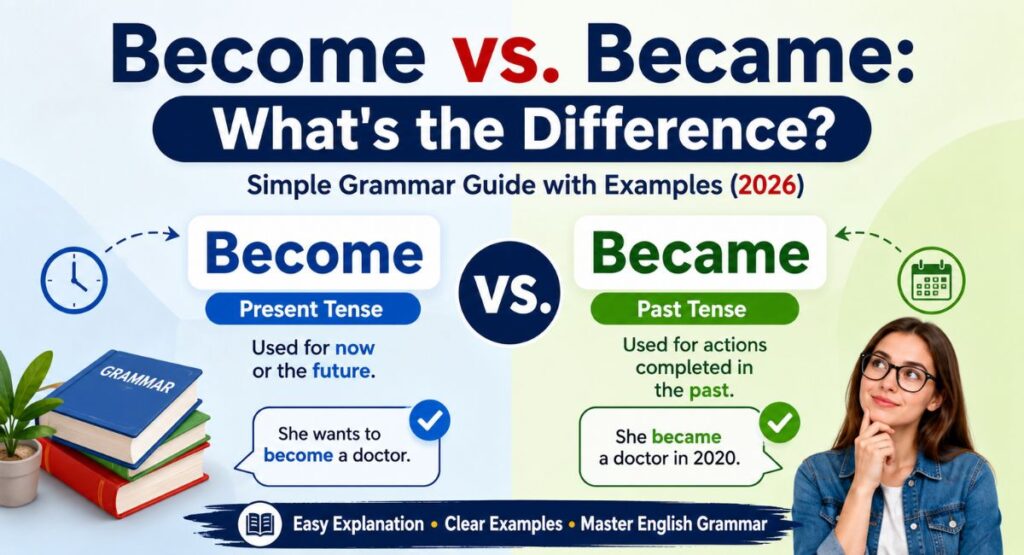
Many English learners and even native speakers get confused between become and became because both words come from the same verb but are used in different situations. If you’ve ever wondered whether to write “I have became” or “I have become,” you’re not alone. This guide explains the difference in simple English, provides grammar rules, real-life examples, common mistakes, verb forms, and memory tricks. By the end, you’ll know exactly when to use become and when became is the correct choice.
What Does “Become” Mean?
Become is an irregular English verb that means:
- To start being something
- To grow into a new condition
- To change from one state to another
Examples
- She wants to become a doctor.
- The weather will become colder tonight.
- He has become very confident.
- Technology continues to become more advanced.
The meaning always involves change or transformation.
Become vs. Became: The Main Difference
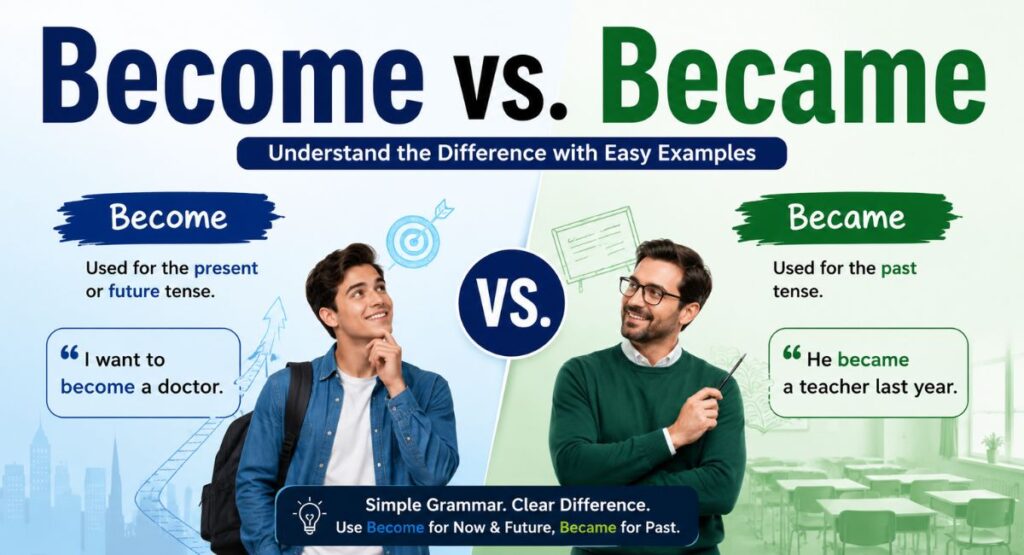
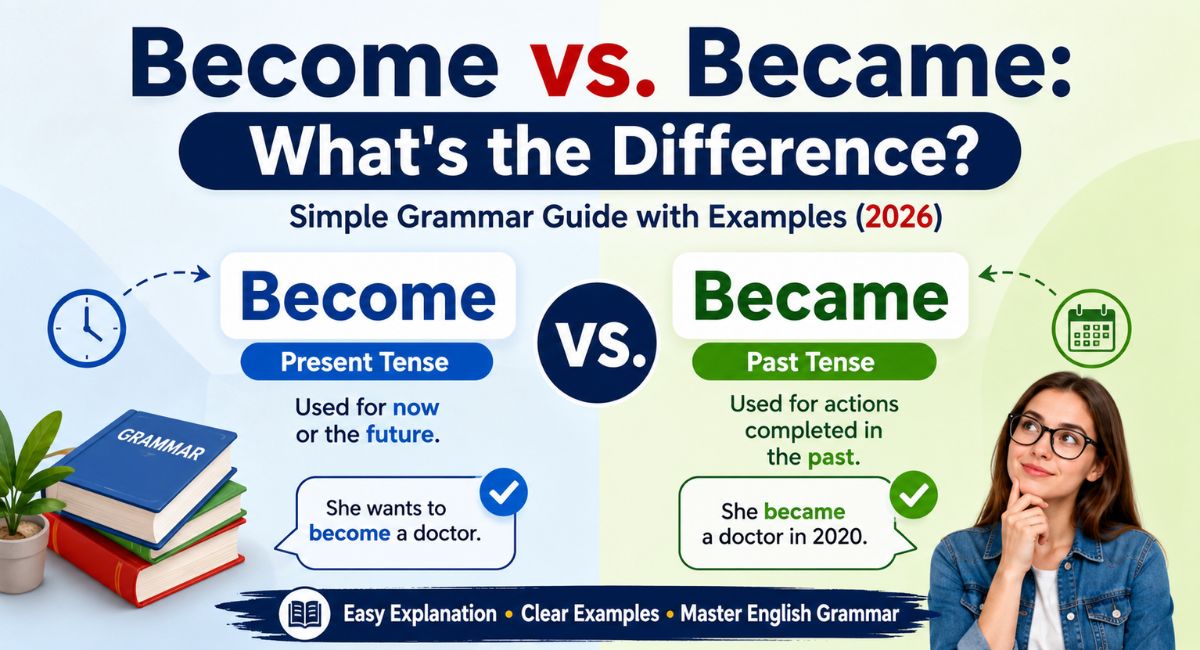
The biggest difference is verb tense.
| Word | Tense | Example |
|---|---|---|
| Become | Base form / Past participle | I want to become a teacher. |
| Became | Simple past | She became a teacher last year. |
In simple words:
- Become = used in the present, future, infinitive, or perfect tenses.
- Became = used only for actions completed in the past.
The Three Forms of Become
Since become is an irregular verb, its forms are:
| Verb Form | Word |
|---|---|
| Base Form | Become |
| Past Simple | Became |
| Past Participle | Become |
Example:
- I become nervous before exams. (rare/simple present)
- I became nervous yesterday.
- I have become more confident.
Notice that the past participle returns to become, not became.
When to Use Become
Use become in these situations.
1. After Modal Verbs
Examples:
- You should become more patient.
- She will become famous someday.
- They might become successful.
Never use became after modal verbs.
❌ She will became famous.
✅ She will become famous.
2. After “To”
Examples:
- I hope to become an engineer.
- He wants to become healthier.
- They plan to become homeowners.
3. In Perfect Tenses
Examples:
- She has become a great singer.
- They had become friends before college.
- Our city has become much cleaner.
4. In Passive-Like Expressions of Change
Examples:
- Milk can become sour.
- Water may become polluted.
- The roads have become safer.
When to Use Became
Use became only for actions completed in the past.
Examples:
- He became rich after starting his business.
- She became angry.
- My phone became slow after the update.
- The sky became dark.
The event happened and finished in the past.
Examples in Everyday Life
School
- Sarah wants to become a teacher.
- Sarah became a teacher in 2024.
Career
- I hope to become a software engineer.
- He became CEO at age 35.
Health
- I have become healthier.
- I became sick yesterday.
Technology
- Smartphones have become more powerful.
- Computers became popular in the 1990s.
Common Mistakes
Mistake 1
❌ I have became tired.
✅ I have become tired.
Mistake 2
❌ She will became famous.
✅ She will become famous.
Mistake 3
❌ He has became a doctor.
✅ He has become a doctor.
Mistake 4
❌ I became to understand.
✅ I began to understand.
Become in Different Tenses
| Tense | Example |
|---|---|
| Present Simple | I become nervous easily. |
| Present Continuous | I am becoming stronger. |
| Past Simple | I became excited. |
| Present Perfect | I have become confident. |
| Past Perfect | She had become famous. |
| Future | I will become a pilot. |
Become in Common English Expressions
These phrases are used frequently.
- Become famous
- Become successful
- Become friends
- Become popular
- Become clear
- Become available
- Become stronger
- Become weaker
- Become better
- Become worse
Examples:
- The app has become popular worldwide.
- They quickly became friends.
- The rules have become clearer.
Synonyms of Become
Depending on context, become can mean:
- Turn into
- Grow into
- Develop into
- Transform into
- Evolve into
- Change into
- Come to be
- End up as
- Mature into
Example:
“He became famous.”
can also be
“He grew into fame.”
or
“He turned into a well-known actor.”
Is “Become” a Regular or Irregular Verb?
Become is an irregular verb.
Regular verbs add -ed.
Example:
- Walk → Walked
Irregular verbs change differently.
Example:
- Become → Became → Become
This pattern must be memorized.
Quick Memory Trick
Remember this sequence:
Become → Became → Become
Think of it like this:
Present → Past → Perfect
- I want to become.
- Yesterday I became.
- I have become.
Become vs. Get
Both words describe change, but they are not always interchangeable.
| Become | Get |
|---|---|
| More formal | More informal |
| Used in writing | Common in conversation |
| Become successful | Get successful (less common) |
| Become angry | Get angry |
Examples:
Formal:
- She became interested in science.
Informal:
- She got interested in science.
Become vs. Turn Into
These expressions have similar meanings but different emphasis.
Become
Focuses on gradual change.
- He became confident.
Turn Into
Often emphasizes transformation.
- The caterpillar turned into a butterfly.
Pronunciation
Become
/bɪˈkʌm/
Sounds like:
bih-KUM
Became
/bɪˈkeɪm/
Sounds like:
bih-KAYM
Learning pronunciation helps improve speaking confidence.
Practice Sentences
Choose the correct word.
- She has ______ very confident.
Answer: become
- He ______ famous after the movie.
Answer: became
- I want to ______ a pilot.
Answer: become
- They had ______ close friends.
Answer: become
- The weather ______ cold yesterday.
Answer: became
Quick Quiz
Fill in the blanks.
- I hope to ______ an artist.
- She ______ upset after hearing the news.
- They have ______ successful entrepreneurs.
- He will ______ stronger with practice.
- My dream is to ______ a writer.
Answers:
- become
- became
- become
- become
- become
What Missed
Many articles explain only that become is the base form and became is the past tense. However, they often miss several practical points that help readers avoid mistakes:
The Past Participle Confusion
A very common error is writing:
❌ I have became.
The correct sentence is:
✅ I have become.
This mistake is especially common among English learners because many irregular verbs use the same form for the past and past participle, while become returns to its original form.
Real-Life Usage
Instead of isolated grammar rules, understanding how native speakers naturally use these words makes the distinction much easier.
Examples:
- She has become more confident over time.
- The city became crowded during the festival.
- AI has become part of everyday work.
- He became interested in photography after college.
Why English Learners Mix Them Up
Many learners assume every past-related sentence uses became, but perfect tenses always require the past participle become after has, have, or had.
Frequently Asked Questions
Is it “have become” or “have became”?
Always say have become. Become is the past participle.
Is “became” grammatically correct?
Yes. It is the simple past tense of become.
Can I say “will became”?
No.
Correct:
- will become
Incorrect:
- will became
Is become an action verb?
Yes. It describes a change of state or condition.
Why is become an irregular verb?
Its past tense changes to became, while its past participle changes back to become instead of following the regular -ed pattern.
Which is more common: become or became?
Both are common, but their usage depends entirely on the grammar of the sentence. Become appears in infinitives, future constructions, and perfect tenses, while became is used for completed past actions.
Conclusion
Understanding the difference between become and became is easier once you remember their roles in English grammar. Become is the base form and the past participle, while became is the simple past tense. Whenever you use has, have, had, will, should, or to, the correct choice is become. Use became only when describing an action that happened and finished in the past. By practicing these patterns and reviewing real-world examples, you’ll avoid one of the most common English grammar mistakes and write with greater confidence.