If you’ve typed the word “prioritize” for the fifth time in one email and it’s started to look misspelled even though it isn’t — you’re in the right place.
That weird, glazed-eyed feeling when a word loses all meaning from overuse has a name (semantic satiation, if you’re curious), and “prioritize” is one of the most common culprits in modern work and school writing. It’s useful, it’s clear, and it’s everywhere — which is exactly the problem.
Another Word for Prioritize ; Quick Answer: The best alternatives to “prioritize” are focus on, emphasize, put first, give precedence to, and rank above. The right one depends on how formal your writing needs to be and whether you’re using it as a verb, describing an action, or writing a noun form like “prioritization.”
This guide doesn’t just hand you a wall of words. It shows you how to actually use each one correctly — including the grammar rules people usually get wrong — so you never have to guess whether a synonym fits the sentence you’re writing.
What Does “Prioritize” Actually Mean?
Before swapping it out, it helps to know exactly what you’re replacing.
Prioritize (verb): to arrange or deal with things in order of importance, or to treat something as more important than other things.
- Part of speech: Verb (transitive)
- Pronunciation: prahy-AWR-i-tahyz
- Noun form: prioritization (“The prioritization of this task took the whole meeting.”)
- Adjective form: priority (used as a noun-adjective — “a priority task”)
- Past tense: prioritized
- Present participle: prioritizing
Knowing the part of speech matters more than most vocabulary lists admit. A synonym that works as a verb (“focus on”) won’t always slot into a sentence the same way a phrase built for formal writing (“give precedence to”) does. That’s the gap this guide fixes.
Another Word for Prioritize: Quick List
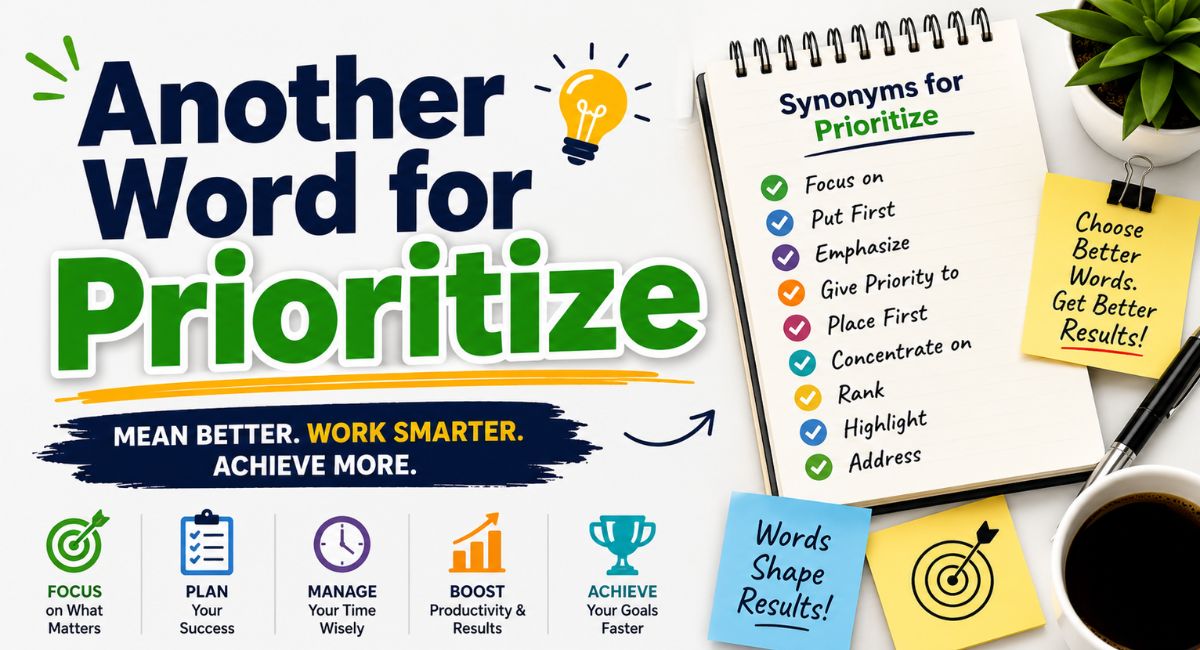
If you only need a fast answer, here are the 10 most useful alternatives to “prioritize,” ranked by how commonly they’re used in real writing:
- Focus on
- Emphasize
- Put first
- Give priority to
- Rank above
- Concentrate on
- Give precedence to
- Treat as essential
- Attend to first
- Value most
Now let’s break these down by tone, correct grammar usage, and real sentence examples — because knowing the word isn’t the same as knowing how to use it.
Synonyms for Prioritize by Formality Level
Different situations call for different registers. Using “attend to first” in a text to a friend sounds stiff. Using “put first” in a legal document sounds sloppy. Here’s how to match tone to context.
| Formality | Synonym | Example Sentence |
| Very Formal | Afford precedence to | The committee chose to afford precedence to the safety review. |
| Formal | Attach importance to | Investors attach importance to transparent reporting. |
| Professional | Give priority to | Please give priority to the client’s request this week. |
| Neutral | Focus on | Let’s focus on the budget first. |
| Conversational | Put first | I always put my health first. |
| Casual | Deal with first | Just deal with the urgent emails first. |
Grammar tip: Phrases like “put first” and “deal with first” separate their object from “first” — the object goes between the verb and “first” (e.g., “put the report first,” not “put first the report”). This is one of the most common grammar mistakes non-native English speakers make with this phrase.
Professional & Workplace Alternatives
These are safe for emails, meetings, and project updates.
- Focus on — We need to focus on customer retention this quarter.
- Give priority to — Managers should give priority to onboarding new hires.
- Concentrate on — The team is concentrating on the Q3 launch.
- Address first — We’ll address the server issue first.
- Allocate resources to — Leadership decided to allocate resources to the mobile app.
- Treat as a priority — This ticket should be treated as a priority.
- Keep front and center — Customer feedback stays front and center in our roadmap.
Grammar note: Most of these are verb phrases requiring a direct object right after them (except “front and center,” which functions as an adverbial phrase). Skipping the object — writing “we need to focus” instead of “we need to focus on X” — is grammatically incomplete in formal writing, even though it’s common in casual speech.
Formal & Academic Alternatives
Use these in essays, research writing, or official documents where “prioritize” feels too plain.
- Regard as paramount — Researchers regard data accuracy as paramount.
- Deem essential — The board deemed the merger essential to growth.
- Give precedence to — Courts give precedence to constitutional rights in such cases.
- Place emphasis on — This paper places emphasis on long-term outcomes.
- Assign primary importance to — Educators assign primary importance to comprehension over speed.
Common mistake: Many learners write “give precedence for” instead of “give precedence to.” The correct preposition after precedence is always to. Prepositions like this trip up even confident writers because they don’t follow a logical rule — they simply have to be memorized.
Casual & Everyday Alternatives
For texts, conversations, and informal writing where “prioritize” sounds too corporate.
- Put first — I put sleep first these days.
- Care about most — She cares about her family most.
- Start with — Let’s start with the easy tasks.
- Work on first — I’ll work on the kitchen first.
- Make time for — Try to make time for exercise this week.
These phrasal alternatives are naturally verb + preposition combinations, so double-check that your preposition matches (“start with,” not “start on” or “start at”) — mismatched prepositions are one of the most common English errors for intermediate learners.
Resume & Career Alternatives
“Prioritize” and its past tense “prioritized” appear so often on resumes that recruiters barely register them anymore. Swap them out for stronger, more specific action verbs:
- Led key initiatives
- Directed strategic efforts
- Managed critical deadlines
- Oversaw high-impact projects
- Championed core objectives
Resume grammar rule: Always keep tense consistent. If your resume is written in past tense for previous roles, every bullet — not just the ones with “prioritized” swapped out — must stay in past tense. Mixing “manage” and “managed” in the same section is a red flag recruiters notice immediately.
Antonyms of Prioritize (Opposite Meaning)
Sometimes you need the opposite word, not another synonym. Here are common antonyms:
- Neglect — to fail to give attention to
- Deprioritize — to lower in importance (increasingly common in workplace English)
- Disregard — to pay no attention to
- Postpone — to delay to a later time
- Overlook — to fail to notice or consider
Note: “Deprioritize” is technically a neologism (a newer, informally accepted word) built from “de-” + “prioritize.” It’s now widely used in business English, but some style guides still flag it as non-standard — so avoid it in very formal or academic writing.
Common Grammar Mistakes With “Prioritize” (And Its Synonyms)
Since grammar confusion is often the real reason people search for alternatives, here are the mistakes worth fixing:
- Wrong preposition — “prioritize on” is incorrect; it’s simply “prioritize + object” (“prioritize your health,” not “prioritize on your health”).
- Missing object — “I need to focus” is casual but incomplete; formal writing needs “focus on [something].”
- Inconsistent tense — mixing “prioritize” and “prioritized” within the same paragraph or resume section.
- Confusing “priority” and “priorities” — “priority” is often used as a singular noun-adjective (“a priority task”), while “priorities” is used when listing multiple important items (“set your priorities”).
- Using “deprioritize” in formal writing — safer to write “lower in priority” or “deem less urgent” instead.
Another Word for Prioritize: FAQs
What is another word for prioritize?
Common alternatives include focus on, emphasize, give priority to, put first, and concentrate on. The best choice depends on how formal or casual your writing needs to be.
What is the most professional word for prioritize?
“Give priority to” and “treat as a priority” are the safest, most widely accepted options in professional emails, reports, and meetings.
What is a simple, everyday way to say prioritize?
“Put first” is the simplest and most natural alternative in everyday conversation.
Is “deprioritize” a real word?
It’s an informal but widely used word in modern workplace English, especially in tech and business settings. It’s still avoided in formal or academic writing, where “lower in priority” is preferred.
What preposition follows “prioritize”?
None — “prioritize” is a transitive verb and takes a direct object with no preposition (“prioritize the task,” not “prioritize on the task”).
What’s the noun form of “prioritize”?
Prioritization — for example, “The prioritization process took longer than expected.”
Final Thoughts
“Prioritize” isn’t a bad word — it’s just an overused one. The real skill isn’t memorizing a giant list of synonyms; it’s knowing which word fits the tone, the sentence structure, and the grammar rules of the situation you’re writing in.
Keep this guide bookmarked next time “prioritize” shows up for the third time in one paragraph — and if grammar mix-ups like these trip you up often, that’s completely normal. Small, specific fixes like preposition rules and tense consistency make the biggest difference in how polished your writing sounds.