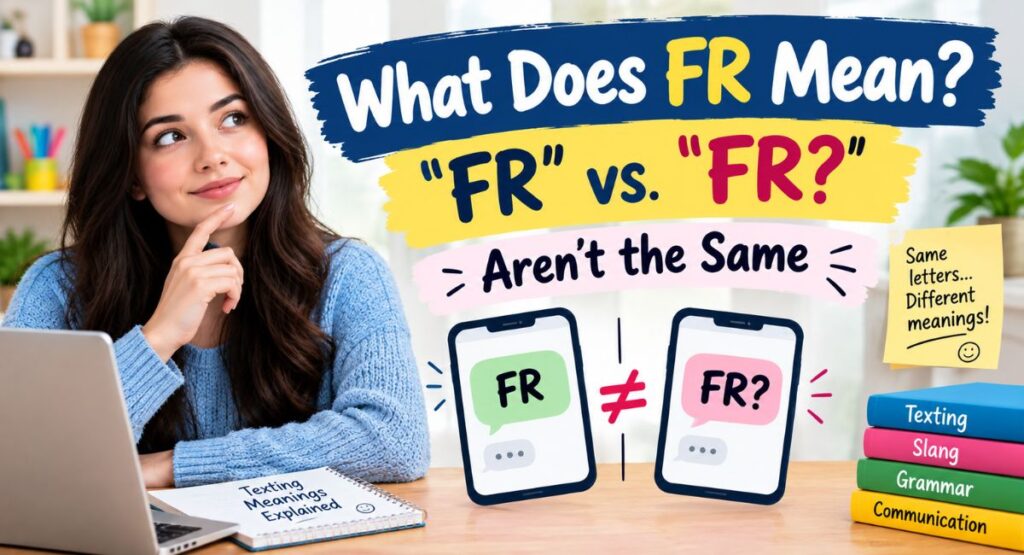
FR MEAN Quick Answer: FR stands for “for real” — used to express agreement, sincerity, or emphasis in casual texting. But FR functions two different ways depending on punctuation: as a statement (“FR, that’s true”), it signals agreement. As a question (“FR?”), it signals disbelief or a request to confirm something is actually true.
Most guides define FR once and move on. The punctuation distinction is what actually determines how to read — and reply to — it.
Where FR Actually Comes From
FR is rooted in African American Vernacular English (AAVE), where “for real” has been used for decades to underline sincerity. The specific two-letter abbreviation didn’t become widely used until 2014, when it spread through Vine and Twitter, before exploding into mainstream use during the 2020s alongside Gen Z internet culture. That’s notably later than abbreviations like LOL or BRB, which some guides incorrectly group it with.
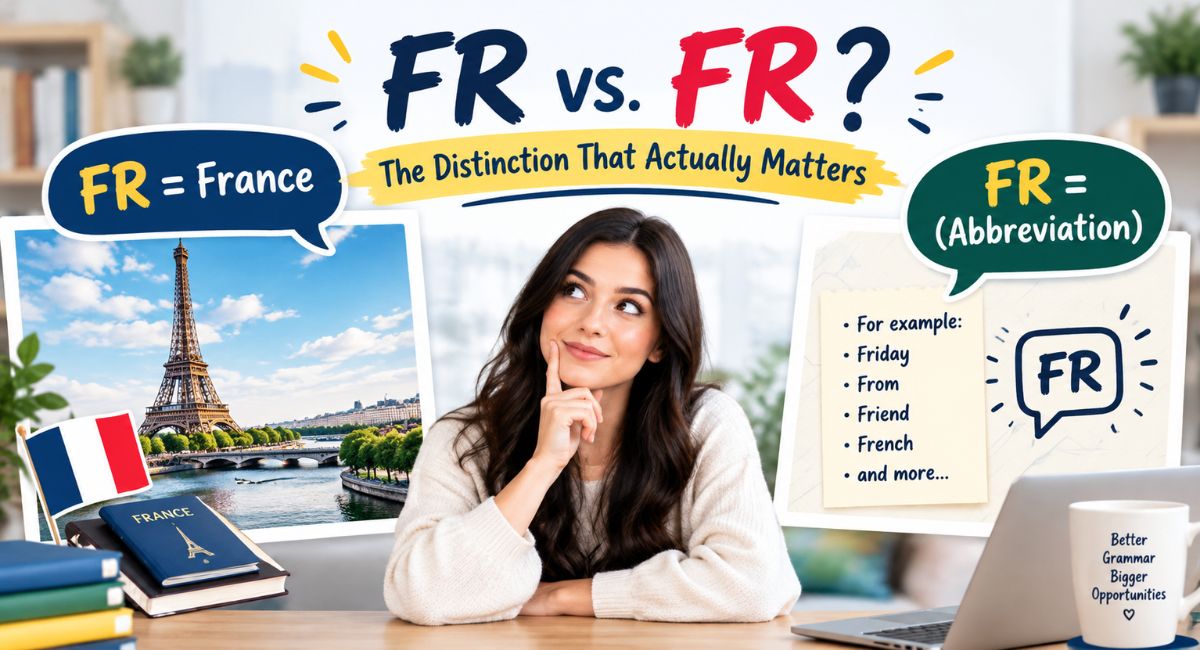
FR vs. FR? — The Distinction That Actually Matters
| Form | Function | Example |
| FR (statement) | Agreement, emphasis | “That exam was brutal, FR.” |
| FR? (question) | Disbelief, verification | “You got the job? FR?” |
| FRFR | Stronger emphasis | “That pizza was good FRFR.” |
The statement version confirms something is true. The question version asks whether it’s true. Missing this distinction is the most common way people misread FR in a real conversation.
Real Chat Examples
Example 1 — FR as agreement
Friend: “this weather is insane today” You: “FR, it’s changed like three times already”
No question mark, just backing up what was said — this is pure agreement.
Example 2 — FR? as disbelief
Friend: “I got free tickets to the show” You: “FR?? no way”
Here FR is doing the opposite job — asking for confirmation because the news is surprising.
Example 3 — FRFR for extra emphasis
Someone: “I’m never doing that again” You: “FRFR, me neither”
Doubling FR intensifies the agreement — it’s not a typo, it’s an intentional emphasis pattern.
The rule of thumb: if FR follows a claim and adds no punctuation, it’s agreement. If it follows surprising news and includes a question mark, it’s asking for confirmation, not giving it.
Grammar & Common Mistakes
- Punctuation: A trailing question mark is the single biggest signal — “FR” agrees, “FR?” questions. Multiple question marks (“FR??”) intensify the disbelief.
- Capitalization: Both “fr” and “FR” are common and don’t change meaning — lowercase is slightly more casual overall.
- Common mistake: Assuming FR always means agreement, even when it’s clearly punctuated as a question — this flips the entire function of the message.
- Common mistake: Confusing FR with FRFR as unrelated terms — FRFR isn’t a separate word, it’s FR repeated for emphasis, similar to saying “real real.”
When to Use (and Avoid) FR
Good fits:
- Backing up an opinion or reaction in casual texting
- Reacting to surprising news with “FR?” to ask if it’s true
- Group chats and social media captions/comments
Avoid it:
- Professional or formal writing — use “seriously” or “I agree” instead
- Situations where punctuation could be misread — add extra context if the message could go either way
- Assuming gender or sender changes the meaning — the punctuation and context matter far more than who sent it
FR vs. Similar Slang
| Term | Meaning | Function |
| FR | For Real | Agreement (or question, if punctuated) |
| FRFR | For Real, For Real | Stronger emphasis |
| NGL | Not Gonna Lie | Prefacing an honest opinion |
| NO CAP | No Lie | Emphasizing truthfulness |
FR is unique on this list because its function genuinely changes with punctuation — the others stay consistent regardless of how they’re punctuated.
Related Reads
FR MEAN : FAQs
What does FR mean in chat? FR stands for “for real,” used to express agreement, sincerity, or emphasis in casual texting.
What’s the difference between FR and FR?? FR without punctuation signals agreement with something already said. FR with a question mark asks for confirmation, usually reacting to surprising news.
Is FR the same as FRFR? No — FRFR is FR repeated for stronger emphasis, similar to saying “real real,” not a separate or unrelated term.
Where did FR come from? FR is rooted in African American Vernacular English, with the abbreviated form spreading through Vine and Twitter starting in 2014, before becoming mainstream in the 2020s.
Is FR appropriate in professional messages? No — it’s casual internet slang, so formal writing should use “seriously” or “I agree” instead.