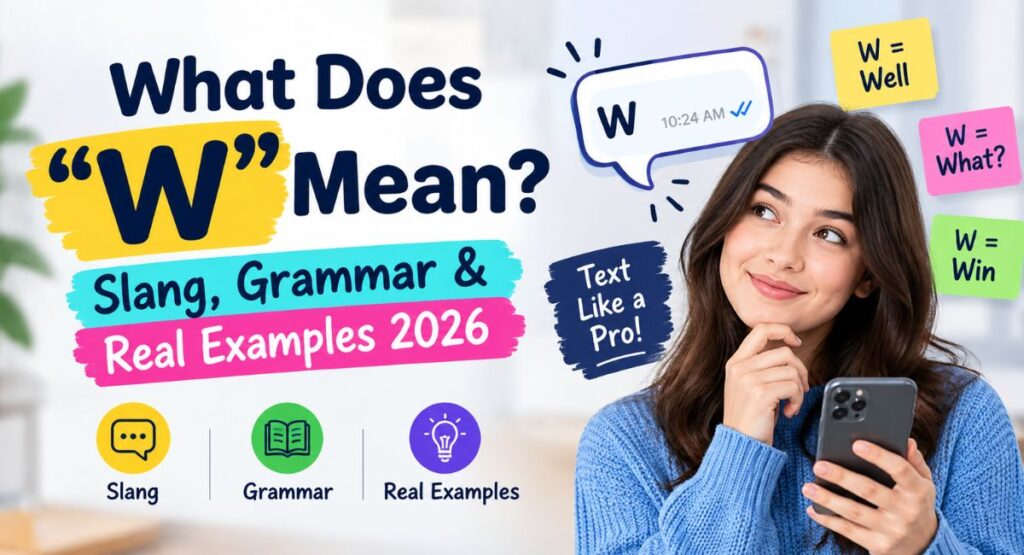
You are scrolling through comments and someone has posted a single “W” under a video. Another person texts “bringing snacks w/ cheese.” A third writes “w?” with a question mark. Same letter, three different jobs.
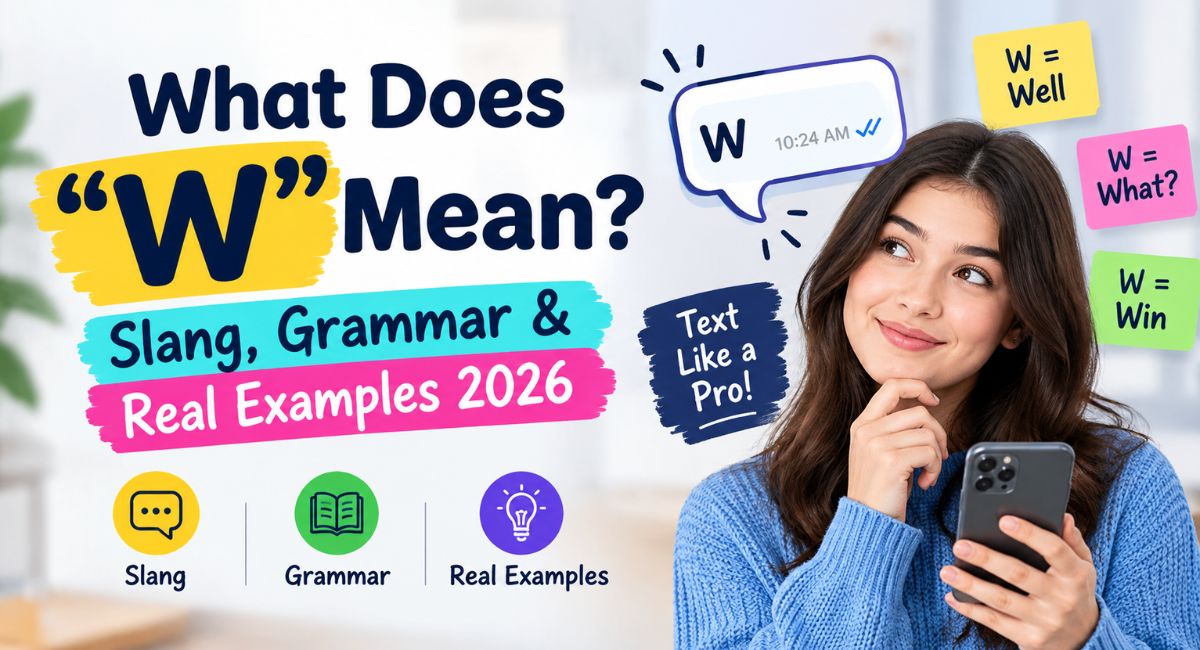
“W” in text usually means “win,” a quick way to celebrate good news or praise something. Written as “w/,” it means “with.” Because one letter can carry different meanings, the slash, the capitalization, and the setting tell you which one the sender intends.
This guide shows how to read each meaning, how to reply, and the grammar that keeps your own messages clear.
W Meaning in Slang: “Win” and Its Common Phrases
As slang, “W” stands for a win, a good result, or an impressive moment. Its opposite is “L” for loss or failure.
Common ways you will see it:
- “W!” after good news: “You got the internship? W!”
- “Big W” or “massive W”: a major success.
- “W in the chat”: a call for a group to celebrate a great moment.
- “W” plus a noun: praise for a specific thing, such as “W edit” or “W idea.”
If someone sends a lone “W,” they are saying something good just happened. Nothing more complicated than that.
Why Is It “W”? A Short Origin Note
Wins and losses have long been marked with “W” and “L” in sports records and standings. Online communities borrowed the habit, which is why “W” and “L” appear together as a pair. Exact details of who started the slang are not well documented, so treat any single origin story with caution.
What “w/” Means (and Why the Slash Changes Everything)
Many people searching for “W” are actually asking about “w/”. With a slash, the letter is shorthand for “with.”
- w/ means with: “Coffee w/ milk, please.”
- w/o means without: “I went w/o my charger.”
This is a different job from the slang “W.” The slash tells you it is an abbreviation, not a reaction. It is common in notes, quick texts, and menus, but you should write the full word in formal and academic writing.
4 Real W Chats (and the Best Reply for Each)
Chat 1: The good news
Sana: I got the internship!! Ali: W! You (as Sana): ?
Best reply: “Thank you! Dinner is on me this weekend.” Why: “W!” is celebration, so answer with thanks and keep the happy mood going.
Chat 2: The slash
Imran: bringing snacks w/ extra cheese, ok? You: ?
Best reply: “Yes please! Extra cheese is perfect.” Why: “w/” means “with,” so this is a normal message about food, not a reaction.
Chat 3: The comment
Viewer: that edit is a W 🔥 You (the creator): ?
Best reply: “Thank you, that means a lot!” Why: it is public praise. A short, grateful reply works well.
Chat 4: The Hinglish mix
Raj: bhai promotion mil gaya 💪 Dev: W bro, party kab hai?
Best reply: “Shukriya yaar! Is weekend pakka.” Why: “W” is celebration, and answering the party question keeps the conversation moving.
When you see “w?” with a question mark: it is ambiguous. It could be an unfinished question word or a request for clarity. Reply with “Do you mean win or with?” to settle it.
Grammar Corner: Is “W” a Noun or an Interjection?
Part of speech
- Interjection: “W!” works as a standalone exclamation, like “Nice!” or “Wow!”
- Informal noun: “That’s a W” treats it as a countable thing. The article “a” is the clue.
- Abbreviation: “w/” is a shorthand for the preposition “with.”
“A W” or “an W”?
Use a W. The rule follows the sound, not the spelling. “W” is pronounced “double-u,” which starts with a “d” sound, so “a” is correct. For its opposite, use an L, because “L” is pronounced “el,” which starts with a vowel sound.
Plurals
Write the plural as Ws and Ls, without an apostrophe: “We took three Ws this week.” An apostrophe shows ownership, not “more than one.”
Capitalization
- “W” in capitals is common as a standalone reaction.
- “w” in lowercase is common mid-sentence in casual chats.
- “W!!!” with extra marks shows stronger enthusiasm. This is style, not a rule.
- “w/” is almost always lowercase.
Punctuation
Do not leave a space inside the slash abbreviation. Write “w/” and “w/o,” not “w /” or “w / o.” A period after a lone “W” (“W.”) reads flat or sarcastic, while an exclamation mark reads excited.
W, “Dub,” and Related Terms
| Term | Meaning | Note |
| W | Win, approval | Casual slang |
| L | Loss, failure | The opposite of W |
| Dub | Informal spoken form of “W” | Comes from the sound of “double-u” |
| w/ | With | Abbreviation, not slang |
| w/o | Without | Abbreviation, not slang |
Other Meanings of W You Might Be Looking For
If the slang does not fit, check these:
| Meaning | Where you will see it |
| Double-u | The name of the letter |
| Watt | Electricity and appliances (W) |
| West | Compass directions and maps |
| Tungsten | The chemical symbol for the element |
| With | Written as “w/” in notes and texts |
Context usually makes it clear. A “60 W” lightbulb is a unit of power, and a “W” under a gaming clip is a win.
How W Is Used Across Platforms
The meaning stays the same on every app. The tone changes:
| Platform | Typical tone | Example |
| Personal, warm | “You helped him move? W ❤️” | |
| Public praise | “This edit is a W 🔥” | |
| TikTok | Fast, reactive | “W video” |
| Snapchat | Playful, light | “W reply, lol” |
| Gaming chats | Literal | “GG, that’s a W” |
On public platforms, “W” often works like a thumbs-up for a stranger’s content. In private chats, it feels warmer because the people already know each other.
How to Reply to a W
| Message | Easy reply |
| “W!” after your news | “Thanks! Let’s celebrate.” |
| “W” on your post | “Thank you!” |
| “massive W” | “I’m so happy, thanks for the support.” |
| “w?” | “Do you mean win or with?” |
Match the tone first. Celebrate with celebration and keep it short.
Clues That Tell You Which W You Got
When you meet a lone letter, look at what surrounds it:
- The slash. “w/” almost always means “with.”
- The punctuation. “W!” suggests celebration. “w?” suggests a question or an unfinished word.
- The topic. Good news, a post, or a game result points to “win.” Food, lists, and notes point to “with.”
- The platform. Comment sections and gaming chats lean toward slang. Notes and quick plans lean toward abbreviations.
If two clues agree, you can reply with confidence. If they disagree, ask a quick question instead of guessing.
Common W Mistakes
- Mixing up “W” and “w/”. One is slang, the other means “with.”
- Using it in professional messages. Work email, Slack, and formal comments need full words.
- Writing “an W.” Use “a W.”
- Adding an apostrophe to the plural. Write Ws, not W’s.
- Spacing the slash. Write “w/” with no gap.
- Treating a lone “w?” as a clear message. Ask what the sender meant.
Related Reads
- Seeing other short reactions on social media? Read TT meaning on TikTok.
- Decoding a one-word chat message? See ING meaning in text.
FAQs
What does W mean in text?
“W” usually means “win,” a quick way to celebrate good news or praise something. Written as “w/,” it means “with.” The slash, the capitalization, and the setting show which meaning is intended.
Is W a noun or an interjection?
Mostly an interjection when it stands alone (“W!”). It works as an informal noun when it follows an article, as in “that’s a W.” The word “a” is the clue.
What does w/ mean?
“w/” is shorthand for “with,” and “w/o” means “without.” They are abbreviations, not slang. Use the full words in formal or academic writing.
Should W be capitalized?
There is no strict rule. Capital “W” is common as a standalone reaction, and lowercase is common mid-sentence. The abbreviation “w/” is almost always lowercase.
What is the difference between W and dub?
“Dub” is an informal spoken form of “W,” based on how the letter “double-u” sounds. Both mean a win in casual slang.