Scrolling through a comment section and see someone reply with just “smh”? You’re not alone if you paused and thought — wait, what does that even mean?
Good news: it’s simpler than it looks, and once you get it, you’ll start noticing it everywhere — texts, tweets, Instagram captions, even in real conversation. This guide breaks down the SMH meaning, how to use it correctly (including the grammar part most guides skip), and where it came from.
What Does SMH Mean? (Quick Definition)
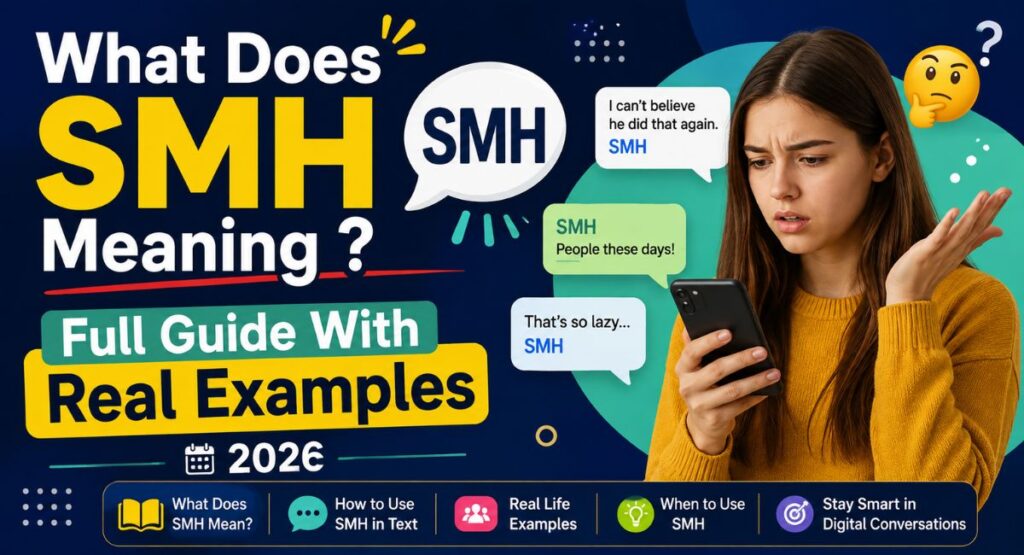
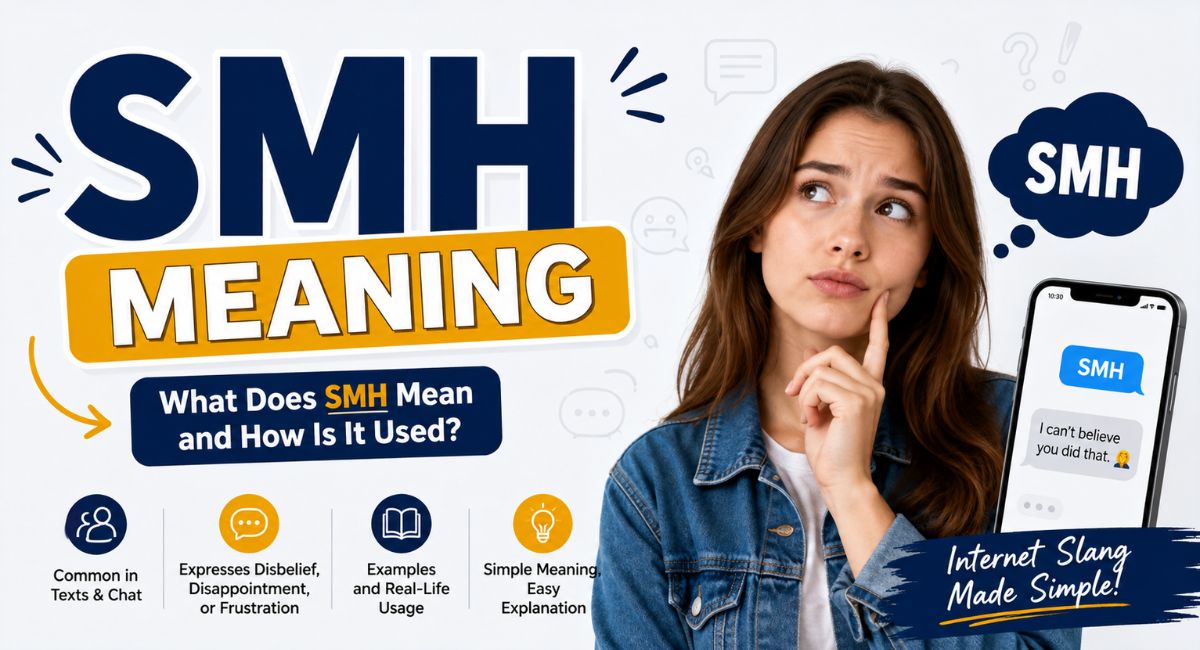
SMH stands for “Shaking My Head.”
People use it as a short, wordless way to react to something disappointing, unbelievable, silly, or frustrating — the same way you’d physically shake your head if someone told you something ridiculous in person.
Quick facts:
| Detail | Info |
| Full form | Shaking My Head |
| Part of speech | Interjection / discourse marker |
| Case sensitivity | Works as SMH, Smh, or smh — none is “more correct” |
| First used | Late 1990s–early 2000s (AOL Instant Messenger, IRC, web forums) |
| Common tone | Disbelief, mild frustration, sarcasm, or amusement |
| Used on | Texting, X (Twitter), Instagram, TikTok, Reddit, Discord, WhatsApp |
Where Did SMH Come From?
SMH started as shorthand born out of necessity. In the late 1990s and early 2000s, people chatting on AOL Instant Messenger and early internet forums typed fast by compressing common reactions into initials — the same habit that gave us LOL, BRB, and TTYL.
The phrase behind it — physically shaking your head — was already a universal gesture of disapproval, long before the internet existed. That’s exactly why SMH caught on so fast: you didn’t need anyone to explain it to you. Unlike LOL (which some people genuinely had to look up), SMH mapped onto something everyone already understood.
When texting took over as the default way people communicated (roughly 2007 onward), SMH carried over without changing meaning — just fewer characters, faster typing, same head-shake energy.
How Do You Use SMH in a Sentence? (Grammar Guide)
This is the part most guides skip — and it’s exactly where people with English grammar struggles usually get stuck. Here’s how SMH actually functions grammatically:
1. As a Standalone Reaction
SMH can be a complete reply on its own — no subject, no verb needed, because it’s an interjection, just like “wow” or “ugh.”
Example: “SMH.” (posted alone as a comment)
2. At the End of a Sentence
Most commonly, SMH is tacked onto the end of a sentence, usually after a comma, to add tone/emphasis to what was just said.
Example: “He forgot his own birthday, smh.”
3. At the Start of a Sentence
Less common but still correct — used to set the tone before the explanation.
Example: “Smh, he did it again.”
Punctuation & Capitalization Rules
- No period needed after SMH in casual texting — it’s slang, not a formal abbreviation like “etc.”
- Lowercase (smh) is more common in casual texts and captions; uppercase (SMH) appears more in headlines or emphasis.
- Don’t use SMH as a verb — you can’t say “I’m SMH-ing right now.” It only works as a reaction word, not an action.
- Avoid using SMH mid-sentence as a noun or adjective (“that was so SMH”) — this is a common mistake among learners and reads as grammatically incorrect to native speakers.
Common mistake to avoid: Writing “SMH” when you mean genuine anger or serious criticism. Because it reads as casual and even humorous, it can come across as dismissive if the situation actually needs empathy.
How Is SMH Used Today? (Real Examples by Platform)
On Texting & WhatsApp
Between friends, SMH is often playful, not harsh.
“You locked your keys in the car again, smh 😂”
On X (Twitter)
Used as a quick reaction under viral posts, news, or sports clips — usually paired with disbelief at a headline or outcome.
On Instagram & TikTok
Shows up heavily in comment sections reacting to cringe or dramatic videos. People sometimes stack it for comedic effect: “smh smh smh.”
In Group Chats
Gentler and more affectionate — closer to teasing than criticism.
Combined With Emojis
Commonly paired with 🤦 (facepalm), 😂, or 🙄 for extra tone clarity, since text alone can’t carry sarcasm well.
Is SMH Rude or Offensive?
Generally, no. SMH sits closer to an eye-roll than an insult — it’s one of the milder internet acronyms.
| Context | How SMH Lands |
| Casual/playful (friends, memes) | Light, even affectionate |
| Serious or emotional conversations | Can feel dismissive — avoid it |
| Professional/work chats | Skip it entirely, even in casual Slack messages with clients |
If you’re unsure how it’ll land, swap it for a full sentence like “that’s honestly hard to believe” — same meaning, zero risk of sounding cold.
SMH vs SMDH: What’s the Difference?
SMDH is the intensified version of SMH — commonly read as “so much disbelief” or “shaking my damn/darn head.” The two are used interchangeably in casual contexts; SMDH just turns up the volume on the same reaction.
| Acronym | Meaning | Intensity |
| SMH | Shaking My Head | Standard |
| SMDH | So Much Disbelief / Shaking My Damn Head | Stronger |
Words & Acronyms Similar to SMH
| Acronym | Meaning | How It’s Different From SMH |
| LOL | Laughing Out Loud | Reacts to humor, not disbelief |
| OMG | Oh My God | General shock — can be positive or negative |
| SMDH | So Much Disbelief | Stronger version of SMH |
| IDK | I Don’t Know | Expresses uncertainty, not disapproval |
| TBH | To Be Honest | Signals honesty is coming, different tone |
| Facepalm 🤦 | Embarrassment reaction | Same emotion, expressed visually instead of in words |
SMH stands out because it maps directly onto a real physical gesture — most other acronyms on this list don’t have that same one-to-one body-language connection.
Curious about other trending internet acronyms? Check out our guides on IYKYK meaning, TT meaning (TikTok), FAFO meaning, and Sigma meaning to keep building your slang vocabulary.
How Should You Reply to an SMH?
Keep it low-effort — that’s the whole point of the exchange:
- A laughing emoji (😂) or 🤝
- “I know, right”
- “Fr” or “facts”
- Another short acronym back
Frequently Asked Questions
What does SMH mean in a text message? SMH means “shaking my head.” It’s used to react to something disappointing, silly, or hard to believe — usually at the end of a sentence or as a standalone reply.
Is SMH the same as SMDH? Not exactly. SMDH intensifies the SMH meaning, often read as “so much disbelief.” Both fit similar situations, but SMDH signals a stronger reaction.
Can you use SMH at work? It’s best to skip it in professional or client-facing communication. SMH is casual slang and can come across as dismissive in a formal setting.
Is SMH written in capital or lowercase letters? Both are correct. Lowercase (“smh”) is more common in casual texting and captions, while uppercase (“SMH”) is often used for emphasis or in headlines.
Where did the SMH meaning come from? SMH originated in early internet chat culture — AOL Instant Messenger, IRC, and web forums — in the late 1990s and early 2000s, following the same shorthand pattern as LOL and BRB.
Does SMH always mean someone is angry? No. SMH usually signals mild disappointment, disbelief, or amusement rather than real anger. Between friends, it’s often affectionate teasing.
Final Takeaway
SMH has survived over two decades online because it does one job really well — it reacts without needing a full sentence. Use it freely with friends and casual comments, but reach for real words in serious or professional conversations. Get the tone right, and those three letters will say exactly what a head shake says in person.