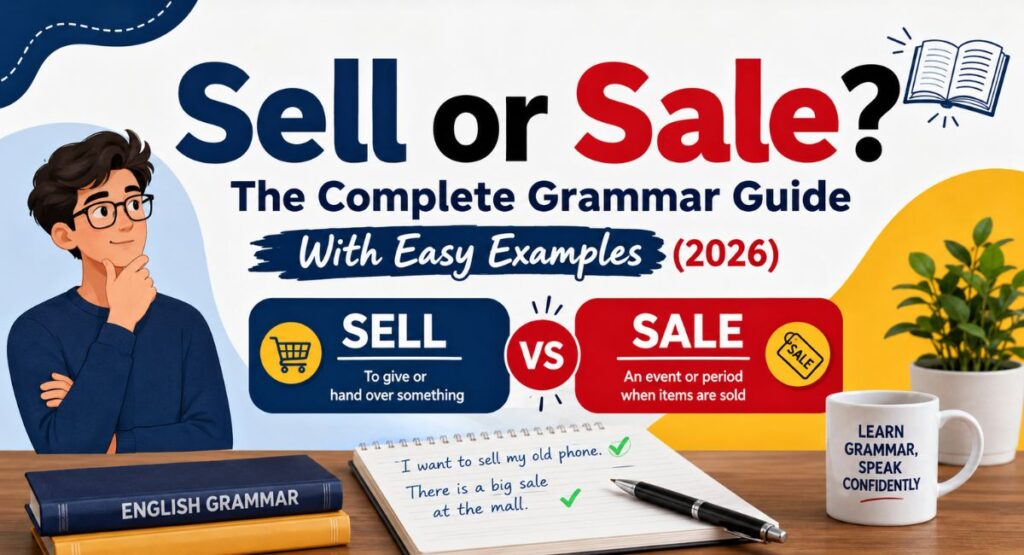
“I want to sell my phone” and “My phone is on sale” both sound fine, yet people mix up sell and sale every day. The two words look almost the same, come from the same family, and often appear side by side in shop windows and online listings. That is exactly why they cause so many mistakes in emails, product descriptions, and social media posts.
Sell or Sale? Quick answer:
- Sell is a verb. It means to give something to someone in exchange for money. I will sell my bike.
- Sale is a noun. It means the act of selling, a single deal, or a period when prices are lower. The bike is for sale. The store has a sale today.
- Sells is the verb with he/she/it. Sales is the plural noun. She sells shoes. Her sales are growing.
Below you will find the full rules, the forms people get wrong most often (sells vs sales, for sale vs on sale), real-life examples, a memory trick, and a short quiz to check yourself.
What Does “Sell” Mean?
Sell is an action word. When you sell something, you hand over goods, a service, or property and receive money (or something of value) in return.
Examples:
- I want to sell my old laptop.
- She sells handmade candles on Instagram.
- They sold their house last spring.
- We are selling tickets at the door.
All Forms of “Sell”
| Form | Word | When to use it | Example |
| Base form | sell | I, you, we, they, and after “to” or “can/will” | They sell fresh bread. |
| Third person singular | sells | he, she, it, or one person/thing | He sells used books. |
| Past simple | sold | finished action in the past | I sold my car yesterday. |
| Past participle | sold | after have/has/had, or in passive sentences | The car has been sold. |
| -ing form | selling | ongoing action | She is selling her paintings. |
Notice that “sell” is irregular. The past form is sold, not “selled”.
What Does “Sale” Mean?
Sale is a noun, so it names a thing, an event, or an idea. It has three everyday meanings:
- The act or a single deal of selling. The sale of the house took two months.
- A period of reduced prices. The summer sale ends on Sunday.
- The state of being available to buy. The apartment is for sale.
Because it is a noun, you can put a, the, this, or an adjective in front of it: a sale, the big sale, this weekend’s sale.
Sell vs Sale: The Main Difference
| Sell | Sale | |
| Part of speech | Verb | Noun |
| Shows | An action | A thing, event, or deal |
| Pronunciation | /sel/ (rhymes with “bell”) | /seɪl/ (rhymes with “sail”) |
| Changes form? | Yes: sell, sells, sold, selling | Only the plural: sale, sales |
| Works after “a/the”? | No (almost never) | Yes |
| Example | We sell shoes. | The shoe sale starts Friday. |
Easy test: if someone is doing something, use sell. If you are naming something, use sale.
Sells or Sales? The Mistake Almost Everyone Makes
This is where most confusion happens, because both words end in -s and look like the same word in a hurry.
- Sells = verb. It follows he, she, it, or a singular name. Maria sells flowers.
- Sales = plural noun. It talks about several deals or the total amount sold. Flower sales rose in May.
| Wrong | Right | Why |
| She sales cars. | She sells cars. | You need a verb after “she”. |
| Our sells are up this month. | Our sales are up this month. | You need a noun after “our”. |
| The company sell software. | The company sells software. | “Company” is singular, so add -s. |
| The sells team met on Monday. | The sales team met on Monday. | “Sales” works like an adjective here. |
Quick trick: try replacing the word with “buys”. If “buys” fits (She buys cars), use sells. If “revenue” fits (Our revenue is up), use sales.
Sell and Sells, Sale and Sales
- I sell, you sell, we sell, they sell.
- He sells, she sells, it sells.
- One sale, many sales.
Sale vs sales: “a sale” is one deal or one discount event. “Sales” means more than one deal, or the overall results of a business. We made a sale this morning. Total sales for the year were strong.
Using Sell and Sale in the Same Sentence
Many sentences need both words. Here is how they work together:
- “I want to sell my sofa, so I put it up for sale.”
- “The shop sells winter coats, and they are on sale now.”
- “They plan to sell the company, but the sale is not final yet.”
The verb describes what someone does. The noun describes the result or the situation.
For Sale vs On Sale
These two phrases are easy to mix up, and they do not mean the same thing.
| Phrase | Meaning | Example |
| For sale | The owner is willing to sell it. It is available to buy. | The house is for sale. |
| On sale | It costs less than usual (mostly US usage). | These sneakers are on sale this week. |
| Go on sale | It becomes available to buy for the first time. | Concert tickets go on sale at noon. |
| Up for sale | Being offered for sale, often something big or important. | The old hotel is up for sale. |
| In the sale | Discounted (common in British English). | I bought this coat in the sale. |
Never write “for sell” or “on sell.” After the prepositions for and on, you need a noun, and the noun is sale. Correct: The car is for sale.
A Small US vs UK Difference
Both varieties of English use the same grammar for sell and sale, but they phrase discounts a little differently. Americans say an item is on sale. British speakers often say it is in the sale or talk about the sales (for example, “the January sales”). In British English, “on sale” can simply mean “available to buy.”
Pronunciation: Sell vs Sale
The spelling difference is tiny, but the sounds are different:
- Sell /sel/ sounds like cell and rhymes with bell, tell, well.
- Sale /seɪl/ sounds like sail and rhymes with mail, tale, fail.
Both words are homophones of other words (sell/cell and sale/sail), so you cannot rely on listening alone. Check the job the word does in the sentence.
Common Phrases With “Sell”
| Phrase | Meaning | Example |
| sell out | sell everything; also to betray your values | The tickets sold out in an hour. |
| sell off | sell things cheaply to get rid of them | They sold off the old stock. |
| sell up | sell your house or business (mainly British) | They sold up and moved abroad. |
| sell yourself | present your skills well | Learn to sell yourself in an interview. |
| sell someone short | underestimate them | Don’t sell yourself short. |
| sold on (an idea) | fully convinced | I’m sold on this plan. |
| sell-by date | last date a shop should sell a product | Check the sell-by date on the milk. |
| sell like hot cakes | sell very quickly | The new phones are selling like hot cakes. |
Common Phrases With “Sale”
- Garage sale / yard sale: people sell used items from their home.
- Bake sale: baked goods sold to raise money.
- Flash sale: a discount that lasts a short time.
- Clearance sale: prices cut to remove old stock.
- Fire sale: goods sold very cheaply, often in a hurry.
- Sale price: the reduced price.
- Sales tax: tax added at the point of purchase.
- Point of sale: the place or moment a customer pays.
- Bill of sale: a document that proves a sale.
- No sale: the deal did not happen.
Can “Sell” Be a Noun? Can “Sale” Be a Verb?
“Sale” is never a verb. You can’t say “I sale my car.” Always use sell.
“Sell” is occasionally a noun, but only in a few informal expressions. You will hear hard sell (pushy selling), soft sell (gentle selling), and a tough sell (something hard to convince people to buy). In ordinary writing, stick to “sale” when you need a noun.
A related word is sellout. As a noun it means an event where every ticket was sold (The concert was a sellout) or a person who betrays their principles.
Sell vs Sale in Business and Marketing
Business writing uses both words constantly, so it helps to know which belongs where.
- Verb (sell): sell products, sell services, sell online, sell to new customers.
- Noun (sale/sales): make a sale, close a sale, sales report, sales target, sales team, sales funnel, sales manager.
That is why the department is called the Sales Department and not the “Sell Department”. The word sales works as a noun adjunct, which means a noun placed before another noun to describe it.
Example email line: “Our team will sell the new plan to existing clients, and we expect sales to grow next quarter.”
Sell, Sold, and Sale: Don’t Forget “Sold”
Learners often write “I sale it yesterday” or “I selled it.” The correct past form is sold.
| Time | Sentence |
| Present | I sell homemade soap. |
| Past | I sold ten bars yesterday. |
| Present perfect | I have sold all my stock. |
| Future | I will sell more next week. |
| Passive | The soap is sold online. |
Real-Life Examples
Online marketplace:
- “I want to sell my bike. It’s for sale in great condition.”
Shopping:
- “This store sells kitchen tools, and everything is on sale today.”
Real estate:
- “They decided to sell the house, and the sale closed in June.”
Work and school:
- “She sold more than anyone else, so her sales numbers were the highest.”
Common Mistakes and Fixes
| Incorrect | Correct |
| I want to sale my phone. | I want to sell my phone. |
| The car is on sell. | The car is for sale. |
| Our shop has a big sell today. | Our shop has a big sale today. |
| She sales shoes. | She sells shoes. |
| I selled my bike. | I sold my bike. |
| Company sells increased. | Company sales increased. |
Easy Memory Tricks
- Sell = action. If you can say “I ___” or “to ___”, it is sell.
- Sale = thing. If you can say “a ___” or “the ___”, it is sale.
- The “a” in sale: think “a sale” and remember that a noun comes after a.
- Rhyme check: sell rhymes with “tell” (both are verbs), sale rhymes with “tale” (both are nouns).
Words That Mean Almost the Same
| Synonyms for “sell” | Synonyms for “sale” |
| market, trade, retail, offer, vend, peddle, auction | deal, transaction, discount event, promotion, clearance, bargain |
Quick Quiz: Sell or Sale?
Choose the right word, then click the question to check your answer.
1. I want to ____ my old phone.
2. The winter ____ starts on Friday.
3. The sofa is for ____.
4. She ____ handmade candles online. (sells / sales)
5. Our ____ went up by 20% this year. (sells / sales)
6. He ____ his car last week. (sell / sold)
Frequently Asked Questions
Is it sell or sale?
Use sell when you mean the action (verb) and sale when you mean the deal, the event, or the discount (noun).
What is the difference between sells and sales?
Sells is the present tense verb used with he, she, or it (“She sells shoes”). Sales is the plural noun (“Shoe sales are high”).
Is “for sell” correct?
No. The correct phrase is for sale, as in “The bike is for sale.”
What does “on sale” mean?
In most cases it means the item is being sold at a lower price than usual. It can also mean something is available to buy, as in “Tickets go on sale Friday.”
Can sale be a verb?
No. Sale is only a noun. The verb is always sell.
What is the past tense of sell?
The past tense and past participle are both sold. “Selled” is not a word.
What is the difference between sale and sales?
A sale is one deal or one discount event. Sales means several deals or the total amount sold, as in “sales figures.”
Are sell and sale pronounced the same?
No. Sell sounds like “cell” (/sel/), while sale sounds like “sail” (/seɪl/).
Related Reads
Final Thoughts
The rule fits in one line: sell is what you do, sale is what you have. Use sell, sells, sold, and selling for the action, and use sale and sales for the deal, the discount, or the sales figures. Remember “for sale” instead of “for sell,” add the -s in “she sells,” and use “sold” for the past. Once these small points feel natural, you will stop making this mistake in emails, listings, and everyday writing.