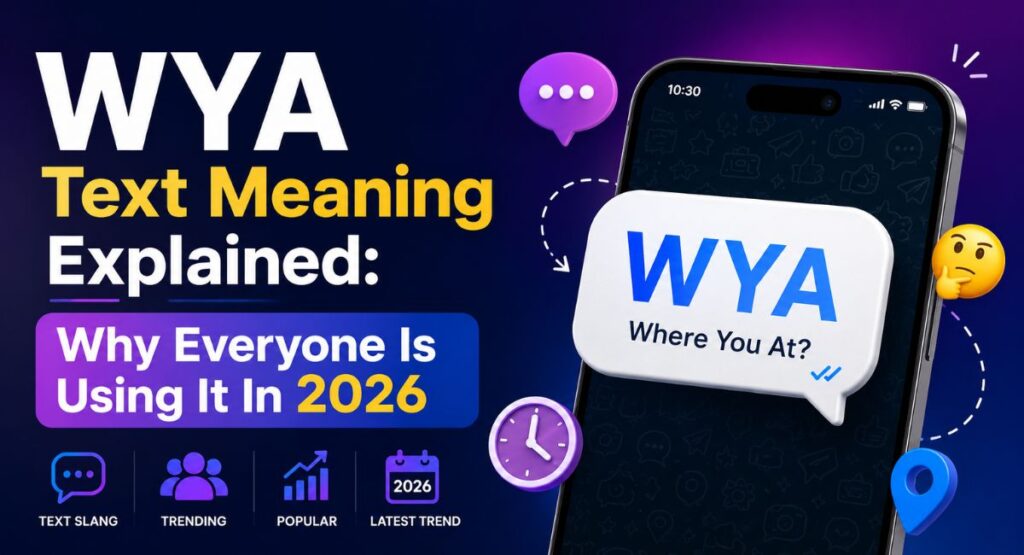
WYA text Meaning: Your phone lights up at 6:45 p.m.: “wya??” Three letters, two question marks, and no context. Are your friends waiting outside, is a buyer checking distance, or is someone fishing for a late-night invitation? The abbreviation is simple. The right reply is not.
WYA stands for “where you at,” a casual way of asking where someone is right now. It is used to arrange meetups, check on arrivals, or start a conversation. The sender, the time of day, and your relationship decide whether it is plain logistics or something more.
This guide covers what WYA means, how to read its tone, how to reply safely, and the grammar behind it.
WYA Meaning: “Where You At” Explained
WYA is an initialism, so people say the letters one by one: W-Y-A. It turns the informal question “Where you at?” into three letters.
You will see it in:
- Direct messages and group chats (“wya? we’re here”)
- Marketplace chats when a buyer checks pickup distance
- Comments and replies when someone asks where a photo or video was taken
It is a question, so it often carries a question mark: “WYA?” or “wya??”. Extra question marks usually signal urgency or impatience, not a different meaning.
Question or Hint? Three Things WYA Can Really Be
The same word can carry three different messages. Reading the situation is half the skill.
1. Logistics: “I need to find you”
This is the most common use. Friends are meeting, a ride is arriving, or someone is waiting for you. Clues: a specific time or place, urgency, and a follow-up like “we’re outside.”
2. An invitation or hint: “Are you free to meet?”
Late at night or after a friendly chat, WYA can be a soft way of asking whether you are available to meet. Clues: no plan has been mentioned, the tone is relaxed, and it arrives out of the blue. This reading depends on your relationship with the sender, not on the sender’s gender.
3. A check-in: “Are you okay?”
Sometimes WYA is concern. If you are late, silent, or travelling, a family member or friend may text “wya?” to check you are safe. Clues: it follows a missed call or delay.
When you cannot tell which one it is, answer the logistics part and let their next message reveal the rest.
4 Real WYA Chats (and the Best Reply for Each)
Chat 1: The friends outside
Sana: wya?? we’re outside the cafe You: ?
Best reply: “On my way, 10 min! Order me a coffee?” Why: they want a location and a time. Give both, and keep the tone light.
Chat 2: The marketplace buyer
Buyer: Hi, is the couch still available? wya? I need to check my driving distance. You: ?
Best reply: “Still available! I’m in the north part of town. I can meet at a public spot if you prefer.” Why: you share your general area, not your home address, and you keep the sale safe.
Chat 3: The late-night text
Imran: wya You: ?
Best reply: If you want to chat: “Home, what’s up?” If you are unsure: “Why, what’s the plan?” Why: asking for the plan puts the sender’s intention on the table without a guess.
Chat 4: The Taglish and Roman Urdu mix
Mika: wya na? nandito na kami sa labas Hira: yaar wya? hum bahar khade hain
Best reply: “Papunta na ako, 5 minutes!” or “Bas aa rahi hoon, 5 minute!” Why: in multilingual chats, WYA stays in English while the rest follows the speaker’s language. Match their language and give a time.
Not sure what they mean? Send “Haha why, what’s up?” It is friendly and gives the sender room to explain.
Grammar Corner: Why It’s “Where You At” and Not “Where Are You”
Grammar is the reason WYA looks odd to many English learners, so this section matters.
What is missing?
Standard English asks “Where are you?” WYA is built from “Where you at?”, which drops the verb “are.” Leaving out “are” is a feature of informal speech, so it works in chats but not in writing for school or work.
The “at” debate
Traditional grammar guides call “Where are you at?” redundant, because “where” already asks for a place. Everyday speech uses it anyway, and WYA keeps the “at.” If you want the standard written form, use “Where are you?”
Punctuation and capitalization
- “wya” in lowercase is normal in casual chats.
- “WYA?” works in captions and group chats.
- “Where are you?” is the right choice in emails, job messages, and anything formal.
WYA vs similar shortcuts
| Shortcut | Stands for | What it asks | Standard English version |
| WYA | Where you at | Your location | Where are you? |
| WYD | What you doing | Your current activity | What are you doing? |
| “where r u” | Where are you | Your location | Where are you? |
The pattern: all of these drop the helping verb “are.” That is why they feel quick and casual.
Does the Platform Change the Meaning?
No. WYA means the same thing on Snapchat, Instagram, TikTok, and WhatsApp. What changes is the tone:
- Private chats and DMs: quick, friendly, often tied to meeting someone.
- Marketplace messages: practical, tied to distance or pickup.
- Public comments: usually a viewer asking where a place or product is.
If the platform seems to change the meaning, it is really the relationship that is changing it.
Safety: When Not to Share Your Exact Location
A WYA from a friend is easy to answer. A WYA from a stranger needs more care.
- Do not send your home address to someone you have only met online.
- Share a general area, such as a neighborhood or a landmark, until you trust the person.
- Meet in public places, especially for marketplace deals.
- Tell someone you trust where you are going if you do decide to meet.
You are never required to answer a location question quickly. A short pause is fine.
A 10-Second Check Before You Reply
Before you answer a WYA, run through three quick questions:
- Is there a plan already? If a time or place was mentioned, treat it as logistics and reply with your location and an arrival time.
- How well do you know the sender? A close friend deserves a direct answer. A stranger deserves a general area or a question back.
- Does the timing feel unusual? A WYA at 11 p.m. with no plan is a different message from one at 6 p.m. outside a cafe.
Two minutes of thought here saves you from over-sharing or from misreading a simple check-in as something else.
When to Use WYA (and When to Skip It)
Good places for it: chats with friends, group plans, casual marketplace messages.
Skip it in: emails, job applications, messages to teachers, and conversations with older relatives who may not know the shorthand. In those cases, write “Where are you?” in full.
Common WYA Mistakes
- Treating every WYA as a hint. Most are plain logistics.
- Replying with an exact address to a stranger. Give a general area.
- Writing “WYA” in formal messages. Spell it out.
- Confusing it with WYD. One asks where, the other asks what.
- Ignoring the follow-up message. Often the second text explains the first.
Related Reads
- Decoding another short chat reply? Read our guide to ING meaning in text.
- Wondering how tone changes a three-letter reply? See TSSS meaning in text.
WYA text Meaning:FAQs
What does WYA mean in text?
WYA stands for “where you at.” It is a casual way to ask where someone is right now, often used to arrange a meetup or check someone’s arrival. The tone can range from practical to friendly depending on who sends it.
Is WYA flirty?
Not by default. Most WYA messages are plain logistics. It can read as a hint when it arrives late at night with no plan attached, but that depends on your relationship with the sender, not on whether they are a boy or a girl.
What is the grammar behind WYA?
WYA comes from “Where you at?”, which leaves out the verb “are.” The standard written form is “Where are you?” The shortened version is fine in casual chats but not in formal messages.
How should I reply when a stranger sends WYA?
Do not share your exact address or live location. Ask why they want to know, or give only a general area. If you do decide to meet, choose a public place and tell someone you trust.
What is the difference between WYA and WYD?
WYA asks where you are (“where you at”). WYD asks what you are doing (“what you doing”). Both drop the helping verb “are” from standard English, which is why they feel casual and quick.