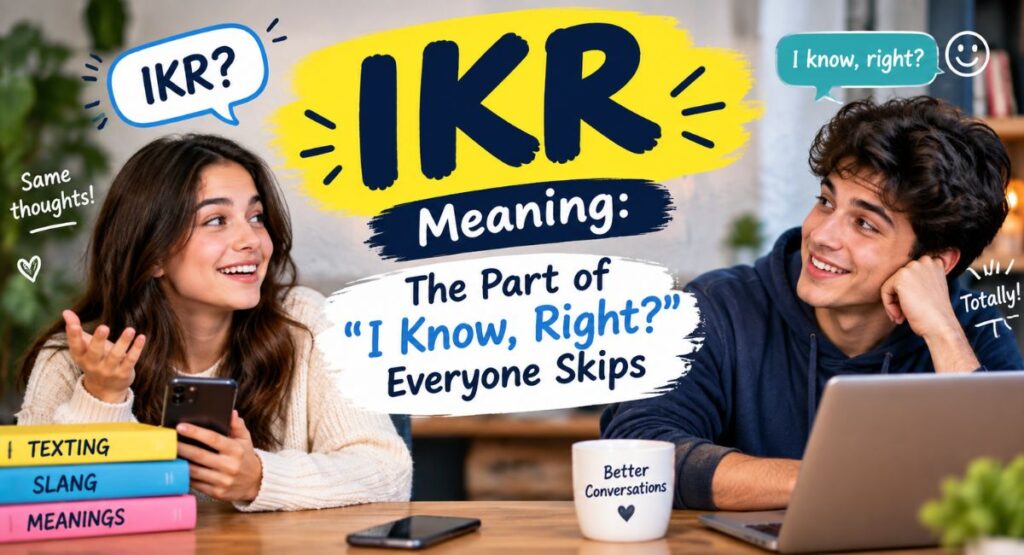
IKR stands for “I know, right?” — a casual way to agree with or validate what someone just said. It works as an interjection, not a full sentence, which is exactly why it trips people up in writing: whether you add a question mark, a period, or nothing at all actually changes the tone. Get that part wrong and IKR can read as flat instead of enthusiastic — or worse, sarcastic when you didn’t mean it to be.
What Does IKR Mean in Text?
IKR is a text-speak abbreviation for “I know, right?” — a phrase people use to signal that they strongly agree with, relate to, or share the same reaction as whoever they’re replying to. It’s not asking a real question; it’s confirming one you already agree with.
Functionally, IKR does two jobs at once:
- It acknowledges what the other person said.
- It adds emphasis, the way “right?” tacked onto the end of a sentence does in spoken English (“That was wild, right?”).
That second part is why some language commentators call the phrase a little illogical on paper — “I know” already states agreement, so “right?” seems to turn it into a question you’re also answering. In practice, nobody parses it that literally. It’s absorbed as a single unit of enthusiastic agreement, the same way “totally” or “exactly” gets used.
Where IKR Comes From
“I know, right?” has been part of casual spoken English since long before texting existed — it shows up in everyday conversation as a way of over-agreeing, often with a rising, slightly exaggerated tone. The shortened ikr form is a product of early SMS and instant-messaging culture, where character limits and typing speed pushed common phrases into initialisms. It followed the same path as brb, idk, and tbh: spoken-language habit first, keyboard shortcut second.
Real Chat Examples
Definitions only tell you what IKR means. Seeing it inside actual conversations is what tells you how to use it — including the two places people misuse it most: sarcastic contexts and formal ones.
Example 1 — Straightforward agreement (most common use)
Zara: this heat is actually unbearable today Aneesa: ikr, I’ve had the fan on full blast since 9am
Example 2 — Group chat, shared frustration
Sam: why does the wifi always crash during exams Priya: IKR?? happened to me twice this week Zara: literally the worst timing every single time
Example 3 — Where it goes wrong: mixed with sarcasm
Colleague (Slack): great, another meeting that could’ve been an email You: ikr 🙄
Here the meaning flips depending on tone markers. Without the eye-roll emoji or context, “ikr” alone in a workplace chat can be read as genuine enthusiasm — the opposite of what was intended. This is the exact ambiguity that trips up non-native English speakers and anyone using IKR outside a close-friend group: the words stay the same, but punctuation, capitalization, and added emoji shift the meaning.
IKR vs. Similar Agreement Phrases
| Phrase | Part of Speech | Typical Punctuation | Formality | Best Used With |
| IKR | Interjection | “?” or none (rarely “.”) | Very casual | Friends, group chats |
| I know, right? | Full clause | Question mark | Casual–neutral | Spoken or written-out contexts |
| Fr fr | Interjection | None | Very casual, Gen Z-coded | Peer group texting |
| No cap | Adverbial phrase | None | Very casual | Emphasizing sincerity, not agreement |
| Exactly | Adverb | Period or exclamation | Casual–formal | Any register, including work chats |
| Totally | Adverb | Exclamation common | Casual | Peer conversation |
The grammar difference matters more than it looks. “Exactly” and “I know, right?” both survive in semi-formal writing; IKR does not — it reads as texting shorthand in almost any context, so it’s a poor fit for emails, cover letters, or professional messaging even when the sentiment is right.
Common Mistakes People Make With IKR
1. Treating it as a real question. IKR isn’t actually asking anything — replying to it with a literal answer (“yes, I do know”) misreads the tone. It functions as agreement, not inquiry.
2. Capitalizing it for emphasis, then wondering why it reads as shouting. “IKR” in full caps signals enthusiasm in a text to a friend. In a work Slack or a comment on a stranger’s post, full caps can read as aggressive rather than excited. Lowercase “ikr” is the safer default outside close-friend contexts.
3. Using it without any tone signal in ambiguous situations. As shown in Example 3 above, bare “ikr” with no emoji, exclamation, or follow-up can be misread — especially by non-native English readers who are parsing the words literally rather than picking up on internet-speak conventions.
4. Using it in formal writing at all. IKR has no formal register. There’s no context — email, essay, cover letter, professional message — where it’s the right choice. “I completely agree” or “That’s exactly right” are the formal equivalents.
Who Says IKR, and When
IKR sits firmly in peer-to-peer, informal digital communication: text messages, DMs, group chats, casual social media comments. It’s common across age groups now, though it originated with and is most associated with younger, internet-fluent speakers.
It is not used in:
- Professional emails or workplace documentation
- Academic writing of any kind
- Formal spoken contexts (interviews, presentations)
- First messages to someone you don’t know well — it can read as overly familiar
Related Reads
- TSSS Meaning in Text
- TT Meaning on TikTok
Frequently Asked Questions
What does IKR mean in a text message? IKR means “I know, right?” — a casual way to agree with or relate to what someone just said, used mainly in texting, DMs, and social media.
Is IKR used as a question or a statement? It functions as agreement, not a real question. No literal answer is expected, even though it carries a question-mark tone.
Should IKR be capitalized? Lowercase “ikr” reads as casual and friendly; full caps (“IKR”) can signal stronger excitement but may come across as intense outside close-friend conversations.
Is it okay to use IKR in a work chat? Generally no. IKR is informal texting shorthand with no professional register — “exactly” or “I completely agree” are safer alternatives at work.
Does IKR always mean the same thing everywhere it’s used? Mostly, but tone markers matter — without punctuation or emoji cues, IKR can occasionally be misread as sarcastic rather than genuinely agreeing, especially in text-only formats like Slack.