Wagwan mean:If you’ve landed here because someone typed “wagwan” at you and you weren’t sure whether to answer with an emoji, a story about your day, or just a confused “?”, you’re not the only one. It looks like a question. It reads like slang. And most guides will tell you it just means “what’s up” and leave it there.
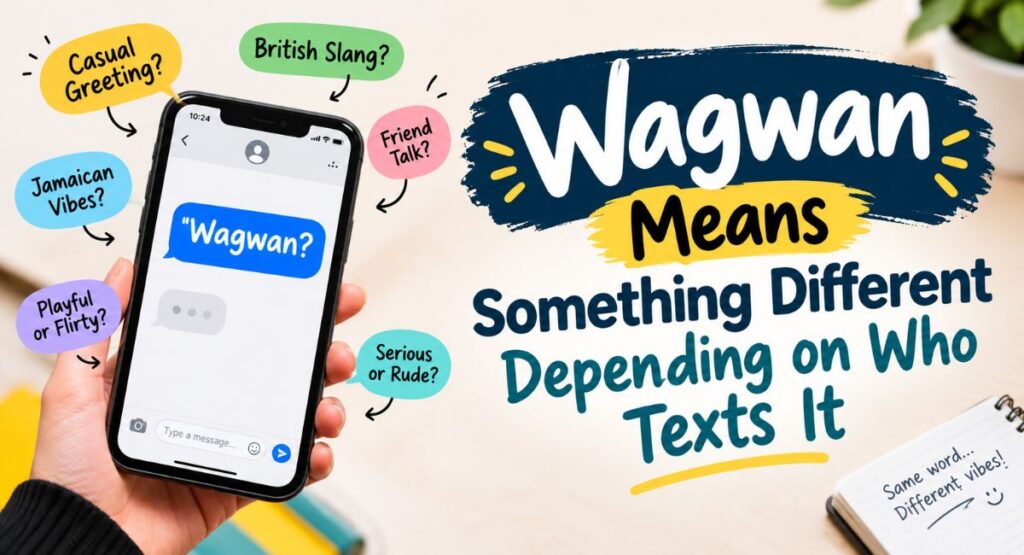
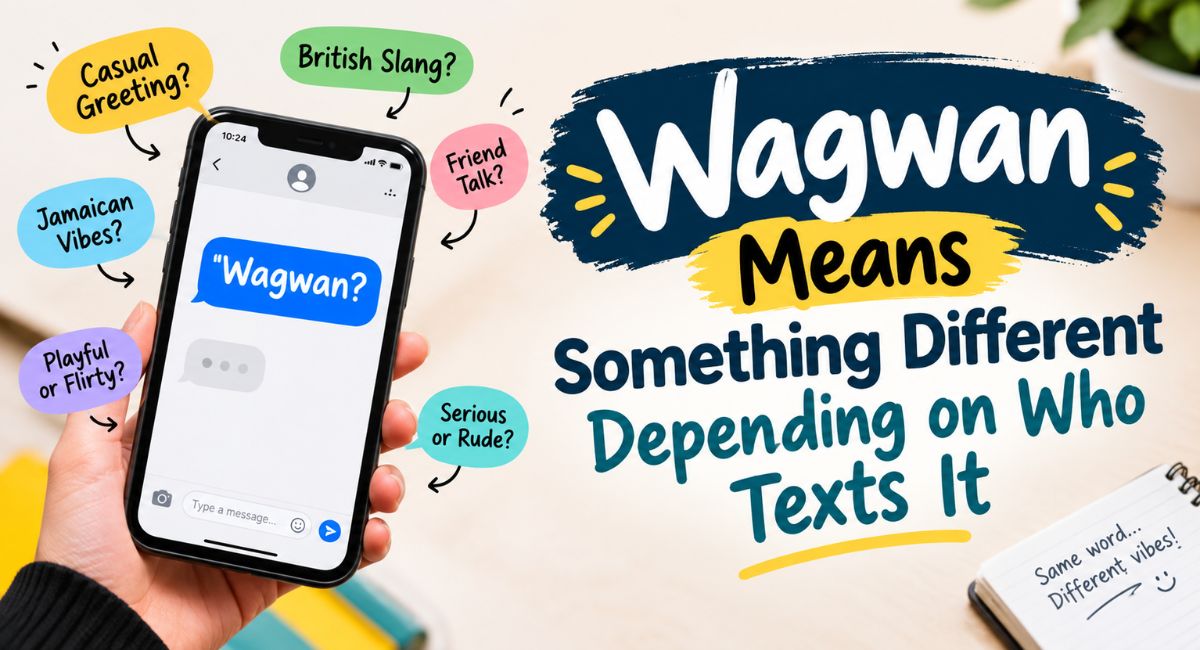
Wagwan is an informal greeting derived from Jamaican Patois (“wha gwaan,” meaning “what’s going on”) and used across the UK, the Caribbean, and online youth culture as a casual hello — not a literal question that expects a detailed answer. Grammatically, it functions as an interjection, not a question, which is exactly where most learners trip up.
That grammar detail — the part nearly every other guide skips — is the actual reason people misuse it, over-explain their reply, or accidentally sound stiff when they try to use it themselves. This guide covers the meaning, the origin, and the part-of-speech rules that decide whether you’re using it correctly.
What Wagwan Means, Word by Word
Wagwan is a contraction of the Jamaican Patois phrase “wha gwaan,” which itself breaks down as “what” + “is going on.” Patois compresses that into a single spoken unit, and over decades of use it got written the way it sounds: wagwan.
Functionally, though, it doesn’t behave like the English question “what is going on?” When someone asks you “what is going on?” in standard English, they usually want an actual answer — a status update, an explanation. When someone says “wagwan,” they’re doing the linguistic equivalent of “hey” or “yo.” A one-word reply, a nod, or a “wagwan” right back is a complete and socially correct response.
| Says This | Actually Means | Expects This Kind of Reply |
| Wagwan? | Hey / how’s it going | “Not much,” “All good,” or “Wagwan” back |
| What is going on? (literal) | Please explain the situation | A real explanation |
| Wagwan, you good? | Checking in, casually | A short honest answer |
The Grammar Nobody Explains: Is Wagwan a Question?
This is the part that separates a genuinely useful guide from a definition rewrite, and it’s the reason meaningbyte covers grammar first.
Part of speech: Wagwan functions as an interjection — a standalone expression of greeting, like “hey” or “yo” — not as an interrogative pronoun phrase, even though it’s built from one.
Punctuation: Because it looks like a question, non-native speakers often feel obligated to answer it with a full sentence and a question mark of their own, when a flat statement works fine: “Wagwan!” → “All good, you?” is natural. “Wagwan?” → “I am currently doing my homework and then I will eat dinner.” is technically an answer but reads as overly formal or even a little awkward in casual chat.
Capitalization: In texting and social captions, wagwan is almost always lowercase unless it opens a formal sentence or a title. Capitalizing it mid-sentence (“I said Wagwan to him”) is one of the more common tells that a writer is translating from a script rather than using it naturally.
Tense and number: It doesn’t conjugate, doesn’t pluralize, and doesn’t change with subject. You never see “wagwaned” or “wagwans” — it’s a fixed form, always used exactly as-is.
Formal vs. casual register: It belongs firmly in the casual column. Using it in a job application email, a customer service reply, or an academic paper reads as out of place, the same way “sup” would in a cover letter.
Real Conversations: How Wagwan Actually Gets Used
Definitions only go so far — seeing the grammar rules apply in real exchanges is what actually sticks. Here are three realistic chat threads.
Notice that in all three, the reply is short and status-based — nobody writes a paragraph back. That’s the interjection behavior in action, not a coincidence.
Where Wagwan Comes From
The word traces back to Jamaican Patois (also called Jamaican Creole), an English-based creole with deep West African linguistic roots that developed from the 17th century onward among enslaved and free communities in Jamaica. The original phrase, “wha gwaan,” is standard everyday speech there — not slang in the way it’s treated abroad, but a normal greeting between neighbors, family, and friends.
The word crossed the Atlantic with the wave of Jamaican migration to the UK in the mid-to-late 20th century, and it became a fixture of Multicultural London English — the dialect spoken across ethnically diverse, working-class London neighborhoods. From there, grime and UK rap artists carried it into music, television shows brought it to wider British audiences, and social media eventually pushed it into global slang.
Recognizing that history matters for one practical reason: it explains why using wagwan mockingly, or exaggerating the accent when saying it, reads as disrespectful to people who grew up speaking it as a first language rather than picking it up from a song.
Who Says This, and When
Wagwan shows up most naturally among:
- Friends and peers, especially teens and people in their 20s–30s, as an opener in person or over text.
- Group chats, where it doubles as a check-in before making plans.
- Social captions and comments, particularly on TikTok and Instagram, as a friendly reaction.
- UK grime, dancehall, and hip-hop lyrics, where it signals cultural authenticity.
It generally does not belong in:
- Job interviews, cover letters, or professional emails
- Academic writing
- First messages to someone significantly older or in a formal role, unless they’ve used casual language first
Common Mistakes People Make With Wagwan
- Treating it as a literal question and over-explaining in reply, when a one-line status update is the natural response.
- Capitalizing it mid-sentence the way a proper noun or a real question would be capitalized.
- Adding a question mark and expecting formality, e.g., writing “Wagwan?” and then being confused when the reply is just “wagwan” back.
- Using it in professional contexts where it clashes with the expected register.
- Exaggerating the pronunciation for comedic effect, which can come across as mocking rather than playful.
Why This Matters Beyond Just Knowing the Definition
Slang words that survive for decades usually do so because they’re tied to identity, not just vocabulary. Wagwan has stayed current since at least the 1990s in the UK and far longer in Jamaica, which is unusual for informal speech — most slang cycles out within a few years. Understanding the grammar (interjection, not question) and the register (casual, not formal) is what actually lets you use it naturally instead of sounding like you’re reading it off a page for the first time.
Related Reads
- What Does “ING” Mean in Text?
- TSSS Meaning in Text — What It Means
Frequently Asked Questions
What does wagwan mean? Wagwan is an informal greeting meaning roughly “what’s going on” or “hey” — used as a casual hello rather than a literal question.
Is wagwan a question? Grammatically, no. It functions as an interjection, similar to “hey” or “yo,” and typically doesn’t require a detailed answer.
Where does wagwan come from? It comes from the Jamaican Patois phrase “wha gwaan,” meaning “what is going on,” and later spread into UK slang through Jamaican diaspora communities.
How do you respond to wagwan? Short, casual replies work best: “all good,” “not much, you?” or simply “wagwan” back.