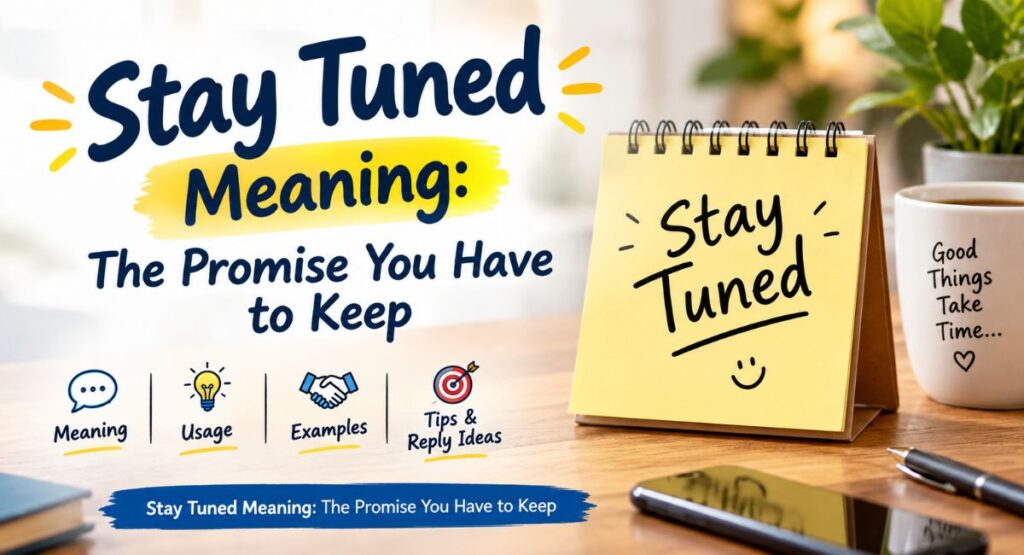
Stay Tuned Meaning : “Stay tuned” means to remain attentive and wait for upcoming information, updates, or content. It originates from early radio broadcasting, where listeners were literally told to keep their radio dial on the same frequency to catch the next program. Today it’s used figuratively in media, marketing, and everyday conversation — but using it without real follow-through can quietly cost you audience trust.
Most guides define the phrase and list synonyms. The part that actually matters for anyone creating content is what happens when the promise behind “stay tuned” doesn’t get kept.
Where “Stay Tuned” Actually Comes From
In early 20th-century radio, “tuning” wasn’t a metaphor — it meant physically adjusting a dial to stay on a specific frequency. Broadcasters said “stay tuned to this station” because switching away, even briefly, meant literally losing the signal. The phrase carried over into television and, eventually, into everyday and digital language, where it’s now entirely figurative.
The Real Cost of Overusing “Stay Tuned”
Here’s what most guides skip: “stay tuned” is a promise, and promises that don’t get kept lose their pull over time. If a content creator, brand, or newsletter repeatedly says “stay tuned for something big” without a concrete follow-up, audiences start to tune the phrase out — the opposite of what it’s meant to do.
This matters specifically for anyone running a blog, social account, or email list: the phrase works best paired with an actual timeline or a specific detail, not used as a vague placeholder when there’s nothing solid to announce yet.
Real-World Examples
Example 1 — Social media, done well
“Stay tuned — we’re dropping the new collection this Friday at 10am!”
Specific day, specific time — this keeps the promise concrete and believable.
Example 2 — Overused, vague
“Big things coming… stay tuned!” (posted weekly with no follow-up for months)
Without any actual update ever arriving, this version trains the audience to stop expecting anything real.
Example 3 — Professional context
Email: “We’re finalizing details on the partnership — stay tuned for an update by end of week.”
Paired with a timeframe, this reads as organized and trustworthy rather than open-ended.
The rule of thumb: “stay tuned” works when it’s backed by a real, upcoming detail. Used repeatedly with nothing concrete behind it, it stops functioning as anticipation and starts reading as filler.
Grammar & Common Mistakes
- Part of speech: “Stay tuned” functions as an imperative phrase — “stay” is the command verb, and “tuned” acts as a predicate adjective describing the state you’re being told to remain in.
- Punctuation: It’s commonly followed by an exclamation point for energy (“Stay tuned!”) or an ellipsis for suspense (“Stay tuned…”) — a period reads noticeably flatter and less inviting.
- Common mistake: Using “stay tuned” in highly formal writing. In professional documents, “further updates will follow” or “details to come” fit better than the more casual broadcasting idiom.
- Common mistake: Repeating the phrase without a timeframe or specific detail attached — this is the single biggest reason it loses impact over time.
When to Use (and Avoid) “Stay Tuned”
Good fits:
- Announcing a specific, upcoming update with a real timeframe
- Casual social media posts building anticipation for something concrete
- Broadcast, podcast, or video content with an actual next episode coming
Avoid it:
- Highly formal business writing — use “further details will follow” instead
- Repeated use with no real update ever arriving — this erodes trust over time
- As a substitute for actually having something to announce
“Stay Tuned” vs. Similar Phrases
| Phrase | Formality | Best Used For |
| Stay tuned | Casual | Social media, media, informal updates |
| Further updates will follow | Formal | Business emails, official communications |
| More to come | Casual | Quick, low-stakes teasers |
| We’ll keep you posted | Neutral | Ongoing situations without a fixed date |
“Stay tuned” sits on the casual end of this scale — it works well for audience-building content but can feel out of place in formal correspondence.
Related Reads
Stay Tuned Meaning: FAQs
What does “stay tuned” mean? “Stay tuned” means to remain attentive and wait for upcoming information or updates, originally from radio broadcasting where listeners kept their dial on a specific frequency.
Is it bad to use “stay tuned” too often? Yes, if it’s not backed by real follow-through. Repeating it without an actual update eventually trains your audience to stop expecting anything concrete.
Is “stay tuned” appropriate in professional writing? It’s more casual — formal writing typically uses phrases like “further updates will follow” instead.
Where does “stay tuned” come from? It originates from early radio broadcasting, where “tuning” meant physically keeping a radio dial on the correct frequency to continue receiving a broadcast.
What’s a more formal alternative to “stay tuned”? “Further details will follow” or “we will provide an update shortly” work better in professional or formal contexts.