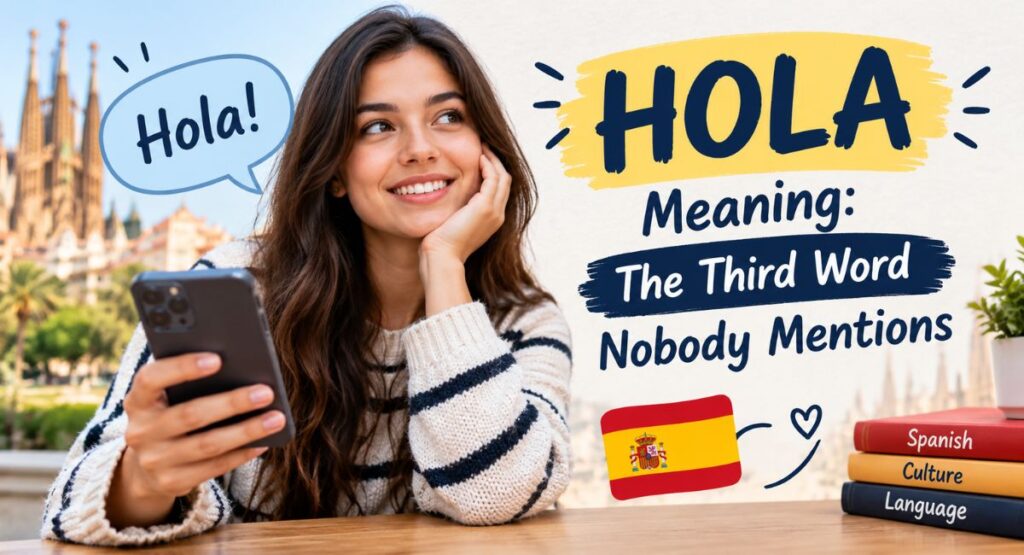
HOLA Mean Quick Answer: “Hola” is the Spanish word for “hello,” pronounced with a silent H (“OH-lah”). It’s commonly confused with two other words: “Ola” (Spanish for “wave,” as in an ocean wave) and “Holla” (English slang, meaning an informal greeting or “I’ll talk to you later”). All three sound similar but mean completely different things.
Most guides stop at Hola vs. Ola. The third word — Holla — is just as commonly confused, especially in English-language texting.
The Three Words People Mix Up
| Word | Language | Meaning | Part of Speech |
| Hola | Spanish | Hello | Interjection/Greeting |
| Ola | Spanish | Wave (ocean) | Noun |
| Holla | English slang | Informal “hey” or “I’ll talk to you later” | Interjection/Verb phrase |
“Holla” actually has its own real history — it traces back to Middle French “hola” (meaning “stop” or “hey there”) before becoming an established piece of English slang, often used in phrases like “holla at me” (meaning “reach out to me” or, in some contexts, “hit on me”).
Real Chat Examples
Example 1 — Hola (Spanish greeting)
“Hola, ¿cómo estás?”
Standard, warm Spanish greeting — this is the word most people are searching for.
Example 2 — Ola (Spanish for wave)
“La ola en la playa fue enorme hoy.”
Completely unrelated to greetings — this describes an ocean wave.
Example 3 — Holla (English slang)
Friend: “I’ll holla at you later this week” You: “sounds good, talk soon”
Here “holla” means “I’ll reach out” or “I’ll talk to you” — a totally different function from the Spanish “hola,” even though they sound alike.
The rule of thumb: if the conversation is in Spanish or with a Spanish speaker, it’s almost certainly “hola” (hello) unless the topic is literally the ocean. If it’s in English slang, especially in phrases like “holla at me,” it’s the double-L English word with a completely different meaning.
Grammar & Common Mistakes
- Spelling matters: “Hola” (one L) is Spanish for hello. “Holla” (two L’s) is English slang. Mixing up the spelling changes the language and the meaning entirely.
- Pronunciation: “Hola” has a silent H, pronounced “OH-lah.” “Holla” is pronounced closer to “HOL-uh,” with the H fully sounded — a genuine pronunciation difference, not just a spelling one.
- Common mistake: Using “hola” in an English sentence to mean “I’ll talk to you later” — that meaning belongs to “holla,” not the Spanish greeting.
- Common mistake: Assuming “ola” is just a casual spelling of “hola.” In Spanish, the missing H isn’t casual — it changes the word to mean “wave” entirely.
When to Use Each Word
Use “Hola” when:
- Greeting someone in Spanish, casually or semi-formally
- Texting bilingual friends or Spanish-speaking contacts
- Adding a friendly, informal touch in a multicultural setting
Use “Ola” when:
- Talking about an ocean wave in Spanish
- Never as a greeting — this is a common and easily avoidable mistake
Use “Holla” when:
- Casually telling someone you’ll reach out later (“I’ll holla at you”)
- Using established English slang, not Spanish
Similar Sound-Alike Pairs (Spanish Homophones)
| Pair | Meaning 1 | Meaning 2 |
| Hola / Ola | Hello | Wave |
| Votar / Botar | To vote | To throw away |
| Echo / Hecho | I throw | Made/done |
Spanish has fewer true homophones than English, but a silent H — like in “hola” — is one of the most common sources of this kind of mix-up.
Related Reads
FAQs
What does “hola” mean? “Hola” is the Spanish word for “hello,” pronounced with a silent H as “OH-lah.”
Is “ola” the same word as “hola”? No. “Ola” means “wave” (as in an ocean wave) in Spanish, while “hola” means “hello.” They’re never interchangeable despite sounding similar.
What does “holla” mean, and is it different from “hola”? Yes, they’re different. “Holla” is English slang, often meaning “I’ll talk to you later” or an informal greeting, while “hola” is the Spanish word for hello.
Why is the H silent in “hola”? Spanish lost the /h/ sound from spoken language centuries ago, but the letter remained in spelling for historical reasons.
Can English speakers use “hola” casually? Yes, especially among bilingual friends or in multicultural settings — but it’s best avoided in formal business writing unless the audience expects Spanish.