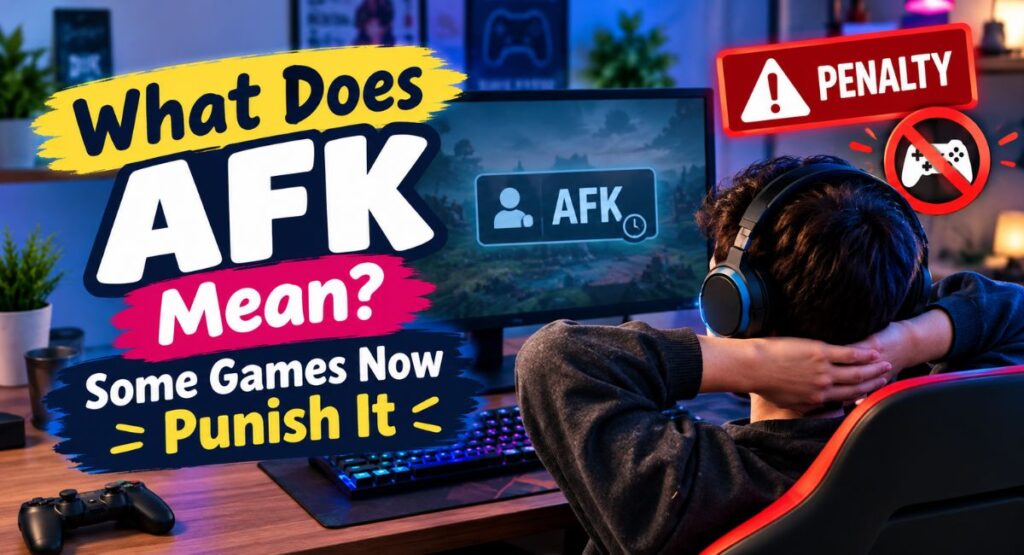
AFK MEAN Quick Answer: AFK stands for “Away From Keyboard” — used to tell others you’re temporarily stepping away from a chat, game, or device. It started in 1990s internet chat culture and gaming, and it still means the same thing today, even on phones with no physical keyboard at all. What’s changed is the consequence: in many competitive online games, going AFK now triggers automatic detection and real penalties.
Most guides explain AFK as harmless and casual. In everyday texting, it still is — but the stakes are different in competitive gaming than most people realize.
AFK Now Has Real Consequences in Gaming
Games like Riot’s Valorant actively track AFK behavior over time rather than punishing every single instance. According to Riot’s own system, occasional disconnects barely register, but players who repeatedly go AFK face escalating consequences: warnings, matchmaking delays, competitive queue bans, XP denial, and in serious repeat cases, game bans. This is a meaningful shift — AFK went from a polite heads-up to something with tracked, automated accountability in ranked play.

Real Chat Examples
Example 1 — Casual, harmless use
Friend: “you still there?” You: “yeah sorry, AFK for a sec, kid needed something”
Completely normal, no consequence attached — this is AFK doing its original job.
Example 2 — In a ranked game
Teammate: “bro why’d you go afk for like 2 minutes” You: “phone call, my bad, back now”
Here, the same word carries more weight — a pattern of this could trigger the game’s own AFK detection system, not just teammate annoyance.
Example 3 — Joking, non-literal use
Someone: “wait did you hear what I said?” You: “sorry my brain went afk for a sec 😂”
No actual absence here — just a lighthearted way to admit you weren’t paying attention.
The rule of thumb: in casual chat, AFK is a low-stakes heads-up. In ranked or competitive gaming, especially if it happens repeatedly, it can trigger real, tracked penalties — worth knowing before you assume it’s always harmless.
Grammar & Common Mistakes
- Part of speech: AFK functions as an adjective (“I’m AFK”) or as part of a verb phrase (“going AFK,” “went AFK”) — it doesn’t need to be hyphenated in either case.
- Capitalization: All-caps “AFK” is the most common form, though lowercase “afk” is just as understood in casual texting.
- Common mistake: Assuming AFK means completely offline — someone can technically still be connected while being AFK; the term describes inactivity, not disconnection.
- Common mistake: Not realizing repeated AFK behavior in ranked games can carry real penalties — treating it purely as casual chat slang misses this practical distinction.
When to Use (and Be Careful With) AFK
Good fits:
- Letting friends or group chats know you’re briefly unavailable
- Casual, joking use to admit you weren’t paying attention
- Any non-competitive online conversation
Be careful with:
- Ranked or competitive matches — repeated AFK time is often tracked automatically now
- Team-based games where AFK affects other players directly
- Assuming a single explanation (“AFK for dinner”) excuses a pattern of frequent absences in competitive play
AFK vs. Similar Slang
| Term | Meaning | Consequence Risk |
| AFK | Away From Keyboard | Low in chat, higher in ranked games |
| BRB | Be Right Back | Low — implies a very short absence |
| GTG | Got To Go | Low — signals ending the conversation |
| Offline | Not connected | None — describes connection, not activity |
AFK stands out because, unlike BRB or GTG, it’s the one term that competitive games have started actively tracking and penalizing.
Related Reads
FAQs
What does AFK mean? AFK stands for “Away From Keyboard,” used to tell others you’re temporarily stepping away from a chat, game, or device.
Can going AFK actually get you penalized? Yes, in many competitive online games. Riot’s Valorant, for example, tracks AFK behavior over time and applies escalating penalties for repeat offenders, ranging from warnings to competitive queue bans.
Is AFK the same as being offline? No — someone can be AFK while still technically connected. AFK describes inactivity, not a loss of connection.
Is it rude to say AFK? Generally no — it’s considered a polite way to explain a brief absence rather than disappearing without context.
What’s the difference between AFK and BRB? AFK (“Away From Keyboard”) describes general inactivity, while BRB (“Be Right Back”) more specifically implies a very short, quick return.