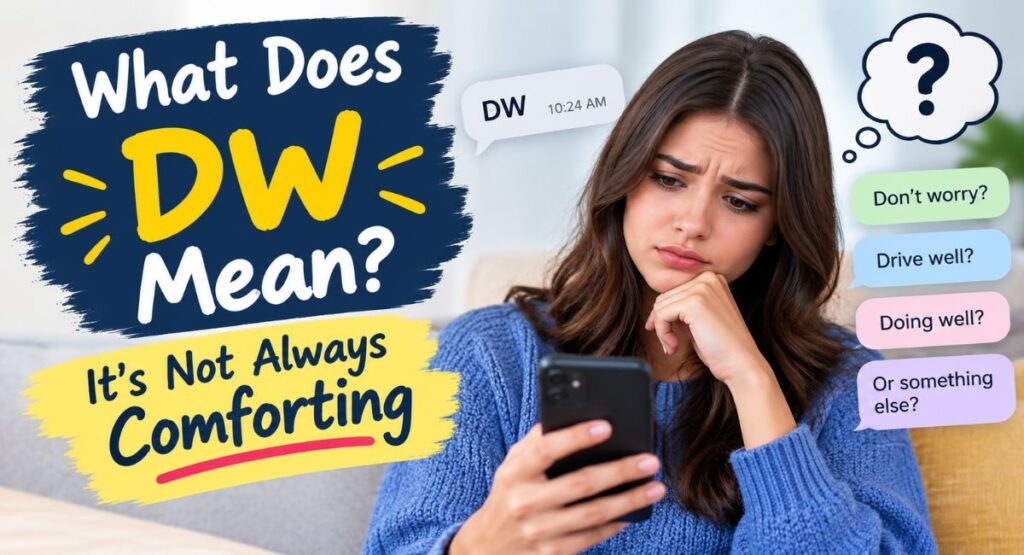
DW Mean Quick Answer: DW stands for “Don’t Worry” — most often used to reassure someone or tell them a situation is fine. But DW has a common sarcastic use too: paired with “I’ll do it myself” or a flat tone, it can signal passive-aggressive frustration instead of comfort. Reading it correctly depends on what comes with it.
Most guides describe DW as simply friendly. In practice, it splits into two very different tones depending on the rest of the sentence.
The Two Faces of DW
| Version | Tone | What It Actually Means |
| Genuine DW | Warm, reassuring | “This is fine, don’t stress about it” |
| Sarcastic DW | Passive-aggressive | “I’m a little annoyed, but I won’t say it directly” |
The genuine version comforts. The sarcastic version often follows a request that wasn’t handled the way the sender wanted — and DW becomes a polite-sounding way to express that without an outright complaint.
Real Chat Examples
Example 1 — Genuine reassurance
Friend: “sorry I’m running late again” You: “dw about it, no rush at all”
Warm, immediate, no tension in the reply — this is DW doing exactly what it’s meant to do.
Example 2 — Sarcastic DW
Roommate: “oh I forgot to grab the package again” You: “dw, I’ll just pick it up myself”
Paired with “I’ll do it myself,” this version reads as quietly frustrated, not reassuring — a classic passive-aggressive pattern in texting.
Example 3 — Genuinely ambiguous (context needed)
Someone: “did you still want me to send that file?” You: “dw”
Without more context, this bare “dw” could mean “don’t worry about sending it” (genuine) or “don’t worry, I’ll figure it out on my own” (slightly annoyed) — this is exactly the kind of message where a follow-up question helps clarify intent.
The rule of thumb: DW paired with “I’ll handle it myself,” “I guess,” or a flat one-word reply after someone dropped the ball tends to be sarcastic. DW paired with warmth, an exclamation point, or reassurance about something out of the other person’s control tends to be genuine.
Grammar & Common Mistakes
- Capitalization: Lowercase “dw” is the casual, warm default. All-caps “DW” doesn’t inherently change tone, but combined with no punctuation, it can read flatter.
- Punctuation: A comma after DW (“dw, it’s fine!”) softens it and reads as genuine. A period with no other warmth (“dw.”) is more likely to carry an edge.
- Common mistake: Sending a bare “dw” as your only reply after someone apologizes sincerely — without any warmth attached, it can be misread as dismissive even when you meant comfort.
- Common mistake: Missing the sarcastic version entirely and taking “dw, I’ll do it myself” at face value — this phrase is a common way people express mild frustration without directly confronting someone.
When to Use (and Avoid) DW
Good fits:
- Reassuring someone about something genuinely minor or out of their control
- Responding to an apology you want to wave off warmly
- Casual chats where a quick, comforting reply fits
Avoid it:
- If you’re actually frustrated and want to address it — sarcastic DW often gets misread as genuinely fine, leaving the real issue unresolved
- Professional messages — spell out “don’t worry about it” instead
- As a bare one-word reply to someone who sounds genuinely anxious — add warmth so it doesn’t land flat
DW vs. Similar Slang
| Term | Meaning | Sarcasm Risk | Best Used With |
| DW | Don’t Worry | High — check context | Genuine warmth, exclamation, or explanation |
| NVM | Never Mind | Medium | Can also carry mild frustration |
| NP | No Problem | Low | Straightforward agreement |
| ALL GOOD | All Good | Low | Clear reassurance |
DW and NVM share a similar risk — both are short enough to double as either genuine reassurance or a clipped way of shutting down a conversation.
Related Reads
dw mean: FAQs
What does DW mean? DW stands for “Don’t Worry,” most commonly used to reassure someone or tell them a situation is fine.
Is DW always reassuring? No — paired with phrases like “I’ll do it myself” or a flat tone, DW is often used sarcastically to signal mild frustration rather than genuine comfort.
How can I tell if someone’s DW is sarcastic? Check what comes with it — warmth, an exclamation point, or an explanation usually signals genuine reassurance, while a bare “dw” after someone dropped the ball often signals sarcasm.
Is DW appropriate at work? It’s best avoided in professional messages — spelling out “don’t worry about it” reads more polished and avoids any tone confusion.
What’s the safest way to send genuine DW? Add a little warmth — an exclamation point, an emoji, or a short explanation — so it clearly reads as comfort rather than a clipped, possibly sarcastic reply.